This integration extends beyond trade. Tourism and human mobility are equally regional, with nearly 78% of Uganda’s international visitors coming from neighbouring East African countries, reflecting a region that is increasingly living, working, and moving across borders.
It is within this context that a new way of life is emerging—one that is borderless, fast-moving, and opportunity-driven. From entrepreneurs expanding into new markets to professionals managing cross-country operations, East Africans are no longer confined by national boundaries.
Through its Brisk platform, I&M Bank is positioning itself at the centre of this transformation—offering financial solutions designed to support individuals and businesses that operate seamlessly across the region. Brisk is not just a product; it is a response to the evolving needs of a more mobile, interconnected East African economy.
As part of the #LivingBrisklyInEastAfrica campaign, CEO East Africa Magazine’s Executive Editor, Muhereza Kyamutetera, is travelling across the region to explore how this new reality is taking shape—on the ground, in businesses, and in everyday life—and how financial institutions are enabling this shift.
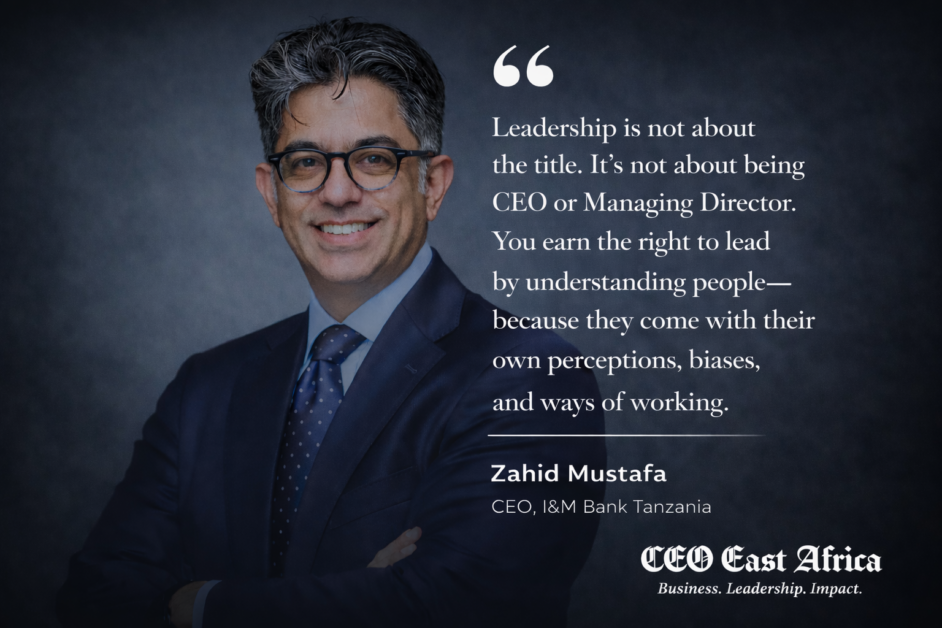
In this conversation, he spoke to Zahid Mustafa, Chief Executive Officer of I&M Bank Tanzania, whose leadership has been central to the bank’s transformation and its growing role in powering trade, growth, and regional integration across East Africa.
I’ve actually been following your work and writing about the progress you’ve been making in Tanzania, so it’s great to have this conversation. To begin, tell us about yourself—your journey into banking, and what has kept you passionate about the industry over the years.
Thank you very much—and good afternoon.
Let me start by introducing myself. My name is Zahid Mustafa, and I’m currently the CEO and Managing Director of I&M Bank Tanzania. It’s actually a small world—I didn’t realise you had written about me before, but these connections tend to come full circle.
It’s been quite a journey. I’ve spent about 30 years in banking, although I didn’t start there. I began my career as a chemical engineer and worked in a polyester manufacturing company for some time. But later, during my MBA, I came across the concept of sunk cost—and I decided to treat my engineering background as exactly that, and move into banking.
I started my banking career with Citigroup in Pakistan, where I’m originally from. That’s really where I learned the fundamentals of banking. Citi is a fantastic institution, especially when it comes to consumer and digital banking. Over the years, I worked across various products and services, eventually leading retail banking and later the credit card business—one of Citi’s largest segments. In that role, I also covered several Eastern European markets, including Poland, the Czech Republic, and Hungary.
After about 12 years at Citi, I moved to Barclays. I was hired by Barclays UK for their African operations, and I still remember being told it would be a one-year assignment—it turned into a 14-year journey.
I started in Egypt as Head of Consumer Banking at a time when Barclays was largely focused on corporate and private banking there, and we were building out the consumer side. From there, I moved into East Africa in 2007 as Head of Consumer Banking for Kenya, and later took on a broader role covering both East and West Africa—including Kenya, Uganda, Tanzania, and Ghana.
At Barclays, beyond the technical side of banking, I really learned leadership—working across different cultures, managing diverse teams, and navigating complex markets.
Over time, my role expanded into Retail and Business Banking, which gave me exposure to the corporate segment as well. This was around my second stint in Kenya, from 2012 onwards.
Then came a major turning point in the industry—the introduction of interest rate caps in Kenya. Overnight, about 30% of revenue was wiped out, and we had to fundamentally rethink the business. That period forced us to innovate. We reduced reliance on brick-and-mortar, streamlined operations, and accelerated our digital journey.
That’s when we launched Timiza, a digital lending product built using Safaricom APIs. I still remember saying at a Barclays global conference—after celebrating 100 years in Kenya and reaching 1 million customers—that with Timiza, we acquired the next million customers in just 100 days. That moment really shifted my perspective toward digital banking and fintech innovation.
From there, I moved into a regional role at Barclays—by then Absa—based in Mauritius, overseeing retail banking across 11 businesses in 10 countries outside South Africa. Then COVID hit, and being in a regional role on a small island gave me time to reflect. I had been travelling extensively, and the pandemic made me rethink the sustainability of that lifestyle.
Around that time, there was an opportunity to return to Pakistan. A new government was calling on expatriates to help transform public sector institutions. After 25 years in multinational banking, I took on the challenge of leading retail and digital banking for one of the country’s largest public sector banks.
It was a very different experience—an organisation with nearly 800 branches, many in rural areas. We were able to introduce modern technology and significantly transform the business. It was both professionally and personally rewarding.
Then came I&M.
I was already familiar with the brand from my time in Kenya, and I had a great deal of respect for it. In fact, during the transition from Barclays to Absa, we had done extensive market analysis, and banks like I&M and what is now NCBA were among the institutions we identified as strong regional competitors.
So joining I&M felt like a natural fit.
Coming into Tanzania, I already had some familiarity with the market from my earlier Barclays experience. But when I arrived, it was clear that while the bank had significant opportunities, it also faced a number of challenges—some of them legacy issues.
I received strong support from both the Group and the Board, which allowed us to take a structured approach. We began by defining the strategy—one concept I often refer to is the “good book” and the “bad book.” We separated the performing parts of the business from the non-performing ones, because if you don’t do that, progress tends to get overshadowed by historical challenges.
Once that was in place, we turned to execution—and that’s where people come in. I always say people are the most important part of any transformation.
Tanzania has its own unique dynamics. The market is quite fragmented, with over 30 banks competing for a relatively small share of the market, while the top three players dominate a significant portion of the revenue pool. This naturally affects talent availability and skill depth.
That said, I was fortunate to inherit a strong team. Around 80% of the leadership had solid potential—they just needed the right structure, clarity, and direction to perform at a higher level.
From there, it became about aligning strategy, people, and execution to drive the turnaround.
Before we come back to your work in Tanzania, you’ve had a long and diverse career across multiple markets and roles. If you were addressing a masterclass of young bankers, what enduring lessons would you share—and what would you consider the non-negotiables of being a great banker?
That’s a difficult question—but I’ll answer it through a few stories. I like to think of myself as a storyteller, so let me share a couple that really shaped my thinking.
I started my career in Pakistan, where I was born and raised, so I understood the environment quite well. But when I joined Citi, I got exposure to different markets. One of my early assignments was in Poland in 1999, where I was involved in launching an auto loan product.
I still remember landing there, being handed a detailed market research report… entirely in Polish. I was told, “Don’t worry, someone will translate it for you.” But that experience taught me something fundamental.
When it comes to consumer banking—or really any consumer product—there are far more similarities across markets than differences. Someone buying a car in Poland is not very different from someone in Karachi, Nairobi, or Dar es Salaam. They want it quickly, they want to pay as little up front as possible, and they want manageable instalments. Those needs are universal.
But—and this is important—while the customer needs are similar, the way people behave is deeply influenced by culture.
My next big lesson came in Egypt. Egyptians are incredibly warm and loyal people. Once you build a relationship, they will go above and beyond for you—even beyond professional boundaries.
But at the same time, getting people into the office early in the morning was nearly impossible. My team would rarely show up before 10 am—but they had no issue working until 10 pm.
At first, I thought it was a discipline issue. But then I realised—it’s cultural.
Let me give you an example. In Cairo, the first traffic jam happens at around 5 pm. The second? Around midnight. People go home, rest, and then come back out with their families—even with young children—late into the night. That’s just how life is structured.
The biggest lesson for me came from a very practical situation. I had a head of auto finance who I could never find during the day. Everyone else would show up by 10 am—he wouldn’t even be in until 3 pm. I was quite frustrated and even raised it with him.
One day, he said, “Come with me in the evening—I’ll show you how we work.”
We met at 5 pm.
What I discovered was fascinating—the entire auto industry in Egypt operates at night. Dealerships open in the evening. Customers come after work, browse cars, and even do test drives late into the night when traffic is lighter. In Egypt, owning a good car is a major aspiration—much like land ownership might be in other markets.
So the business I thought was underperforming was actually operating perfectly—just on a completely different rhythm.
So, coming back to your question—what are the enduring lessons?
First, there are universal customer needs. That doesn’t change. But second, and more importantly, you must deeply understand the cultural context. Because in the end, banking is a people business.
And if you don’t understand people—their habits, their motivations, their environment—you won’t be able to lead them effectively.
Leadership is not about the title. It’s not about being CEO or Managing Director. You earn the right to lead by understanding people—because they come with their own perceptions, biases, and ways of working.
If you don’t take the time to understand that, you may have the position, but you won’t have the respect.
I hear you—and it’s fascinating how much culture shapes leadership. So across all these experiences, how has your leadership philosophy evolved? Would you say you follow a consistent style, or does it adapt depending on the market and context?
You’ve actually asked the question—and partly answered it as well.
All of us have a natural, inbuilt leadership style, shaped by how we’ve grown up and the experiences we’ve had. But to be an effective leader, you also need to develop a range of skills—because no two situations, or teams, are the same.
There are times when you inherit a highly capable team that just needs alignment, and they will run with it. And then there are situations where the team is relatively new, and they need more coaching, more guidance, and more hands-on leadership.
The best way I explain it is this: when you go to a dentist, you’ll notice they have different tools—and they use each one depending on the problem they’re solving. Leadership is very similar. You need to have a range of tools, and you need to know when to use which one.
Even within the same team, individuals are different. Some people are very articulate—they can explain in great detail why something didn’t work. Others may not say much, but they are deeply focused and consistently deliver.
To lead effectively, you have to recognise these differences and adapt your approach accordingly. You can’t lead everyone in the same way.
And I’ll be honest—I don’t claim to have it all figured out. Like everyone else, I have my rough edges. Leadership is a continuous journey of learning and adapting.
Okay, that’s very insightful. Now let’s come back to the transformation story of I&M Bank Tanzania. You’ve touched on it briefly—but looking back now, with the benefit of hindsight, how would you break down that transformation?
If you had to distil it into two or three key pillars that really drove the turnaround, what would those be?
So, as I mentioned earlier, when I came in, there were a few “skeletons in the closet”—primarily in the form of non-performing assets. That was the first area we had to tackle.
This required a complete revamp of the credit function. There were gaps in both skill sets and leadership, so within about four weeks of joining, we had identified the key weaknesses and began addressing them. We invested in strengthening the team—bringing in a new Head of Credit, enhancing the legal function, and going aggressively after recoveries.
At the same time, we recognised that the issue wasn’t just about cleaning up the past—it was also about fixing the credit assessment process going forward. As organisations grow, you can’t rely on individual judgment alone; you need systems and processes. So we strengthened our credit frameworks, introduced better controls, and ensured more disciplined underwriting.
We also had to navigate the realities of the legal environment, which can be challenging across markets. That meant even re-evaluating and changing some of our legal partners to ensure we were working with the right people.
Now, just to give you context—this is a journey I’ve been on for about three and a half years. In fact, I track it quite closely—three years, six months, and a few days—because transformation takes time and consistency.
The second big pillar was people.
I&M Tanzania started as a microfinance institution that evolved into a commercial bank. So naturally, some individuals who had grown with the institution were excellent in earlier roles, but needed development to operate at the next level. We invested in training, coaching, and formal development programmes.
At the same time, where there were clear capability gaps, we brought in external talent. Fortunately, I inherited a strong core team—about 80% of the leadership had the potential to step up, and with the right structure and direction, they delivered.
The third pillar was rethinking our business model, particularly in retail.
As a tier-two bank—now proudly the largest tier-two bank—we were competing against very large institutions with 200+ branches. We had eight. So it was clear we couldn’t compete the same way.
I used an analogy internally—we can’t behave like a small version of a big oil tanker. Instead, we need to be a motorboat—fast, agile, able to change direction quickly, and able to capture niche opportunities.
So in retail, we focused on high-net-worth customers and differentiated ourselves through customer experience. Our philosophy was simple: we may not be the biggest, but anyone who banks with us should feel they’ve had the best experience in the market.
We also made a conscious decision not to expand branches prematurely. When I joined, there was a plan to grow the network, but we paused that. Instead, we focused on extracting value from the existing branches. In fact, in three and a half years, we are only now opening our first new branch.
The fourth—and perhaps most transformative—pillar was digital lending.
This was driven by both experience and opportunity. In traditional retail, we couldn’t match the scale of larger banks. But in digital, the playing field is level—you don’t need hundreds of branches or large teams. A small, focused team can compete effectively.
So we launched Kamilisha, an overdraft product similar to Fuliza in Kenya, in partnership with Airtel Tanzania and our technology partner, Comviva (through their Yabx platform).
The proposition is simple: customers are pre-approved based on their transaction history. Out of Airtel’s roughly 18 million active users, we have about 6 million pre-approved customers. When a customer runs out of funds, a prompt appears offering instant credit. The funds are disbursed immediately, and repayments are automatically recovered when money flows back into their wallet.
The scale has been remarkable.
In any given month, we serve about 1.2 to 1.5 million unique borrowers, each borrowing two to three times. Over the last three and a half years, we’ve processed nearly 100 million loans, and within this month, we’ll cross that milestone. In value terms, we’ve disbursed close to $300 million, with a repayment rate of about 93% within 90 days.
Beyond the numbers, what makes this business truly meaningful are the stories. We’ve seen customers use these small loans—sometimes as little as $3—to buy goods in the morning, sell during the day, repay in the evening, and repeat the cycle. It’s real financial inclusion.
We’ve also started testing larger ticket sizes. For example, we recently identified about 50,000 women entrepreneurs using analytics and AI, and offered them loans ten times larger than the standard product. Interestingly, that portfolio is performing even better than our base.
So that gives us confidence that there’s a much bigger opportunity ahead—particularly in SME financing and last-mile distribution—using the same digital rails.
So, if I were to summarise the transformation, it comes down to four things:
- Fixing the fundamentals—especially credit and risk
- Investing in people and capabilities
- Adopting a focused, differentiated business model
- Leveraging digital to scale efficiently
And I think the journey is still ongoing—we’re now moving from simpler solutions to more complex, higher-impact opportunities.
That’s very insightful. And beyond strategy, you’ve touched on something equally important—culture. Not just understanding your customers’ culture, but also shaping the internal culture of your team.
How important was that in driving the transformation of I&M Bank Tanzania, and what role did culture play in delivering the results you’ve described?
That’s a very important question.
Coming into I&M, one of my initial concerns—having spent most of my career in multinational organisations—was around culture. From the outside, everything looked fine, but I wasn’t quite sure what the internal culture would be like and how it actually worked in practice.
But I must say, I was very pleasantly surprised.
In fact, even before culture, what stood out to me was the strength of corporate governance. The kind of boards that I&M Group has put together can stand shoulder-to-shoulder with—if not outperform—many multinational boards. And I say that very openly. If something is wrong, I would be the first to point it out. But on governance, I was genuinely impressed.
Now, coming back to culture, if you look at I&M’s history, it grew out of a family business. What’s interesting is that many of those foundational values have been preserved, even as the organisation has scaled and expanded across markets. Those values have travelled across borders into different subsidiaries, and that creates a strong, consistent cultural backbone.
When an organisation clearly defines its values and behaviours, it’s essentially signalling the kind of people it wants to attract. Of course, in reality, you may still hire someone for technical skills who doesn’t quite fit culturally. But if the culture is strong enough, one of two things happens—either they adapt, or they eventually move on.
I’ve personally experienced that kind of shift. When I moved from Citigroup—very performance-driven, very intense—to Barclays, it was a big cultural adjustment. I’m sure the people there initially thought I came in like a shark trying to disrupt everything. But over time, you learn, you adapt, and you align.
At I&M, the culture is quite well defined, and importantly, people hold each other accountable to it.
Even as a leader, if I’m not living up to those values, people will call it out. Maybe not always in a formal setting—but sometimes in a more informal way, over a conversation. And that’s actually a good sign. It means you’ve created an environment where people feel safe enough to speak up.
And that’s critical—because culture only works when people have the confidence to raise their hand and say, “This is not right,” or “We can do better.”
I would say it has been a positive journey so far internally. And externally, with customers, while you don’t have the same level of control, you still get a sense of it. When you engage with them, when you listen to their experiences, you begin to understand how that culture is translating into customer relationships.
Okay, let’s talk about vision—and by extension, mission. When you speak about becoming Tanzania’s leading financial partner for growth, what does that actually mean in practical terms for your stakeholders? How should customers, businesses, and partners experience that ambition on the ground?
It actually means different things to different people.
If you look at the segments I spoke about earlier, at the base of the pyramid—through products like Kamilisha—we are serving customers who may be very small, even micro in nature, but they are on their own journey of growth and progress. And we want to be part of that journey.
Then, if you move into the SME or business banking space, the same philosophy applies. These are businesses that are growing, scaling, and looking for support to expand—and we position ourselves as a partner in that growth.
And of course, at the top end, if you’re dealing with large corporates—companies that may want to evolve from being strong domestic players into regional groups—we are there to support that transition as well.
So when we say “the leading financial partner for growth,” it’s really about being relevant across the entire spectrum—from the smallest customer to the largest corporate.
Now, one of the key expressions of this is our tagline: “We are on your side.” And more recently, simply, “On your side.”
What that means in practice is that we stand with our customers—not just in good times, but also in difficult ones.
I’ve had conversations with customers, especially post-COVID, and many of them have said that I&M was there for them when things were tough. And that’s something they genuinely appreciate.
And I say this very honestly—sometimes in banking, especially in large institutions, we can become overly focused on the bottom line, on credit metrics, on financial delivery, and in the process, we may unintentionally damage relationships. I’ve seen that happen in different organisations.
But what I&M has been able to do is strike that balance—being commercially sound, but also being supportive and empathetic.
I’ve also seen similar philosophies elsewhere. For example, at my previous role at the Bank of Punjab, there was a tagline in Urdu—“Har fard ka khayal,” which means “taking care of every individual.” And they truly lived that. They even had propositions for underserved segments, like the third gender and people with disabilities—things many banks don’t even think about.
So, for me, this journey has always been about learning from different places and applying those lessons.
When I look at “On your side,” it resonates very strongly with that idea. It’s about being there—for your customers and for your people—through every stage of their journey.
And that’s really what being a financial partner for growth means in practice.
If you were speaking directly to a potential customer—someone who has heard this conversation but is still undecided—what would you tell them they are missing, and why should they trust I&M with their growth journey?
It almost feels like we planned this question—but let me answer it with a story.
In my previous role at Absa, I was overseeing retail banking across multiple markets—by the time I left, I was responsible for about 10 businesses in nine countries. Each of those businesses was strong on its own, but when it came to working together across borders, it was surprisingly difficult.
Everyone understood there was an opportunity—but the mindset was often very bottom-line driven: “What do I get out of this?” And that made true integration quite challenging.
The biggest difference I’ve seen at I&M—and I believe this is one of our strongest advantages—is how well we work together across borders.
We may only be in five countries, but we operate as one integrated network—and we do that extremely well.
There are other banks with a similar footprint across East Africa, but they don’t necessarily operate in an integrated way. What that means in practice is this: if a successful business in Kenya wants to expand into Tanzania or Uganda, the way we assess and support that business—from a credit and risk perspective—is far more informed.
Because we are connected, we have access to real insights about that customer across markets. In many cases, I benefit from information coming from Kenya or Uganda, which gives us the confidence to finance businesses entering Tanzania—even startups—based on their proven track record elsewhere in the region.
Sometimes this is supported through instruments like standby letters of credit, especially to manage regulatory requirements—but the key point is that we are able to unlock opportunities that might otherwise be difficult.
Now, beyond credit, this integration is even more powerful in payments.
For large corporates, cross-border payments may not be a major issue. But for SMEs, traders, transporters, tourism operators, and individuals, it is a real pain point.
 Nicholas Mukasa Appointed Bank of Namibia Deputy Governor
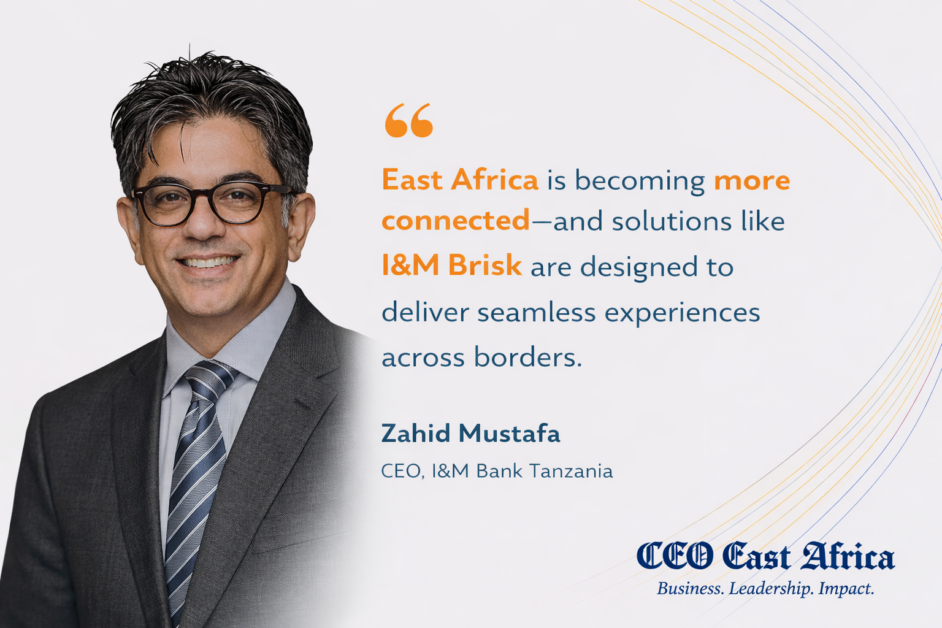
East Africa is becoming increasingly connected—people are travelling more, doing business across borders, and expecting seamless experiences. And that’s exactly what solutions like I&M Brisk are designed to address.
For example, a customer from Kenya can walk into an I&M branch in Tanzania and withdraw money from their Kenyan account in real time—seamlessly. It’s a simple experience, but not something many banks can offer.
I sometimes challenge people with a simple question: “If you can deposit money in one branch and access it instantly in another branch within the same country, can you do the same across borders?”
Most banks can’t deliver that.
Globally, institutions like HSBC have attempted similar models—but in our context, this is a very real and practical advantage.
And it’s not just about individual transactions. There are also strong use cases in collections and business payments.
Take agricultural trade, for example. Kenya imports a lot of agricultural produce. Now, if multiple buyers are purchasing from suppliers in Tanzania, collecting and consolidating those payments back into a master account can be complex.
With I&M’s network, those buyers can deposit funds into any branch in Kenya, and the supplier in Tanzania receives the money instantly. That’s a real, tangible solution to a real business problem.
So, to answer your question—what are people missing?
They are missing the benefit of true regional integration.
And the way we see it, we don’t need to do anything overly complex or revolutionary. It’s about understanding customer pain points—especially across borders—and solving them in a simple, seamless, and practical way.
And from everything you’ve shared, would you confidently look someone in the eye and say—I&M is the bank to partner with if you want to do business across the region?
I would genuinely prefer that our customers are the ones who say that about us.
Like any service industry, we do make mistakes—but I believe we more than make up for them in how we respond and how we support our clients. Have we reached perfection? No. There’s still a lot to improve, and we are very open about that.
What gives me confidence, though, is how our customers engage with us. They treat us as partners—and they tell us what’s working and what’s not. That feedback is important because it helps us keep improving.
Let me give you a practical example.
We recently supported a business group that originated from Kenya and had expanded into Uganda. They had already approached a few banks and were working with another institution at the time. When they came to us, we were able to quickly understand their structure and needs—partly because of our visibility into their operations across the region.
We moved fast, structured the solution, and supported them with about $6 million in financing. Beyond that, we were able to connect their operations seamlessly across Kenya and Uganda.
As a result of that experience, they chose to move their banking relationship to I&M—even though their previous bank also had a regional presence.
So, when I see examples like that, it gives me confidence—not overconfidence, but the reassurance that we are doing some things right, and that customers do recognise and appreciate it.
And taking you back to when you were “in the kitchen” with the team designing I&M Brisk—what key problems or frictions were you trying to solve across the region?
And beyond Brisk, because not all challenges can be solved by a single solution, what other products or capabilities are you building to make it easier for customers to do business across East Africa?
Let me break that into two parts.
First, in terms of success transfer across markets—that’s something we are doing quite well. For example, Kamilisha is actually a Tanzania-born success story. While Kenya is a much larger market, Kamilisha originated here, and we are now exporting that model into Rwanda and Uganda—and adapting it differently for Kenya as well. So that ability to take what works in one market and replicate it across others is a key strength for us.
Now, if your question is more about how we solve regional challenges better, then I would say it comes down to two main things: payments and credit.
These are the two biggest friction points in East Africa—moving money seamlessly across borders, and accessing financing in a timely and practical way. And as I’ve shared earlier, we are actively working on both.
The next step—and where I think the real opportunity lies—is consistency of experience across markets.
Coming from a multinational background, I strongly believe that we need to build solutions that feel the same, regardless of where the customer is. Ideally, an I&M Tanzania customer should be able to walk into a branch in Kenya and almost forget they are in a different country.
That’s the level we should aspire to.

If you look at global service brands—take McDonald’s or KFC, for example—the experience is standardised. I’m told even the way they place their products is consistent globally. So if you took someone from Boston and brought them to Nairobi, after a while—if they didn’t look outside—they might not even realise they’re in a different country.
Now, of course, banking is different—but the principle still applies.
The customer is the same. Their expectations are the same. So why should their experience be different?
That’s really where we are heading—building a banking experience that is seamless, consistent, and reliable across the entire region.
And from your time in the bank to today, how have you seen customer expectations evolve? What matters most to customers now—and would you say their expectations are simply higher, or fundamentally different from before?
Customer expectations are definitely rising—and in some ways, becoming more demanding.
If I’m being very candid, I’ve worked across markets, and I would say Kenyan customers, for example, are extremely demanding. If you give them poor service, they will tell you—very directly. You know immediately where you stand.
Tanzanian customers, on the other hand, tend to be more reserved. They may not be satisfied, but they won’t always confront you in the moment. And in some ways, that’s even more challenging—because if you don’t have the right feedback mechanisms, you may not realise where you’ve fallen short.
So as a bank, you have to be much more proactive—you need your “radar” up all the time to pick up those signals and continuously improve.
That said, the biggest shift is really generational.
The new generation—millennials and younger customers—have much higher expectations. They are less tolerant of inefficiencies, and they are far more willing to question and demand better service. We were brought up in a system where you accepted certain things, even when they didn’t work. That mindset has changed completely.
In fact, I often say I’ve been trained by my own children—they’ve helped me understand just how much expectations have evolved.
And it’s not just about banking anymore.
Customers today are comparing their banking experience to the best experiences they have anywhere—whether that’s fintech platforms, tech companies, or digital services. If you don’t meet those expectations, it’s not just another bank you’re competing with—someone from outside the traditional banking space can step in and take your customer.
So the reality is, expectations are not just higher—they are fundamentally changing. And as a bank, you have to stay ahead of that curve.
And you mentioned Gen Z—and it’s becoming a big topic in leadership today, both as customers and as part of the workforce. From your experience, how are you engaging and managing this generation—and what does it take to keep them motivated and committed?
That’s a very interesting topic—and let me answer it with a story.
One of the biggest challenges we face, especially in a market like Tanzania, is attrition. The average tenure in banking here is about three years, which is quite concerning. You lose institutional knowledge, you lose experience, and you’re constantly rebuilding teams.
Initially, as we were growing, we hired laterally—from other banks. But what we noticed was that many people would join and then leave within a year. In some cases, they were very good at interviews and positioning themselves for the next opportunity—but not necessarily as strong in execution on the job.
So we decided to rethink our approach.
We shifted focus to fresh graduates through a management trainee programme. Now, that in itself is not new—many organisations do it. But where we differentiated ourselves was in what happens after the programme.
The programme runs for about 9 to 12 months, similar to others. But we realised that once trainees completed it, they were treated like any other employee—and that’s where we were losing them. They couldn’t see a clear future.
So we fixed that.
Now, anyone joining the programme has a clear four-year roadmap:
- The first year is purely training—no permanent role, no targets.
- From the second year, they are placed into a function based on both their strengths and business needs.
- But importantly, if they perform well—say they are rated A or B—they have the flexibility to either grow within that function or rotate into a different one.
So over three years, they can experience multiple areas—Treasury, Credit, Finance, Front Office. That kind of exposure builds confidence, capability, and a much deeper understanding of the business.
We’re about two and a half years into this journey, and what we’re seeing is encouraging. These young professionals are more confident, they can see a future, and most importantly, they’re not bored. And boredom is a big issue with this generation.
The second part of the story is about what Gen Z actually cares about.
In our time, success was quite straightforward—career progression, income, and assets. You measured success by things like the car you drove or whether you owned a home.
This generation is different.
They are looking for purpose and experience. They want to know what the organisation stands for beyond the balance sheet and income statement.
If you speak to them and you’re not talking about ESG, climate, or how you’re contributing to society, they disengage. And I actually think that’s a very positive shift.
They are far more conscious about the environment, about social impact, and about doing meaningful work. In many ways, they are correcting the things our generation overlooked.
So, to engage and retain Gen Z, you have to do two things:
- Give them clarity of growth and learning
- And give them purpose beyond profit
If you can combine those two, you stand a much better chance of keeping them engaged for the long term.
So with all these shifts—in customer expectations, talent, and the pace of change—it’s clear the landscape is evolving very quickly. From a leadership perspective, what do you see as the key priorities over the next five years to ensure you stay relevant and don’t get left behind?
And specifically for I&M, how are you thinking about staying ahead of that curve—continuing to win customers, while also attracting, developing, and retaining the right talent across the region?
What honestly worries me the most is becoming obsolete—not just as a banker, but as an individual. Because in many ways, I am also a product, just like the products we offer. So I have to constantly stay relevant and keep up with what’s changing around me.
For me, that starts with continuous learning—reading, listening, and trying to understand the world. One thing that has really helped me is podcasts. I listen a lot, because the world is increasingly connected. What you hear happening in one part of the world often has relevance here in Africa as well.
The second thing is staying close to young people.
Now that my own children are away, I make it a point to regularly engage with our management trainees. I meet them quarterly, and even after they move on from the programme, I continue those conversations. The advantage with younger people is that they have fewer filters—they tell you things as they are.
If you ask them the same question you just asked me, they won’t hesitate to tell you if you’re getting it wrong. They will challenge you—and that’s important, because it keeps you grounded.
Beyond that, as leaders, we have to think ahead.
I remember during my time at a previous organisation, there was a big push for branch expansion across Africa. The thinking came from experiences in Asia, where regulatory changes had favoured local banks over foreign ones, so there was a rush to build physical presence.
But in hindsight, that was the wrong bet.
If we had anticipated the rise of digital banking and invested more in mobile and technology instead of branches, we would be in a very different place today.
I saw this firsthand. When I joined Barclays in 2007, it was one of the largest companies on the Nairobi Stock Exchange—dominant, well ahead of many others. Then Safaricom came in with mobile money and digital lending, and initially, many in banking dismissed it. We thought, “They don’t understand banking—they’ll fail.”
But the rest, as they say, is history.
So the lesson is simple: never become complacent.
As leaders, we need to keep our ear to the ground, stay curious, challenge ourselves, and—equally important—create an environment where others can challenge us.
Because that’s the only way you stay relevant in a world that is constantly evolving.
Let’s fast forward five years from now. If we were to sit here again and reflect on this journey, what would you want I&M Bank Tanzania to have become—and what would success look like for you and the institution by then?
I strongly believe—and I hope this is not taken the wrong way—that leaders should not stay in one role beyond a certain point, say five years.
Over time, every leader develops blind spots. You build something to the best of your ability, but there comes a moment when a fresh perspective is needed—someone else to take the baton, build on what has been done well, and address the gaps you may no longer see.
So, if you ask me where I’ll be in five years’ time, you will not find me at I&M Tanzania.
And I say that very consciously.
I believe in building successors. Part of my role is to prepare the next generation of leaders who can take this organisation forward. That continuity is important.
As for me, I’ll be looking to do something different—something more meaningful, where I can continue contributing, whether to the bank, the broader economy, or in a different capacity.
(Laughs) Maybe just make sure you don’t go into politics, because there, people believe in staying forever.
But on a more personal note, there’s something I like to ask leaders—I call it “staying sane in the fast lane.” With everything moving so quickly and so many demands competing for your attention, how do you stay focused and grounded? How do you decide what truly matters, avoid being pulled in every direction, and still deliver results at the end of the day?
I think I’ve been very fortunate—and I would be remiss not to mention my spouse.
She has been a constant source of support throughout my professional journey. More than that, she’s been a sounding board—someone who helps me stay focused, grounded, and aligned. And I think that’s incredibly important for anyone, whether you’re a man or a woman.
But beyond that, I also believe that the workplace itself has to provide that kind of support.
We spend more time at work than we do at home, so the relationships we build there really matter. For me, the ideal is when you can introduce someone not just as a colleague or a direct report, but as a friend—someone you happen to work with.
That’s where trust comes from.
And trust is critical, because things will go wrong. No organisation is perfect. Whether it’s Apple, Amazon, or any other company, challenges are always there. The difference is how you respond to them.
And in those moments, it’s often the person standing next to you—a trusted colleague or friend—who helps you refocus, regain perspective, and re-energise.
So for me, staying “sane in the fast lane” is really about two things:
- Having strong personal support systems
- And building trusted relationships at work
I’ve tried to cultivate that in my own journey—and also to be that person for others.
Because in the end, leadership is not just about strategy or execution—it’s about people.
As we wrap up, is there anything you feel we haven’t touched on that you would like to emphasise—particularly for leaders today, and the next generation of leaders who, as you’ve said, will be taking over in the years ahead?
I think we’ve covered quite a lot.
But as we close, I would like to express my gratitude—to Allah—for the opportunities I’ve been given. I’ve spent over 20–25 years working outside my home country, and wherever I’ve gone, I’ve been fortunate to meet incredible people.
I feel truly blessed to have built friendships across the world, working with different cultures and different kinds of individuals. That, for me, has been one of the most rewarding parts of this journey.
At the end of the day, it’s not really about the money you make or the numbers you deliver. Those matter, of course—but what stays with you is the impact you’ve had on people, the relationships you’ve built, and the friendships you carry with you.
That is what I truly cherish.
This has been a great conversation. Before we wrap up—on a lighter note—you’ve spent time across Tanzania and Kenya, and you’ve also experienced Uganda.
People often say Uganda has some of the best food in the region—and I say that proudly as a Ugandan. What has been your experience? And more broadly, having worked across these three markets, what cultural differences have stood out to you the most?
Yes, Uganda was actually one of my markets.
I wasn’t based there, but I used to visit quite regularly—especially during the time I was overseeing both East and West Africa. That said, Uganda was performing relatively well, so I didn’t need to spend as much time there compared to markets like Ghana, which had more challenges at the time.
I also recall being involved in the acquisition of Nile Bank. That was a significant moment, though not without its difficulties. It was part of my oversight, and there were some tough phases during that integration. But it’s good to see that the business has since stabilised and is doing well.
On the lighter side—about food—I must admit, I may not be the best judge.
My wife has really spoiled me with her cooking, so I don’t experiment much when it comes to food. I remember when I was in Uganda, I would go to places like the Kampala Club and enjoy the food there, but I wouldn’t say I can clearly distinguish between Ugandan, Kenyan, or Tanzanian cuisine in a very strong way, so I’ll have to apologise for that.
But where I can speak with more confidence is about the people.
One thing I’ve consistently noticed is that Ugandans are very well put together—they dress very well. That stood out to me. If you compare across the region, there’s a certain attention to detail and presentation that I found quite distinctive.
More broadly, across Africa, you also see differences—for example, in West Africa, people tend to be much bolder with colours and expression. But in Uganda, from my experience, there’s a refined sense of style and presentation.
And then, of course, you see how markets evolve. When I first experienced Kenya around 2006 and compare it to today, you can clearly see the transformation into a middle-income economy—the vibrancy, the pace of life. In fact, I often tell my wife that Nairobi today feels like what Johannesburg was maybe 10 years ago.
But Uganda has always had its own unique charm—especially in the people.
On that note, I think that’s a great place to close. I’m sure not everyone will agree with you—but I certainly do, and we can debate the rest off-camera.
It’s been a real pleasure having this conversation with you. I look forward to visiting Tanzania soon so we can continue it. Thank you very much for your time.
Absolutely—there’s so much to experience in Tanzania, and I’ll be looking forward to hosting you.
Our tourism sector is doing extremely well. And again—Kenyans may not like me saying this—but I truly believe the way we showcase the Serengeti, and the overall experience we offer, is unmatched.
When you combine that with Zanzibar, you get the best of both worlds—wildlife and beach, adventure and relaxation. It becomes a very complete and fulfilling travel experience.