Bank of Uganda, Uganda’s central bank, on January 19th, 2024 placed EFC Uganda Limited under liquidation, revoked its license, and ordered the winding up of its affairs.
This in effect fired all the bank’s employees and board and put all the remaining affairs of the financial institution under the Central Bank.
This, the Central Bank said was due to “significant undercapitalisation and poor corporate governance” which if left unattended to, would be “detrimental to the interests of its depositors”.
Started in July 2012 as a Greenfield operation, EFC would have clocked 12 years this July. Unfortunately, it didn’t get to see its 12th anniversary.
It was one of 4 remaining Microfinance Deposit-Taking Institutions (MDIs), after Top Finance, the 5th MDI was last year acquired by Djibouti-based Islamic bank, Salaam Africa Bank and renamed Salaam Bank.
The other three are Pride Microfinance, FINCA Uganda and UGAFODE Microfinance Limited.
The company’s equity shareholders consisted of a group of world-renowned reputable financial organisations including the Desjardins Group based in Canada (38.85%); AfricInvest Financial Sector Limited (AFS) (28.92%), Mauritian-based Bamboo Financial Inclusion (5.33%), the Belgian Investment Company for Developing Countries (BIO) (19.28%); and ASN-Novib Microcredit Fund (3.81%), as well as the Uganda Gatsby Trust (3.81%).
Claude Lafond, a French-Canadian nominee from the Dévelopment International Desjardins (DID) was its first Managing Director. Claude joined EFC Uganda, in August 2013, from EFC Zambia another Greenfield operation he had helped to set up.
Although set up in 2012, EFC did not acquire its Microfinance deposit-taking Institution (MDI) license that allowed it to take in customer deposits, in November 2014.
Under Claude Lafond, EFC made a modest growth in deposits, UGX4.1 billion at the end of 2017, from UGX1.3 billion in 2015. As at the end of 2015, EFC had lent out some UGX15.1 billion from which it earned UGX5.578 billion. But by this time, 6 years of straight losses had seen accumulated losses reach UGX13.14 billion, necessitating a UGX4.7 billion capital infusion in 2016.
This increased share capital from UGX10.58 billion in 2016 to UGX15.28 billion at the end of 2017.
Assets also reached a modest UGX19.48 billion.
Lafond, left in April 2018 and was replaced by Shem Kakembo in May 2018.
Expensive growth
Kakembo brought with him a rich financial services experience, especially in retail banking including serving as Deputy CEO at Finance Trust Bank; Senior Financial Specialist for Africa at World Vision USA and Managing Director for VisionFund International, Rwanda. His most immediate roles before joining EFC Uganda were Head of Customer Channels and Head of Personal Markets at Stanbic Bank Uganda.
Just before hiring Mr. Kakembo, shareholders ⏤ the Belgium Investment Company for Developing Countries (BIO) and Afric Invest made a second round of recapitalisation, this time Euros 2 million (UGX8.98 billion).
Armed with fresh capital, Kakembo went on a deposits mobilisation drive, growing customer deposits from the UGX4.1 billion that he inherited (2017) to UGX 78 billion at the end of 2021⏤ a humongous 1802.4% growth!
With more customer deposits, lending grew annually by an average of 23.2% rising from UGX15.1 billion to reach UGX58 billion at the end of 2020. In 2021 lending however slowed down to UGX52.66 billion.
With an improved lending portfolio, assets also grew from UGX28.22 billion in 2017 to UGX87.28 billion at the end of 2019 but reduced to UGX56.27 billion at the end of 2020, but again picked up to hit an all-time high of UGX101.5 billion at the end of 2021.
Aided by increased lending, operating income also grew from UGX5.78 billion, peaking at UGX13.7 billion at the end of 2020, but reduced to UGX8.55 billion at the end of 2021.
EFC also managed to up its market share of industry assets from 8.92% to 13.72% at the end of 2021. Market share of lending reached 14% at the end of 2020 but declined slightly to 12.46% at the end of 2021.
Customer deposits market share more than doubled, from 8.66% to 20.26% at the end of 2021.
However, this expansion drive and rapid revenue growth were achieved at a steeper price.
Expenses grew faster and higher than income. By the end of 2021, Kakembo had racked up an annual expenses bill of UGX15.17 billion, compared to UGX11.7 in operating income. The growth in deposits also came at a heavy cost- UGX10.4 billion in interest expenses at the end of 2021. With increased lending and exposure to the COVID-19 pandemic, credit impairment costs went up to UGX1.29 billion, UGX1.73 billion and UGX3.02 billion in 2019, 2020 and 2021 respectively.
 After 29 Years in Court, Government Ordered to Pay UGX 512.9 Million in Kamuli Land Dispute
Cost to Income Ratio (including loan loss provision expense) went up to 157% in 2021 from 82% in 2020 owing to a deterioration in portfolio quality in 2021.
“The Covid-19 pandemic greatly affected our clients’ business thus constricting their ability to service their loan obligations,” Charles Nalyaali, the Board Chairman said in the 2021 Annual Report.
Even though Kakembo, had even managed to post EFC’s first profit- UGX1.86 billion in 2018, UGX575 million in 2019 and a record UGX2.43 billion in 2020, ballooning costs plunged EFC back into the red with a mother of all losses- UGX6.63 billion at the end of 2021. This loss saw EFC’s accumulated losses reach a humongous UGX20.02 billion!
To help EFC withstand this shock, once again shareholders had to intervene with a UGX6.28 billion recapitalisation in August 2021, bringing total recapitalisation in 5 years to over UGX20 billion.
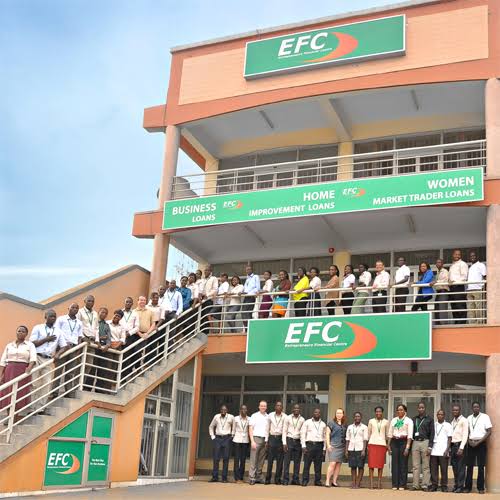
But it appears this new investment came with orders to check expenses. In Q4 2022, EFC closed 5 of its Kampala service centres, namely Kireka, Mukono, Nateete, Kalerwe and Nansana. Although in a statement, EFC said that the closures were simply a “strategic decision meant to streamline business operations and partnerships in the banking sector”, we do understand these branches were all loss-making.
This left the Ndeeba and the main branch at EFC House in Kamwokya as the only deposit-taking branches.
This and other cost-cutting measures produced a slightly better 2022. For example, even though customer deposits reduced by 22.5%, from UGX78 billion to UGX60.47 billion, there was enough liquidity to lend out. Thus, lending in 2022 grew by 6.6% from UG42.6 billion to UGX45.46 billion.
Operating income grew by 14.4% from UGX8.55 billion to UGX9.78 billion. Although expenses remained higher than operating income, they at least reduced by 18.3% to UGX12.4 billion. Interest expenses also slowed down by 8.4% from UGX10.4 billion to UGX9.53 billion. Even though credit impairment remained high- UGX3.4 billion, EFC managed to cut down on its losses from UGX6.63 billion to UGX2.62 at the end of 2022.
Telltale signs of trouble
Just as the shareholders of EFC were onto what they thought was a resilient path to post-Covid-19 recovery, on the 16th of November 2022, the Financial Institutions (Revision of Minimum Capital Requirements) Instrument 2022 was signed into law by Uganda’s Minister of Finance, Planning and Economic Development (MFPED), Hon. Matia Kasaija.
Selected EFC Financials
| 2017 | 2018 | 2019 | 2020 | 2021 | 2022 | |
| Deposits | 4.1 | 9 | 25.62 | 38.85 | 78 | 60.47 |
| Lending | 15.1 | 20.58 | 38 | 58 | 42.66 | 45.46 |
| Operating Income | 5.78 | 6.53 | 9.59 | 13.7 | 11.7 | 9.78 |
| Assets | 19.48 | 28.22 | 87.28 | 56.27 | 101.50 | 83.38 |
| Expenses | 7.53 | 7.58 | 9.01 | 11.28 | 15.17 | 12.40 |
| PAT | -2.56 | 1.86 | 0.575 | 2.43 | -6.63 | -2.62 |
| Share Capital | 15.28 | 24.26 | 24.26 | 24.26 | 30.54 | 30.54 |
| Accumulated losses | -13.14 | –15 | -14.34 | -11.86 | -20.02 | -22.63 |
Micro-deposit-taking institutions were immediately required to increase their minimum capital to at least UGX8 billion by 31st December 2022 and UGX10 billion by June 2024.
This required a fresh recapitalisation because, by the end of December 2022, growing accumulated losses had again eroded EFC’s capital, down to UGX7.91 billion.
Then it appears, that shareholder recapitalisation fatigue set in.
Even before the revised rules on capitalisation. There were telltale signs of brewing trouble as key executives, started jumping ship, one after the other.
Gerald Ssevume the CFO, since December 2020, left the company in April 2022 after less than 2 years. Denis Kibukamusoke, the Executive Director since January 2021 also left in August 2022, after less than two years.
Mr. Kibukamusoke was replaced by Michael Ssekyondwa who was hired from KCB Bank, where he was Head of Retail Banking.
Shem Kakembo, the Managing Director since May 2018, also quietly left the bank in June 2023, shortly followed by Sophia Nakazibwe, the Chief Operating Officer who quit in July 2023.
With Kakembo gone, Michael Ssekyondwa who was still coming to grips with his new Executive Director role was quickly made the Acting Managing Director, while Rachel Kobwesigye, formerly the Head of Internal Audit became Ag. Executive Director.
A rudderless loss-making and capital-strapped EFC could only steer in one direction- failure.
Had it not been closed by the Central Bank, EFC would have made 12 years this July 2024. However, after 3 capital injections in a space of 6 years, to plug holes left by billions in accumulated losses it appears shareholders were sceptical about infusing more capital in the face of new BoU Capital requirements.
Sensing trouble, senior executives started jumping ship, one after the other. With the June 2024 recapitalisation deadline loom and shareholder fatigue on the high, a rudderless loss-making and capital-strapped EFC Uganda could only steer in one direction- failure.
Bank of Uganda only switched off the life-support machine.