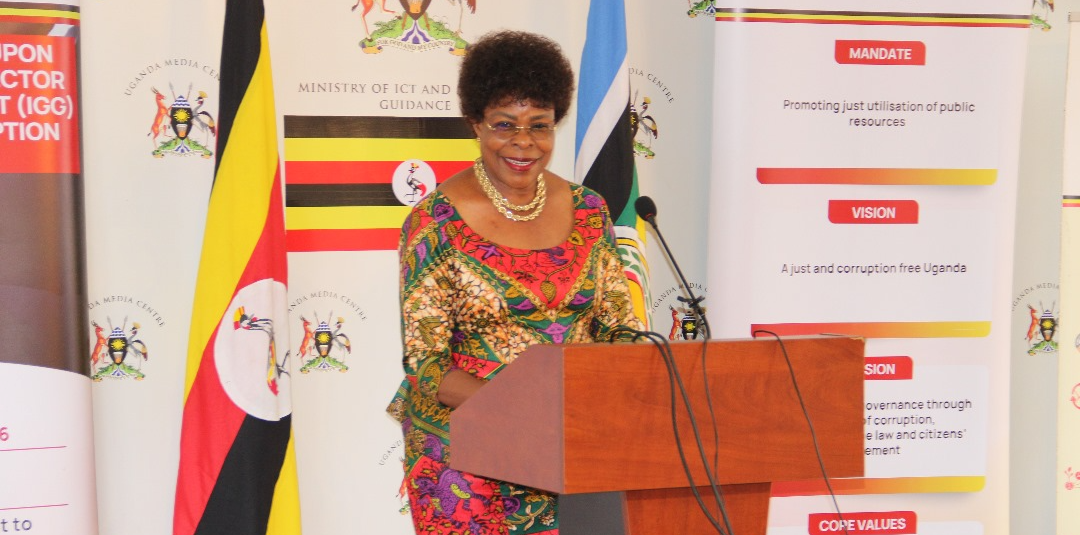
The Office of the Inspectorate of Government (IGG) has implemented new strategies and digital tools in its efforts to combat corruption, as stated by IGG Beti Kamya Turwomwe during a press conference for Africa Anti-Corruption Day.
Kamya highlighted the agency’s focus on recoveries and public accountability, noting that Uganda has long struggled with public sector corruption, which costs the nation an estimated $2.7 billion, or 10 trillion shillings, annually. She emphasized that Africa as a whole loses approximately $140 billion each year to corruption.
Kamya pointed out that saving 10 trillion shillings could provide 1 billion shillings annually to each of Uganda’s 10,000 parishes through the Parish Development Model. This would amount to about 2 million shillings per person annually for every Ugandan.
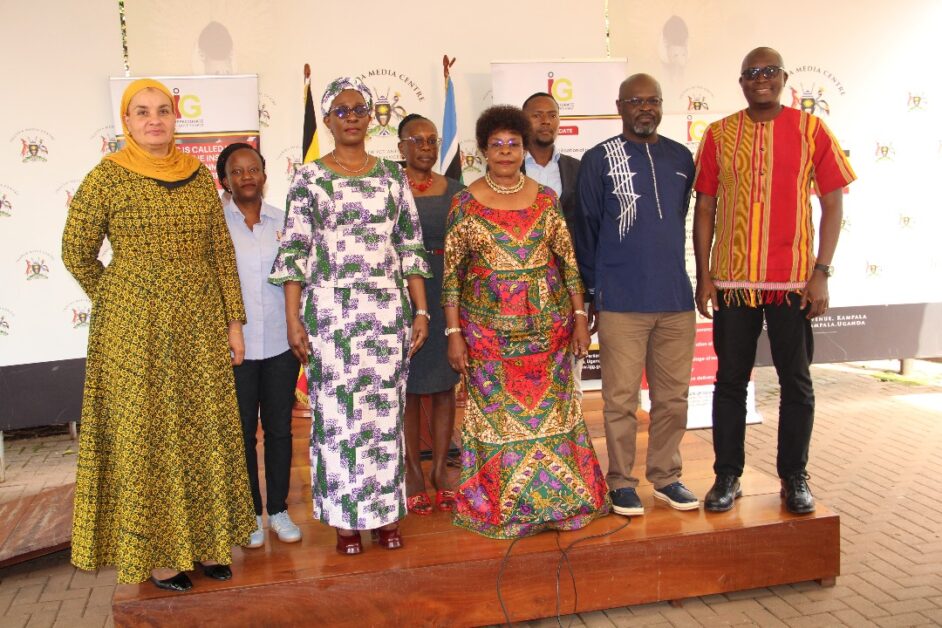
Twinomugisha Muhairwe, and staff of the Inspectorate of Government.
She described Africa as a paradox, rich in resources with 40% of the world’s gold reserves and 65% of its arable land, yet still struggling with persistent poverty. While countries like Seychelles, with a 72% Corruption Perception Index (CPI), and Rwanda, at 57%, have shown progress, Uganda’s CPI stands at 27%.
According to Kamya, the IGG’s office has increased recovery efforts. In the past financial year, the agency recovered a record 30 billion shillings lost to corruption. For the first six months of the current fiscal year, 4.2 billion shillings have already been recovered. Additionally, between January and December 2024, the IG recovered nearly 7 billion shillings from the proceeds of corruption.
During the same period, the IG recommended that 13.3 billion shillings be paid to individuals due to its interventions, with an additional 3.3 billion shillings recommended by the Inspectorate of Government Boards.
 World Bank bans PwC Africa, Rwanda and Kenya affiliates from Bank Group-financed projects over fraudulent practices
Digital transformation is a key strategy for the IG. The Inspectorate has launched the Online Declaration System (IG-ODS) for public officials’ wealth declarations. A new electronic complaints system has also resulted in a 300% increase in public complaints over the last two years, reflecting heightened citizen engagement.
Between January and December 2024, the IG investigated and concluded 2,218 corruption cases. The office took administrative action against 1,204 public officers, including interdictions or job losses. Sixteen public officers were recommended for prosecution at the Anti-Corruption Division, and 37 at the Leadership Code Tribunal. The IG achieved a 94.7% conviction rate in these courts. Kamya also noted that the IG inspected more than 1,200 government projects and conducted 53 spot checks in that year.
Kamya emphasized that institutional efforts must be complemented by changes in public attitude. She pointed out that communities often condone or glorify individuals who acquire wealth quickly, rather than questioning the source of that wealth. “The mindset should be, ‘Please explain to us how you acquired that wealth,'” she said. “That is what oversight and demanding accountability call for, not blind support.”

Kamya urged Ugandans to help expose suspicious wealth, such as high-rise apartments owned by public officials, stating that neighbors are often best positioned to report such inconsistencies. She also called on low- and middle-rank public officers to expose “syndicated corruption” within the government.
She credited the agency’s progress to its multidisciplinary team, including Deputy IGGs Patricia Achan Okiria and Anne Twinomugisha. Kamya concluded by stating that while corruption remains a challenge, the Inspectorate of Government is setting a national example for accountable governance.