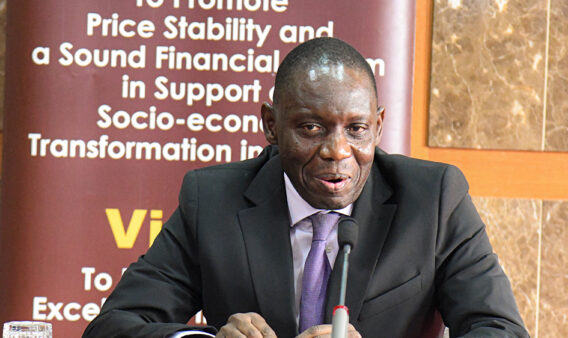
The Governor of Bank of Uganda, Professor Emmanuel Tumusiime Mutebile, has today threatened to take retaliatory statutory action on the banking industry over its reluctance to cut interest rates in line with BoU’s cuts on the Central Bank Rate.
Since the year began, BoU has cut its benchmark lending rate from 9 percent to a historic low of 7 percent in June. Nonetheless, banks have been reluctant to follow cue. Comparatively average lending rates have fallen by 2.15 percentage points from 19.88 percent at the beginning of the year to just 17.73 percent in April 2020. However in May 2020, rates increased again to 18.84 percent, prompting Mutebile to react.
In a strongly worded letter to all Chief Executive Officers of banks and the Executive Director of Uganda Bankers Association, written this week, on July 7th 2020, an apparently furious Mutebile threatened to invoke, Section 39 (1) (d) of the Bank of Uganda Act (2000) to redress this anomaly, which he said was “disheartening”.
“I am writing to you about the downward stickiness in lending interest rates despite the Bank of Uganda’s accommodative monetary policy and more so considering the recent reductions in the Central Bank Rate (CBR) to a record low of 7 percent,” Mutebile wrote in the letter titled: High Lending Interest Rates.
“As you may be aware domestic economic activity is facing unprecedented decline due to the novel coronavirus (COVID-19) pandemic and the measures instituted to contain the spread of the virus. Businesses and households have continued to suffer the brunt of the pandemic arising from lower demand, lower capital inflows, reduced productivity, unemployment, and loss of incomes due to lockdowns and travel restrictions. Resumption of pre-pandemic levels of economic activity will be gradual, partly due to dampened external demand amidst the deterioration in global economic sentiment,” the Governor further wrote.
“To alleviate the economic setback, the Bank of Uganda (BoU) took swift and novel actions. In particular, BoU eased monetary policy and continues to take other far-reaching steps to provide liquidity to the banking system in order to ensure adequate access to affordable credit by households and businesses. Moreover, as you can recall, BoU had been pursuing an accommodative monetary policy stance since April 2016,” Mutebile told the bank CEOs.
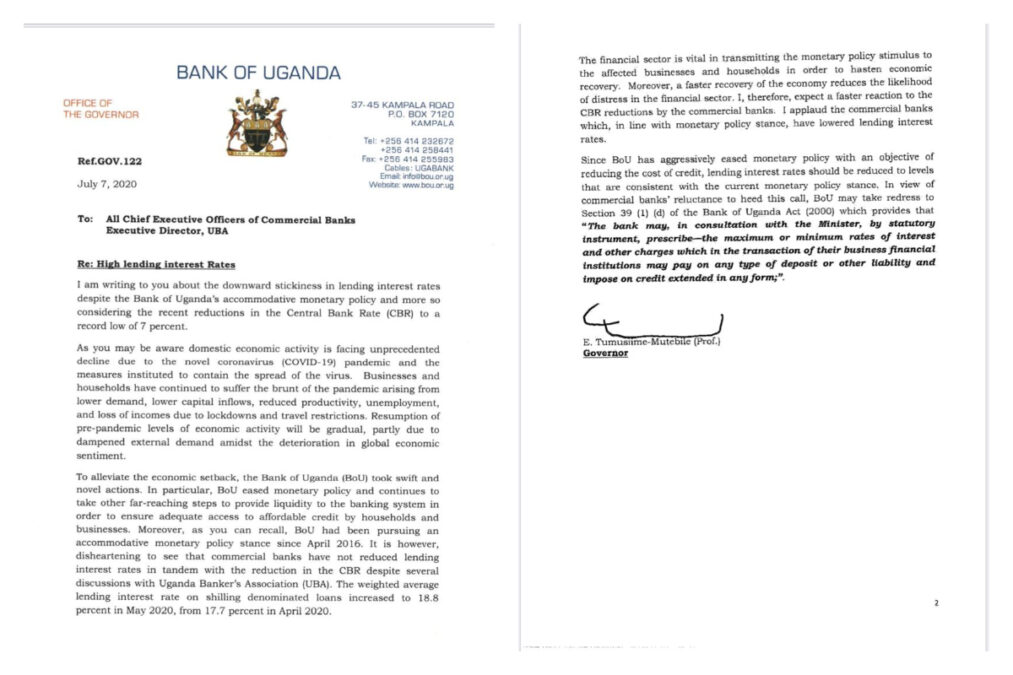
“It is however, disheartening to see that commercial banks have not reduced lending interest rates in tandem with the reduction in the CBR despite several discussions with Uganda Banker’s Association (UBA). The weighted average lending interest rate on shilling denominated loans increased to 18.8 percent in May 2020, from 17.7 percent in April 2020,” a furious Mutebile said.
“The financial sector is vital in transmitting the monetary policy stimulus to the affected businesses and households in order to hasten economic recovery. Moreover, a faster recovery of the economy reduces the likelihood of distress in the financial sector. I, therefore, expect a faster reaction to the CBR reductions by the commercial banks. I applaud the commercial banks which, in line with monetary policy stance, have lowered lending interest rates.
Since BoU has aggressively eased monetary policy with an objective of reducing the cost of credit, lending interest rates should be reduced to levels that are consistent with the current monetary policy stance. In view of commercial banks’ reluctance to heed this call, BoU may take redress to Section 39 (1) (d) of the Bank of Uganda Act (2000),” Mutebile threatened, adding that he may be forced to weigh in and regulate the interest rates chargeable.
 World Bank bans PwC Africa, Rwanda and Kenya affiliates from Bank Group-financed projects over fraudulent practices
Mutebile runs out patience with banks’ hide and seek
Section 39 (1) (d) of the Bank of Uganda Act (2000) provides that: “The bank may, in consultation with the Minister, by statutory instrument, prescribe- the maximum or minimum rates of interest and other charges which in the transaction of their business financial institutions may pay on any type of deposit or other liability and impose on credit extended in any form.”
This is the first time the Central Bank is coming out in such a strong way over interest rates.
Early this week, Stanbic Bank, the largest lender announced it had reduced its prime lending rates to 16 percent down from 16.5 percent in May and 17.5 percent at the beginning the year.
The industry expects bad loans to go up from 4.7 percent at the beginning of the year, through to 10 percent by year-end due to Covid-19 and as such, provisioning for bad debts is one of the reasons interest rates have remained high, despite an eased-down monetary policy by the Central Bank.
Commenting about this latest move by the Central Bank, Stephen Kaboyo, the Managing Director of Alpha Capital Partners, says that “BOU seems to been running out of patience.”
“This sort of response is what I would call a reality check responding to the current economic play as a result of Covid-19 effects. For quite some time BOU has been using the moral persuasion approach to convince commercial banks to respond to the accommodative monetary policy stance, but this has fallen on deaf ears. Clearly the spread has been very large and the policy rate has had little effect on commercial banks liquidity management and pricing which essentially means that there has been a weak monetary policy transmission. This does not only have an economic implication but also puts the Central Bank’s credibility on the line,” Kaboyo said.
In their Bank Lending Survey Report Fourth Quarter – FY 2019/20 outed this June, Bank of Uganda not that on a net basis, banks expected to keep their price terms and conditions broadly unchanged with a bias towards easing for average loans and prime borrowers and tightening for riskier loans in the quarter to September 2020.