
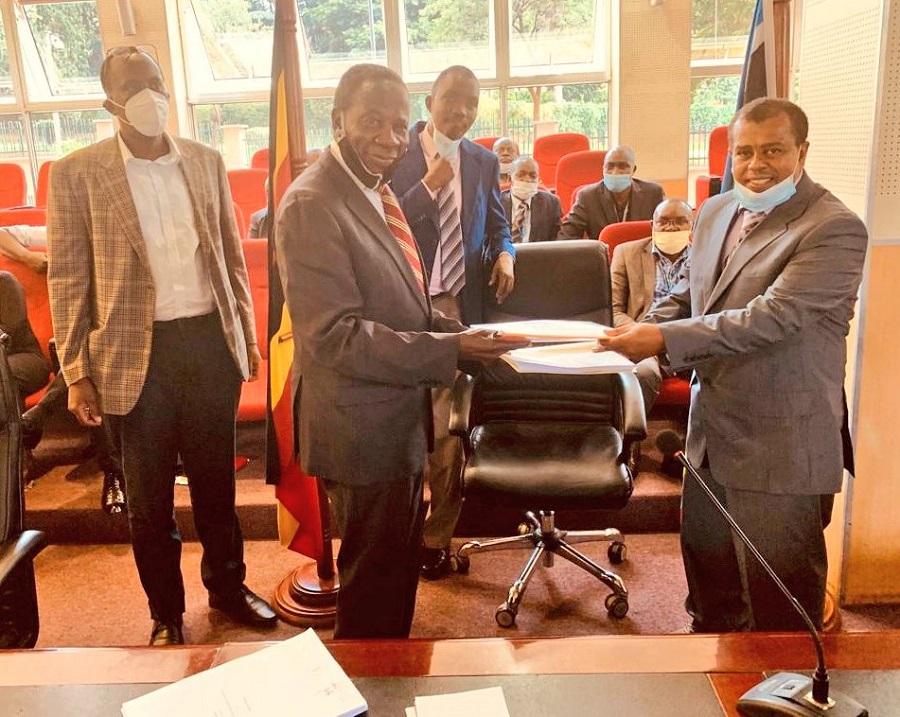
To address the problem of evading taxes, government, through the Ministry of Finance, has signed an agreement with an American Company RippleNami Inc to provide a solution to improve rental income tax compliance for Uganda.
The company will start working at the beginning of the new financial year 2020/2021.
The solution (system) will integrate data from various Ministries, Departments and Agencies (MDA’s) to enable proper identification of individuals and corporations to determine rental income prior to standard deductions.
Betty Kasimbazi the Under-Secretary/Accounting Officer at the Ministry of Finance signed on behalf of Government while Faruk Awadh, Director for Operations Africa signed on behalf of RippleNami.
Finance Minister Matia Kasaija who witnessed the June 5th 2020 signing ceremony, urged Uganda Revenue Authority to collaborate with Ripplenami in solving uncollected rental income tax issues.
“On behalf of Government of Uganda, I congratulate all of us who have been involved in one way or another for having patiently worked through this,” said Kasaija.
“Paying taxes is a noble job of any citizen and it is Biblical. I know many people don’t like to pay taxes, but it’s a noble action that every citizen should undertake with open hands,” said the Finance Minister adding that Ugandans who don’t pay taxes are cheating themselves.
RippleNami shall develop and deploy a rental tax compliance system that will integrate data between the various government agencies to enable proper identification of individuals, and companies that own rentable property and possible rental income tax payable.
Related
 Inside Zahid Mustafa’s Turnaround Playbook: How I&M Bank Tanzania Reclaimed Growth and Relevance
The URA will be the primary end-user of the information and reports generated by the rental tax compliance system.
John Musinguzi Rujoki, the URA Commissioner General said URA will work closely with government agencies such as Ministry of Lands, NIRA, KCCA, URSB and utility companies to provide the necessary data which will be integrated with the RippleNami technology.
How the systems will work
RippleNami will identify properties and assign them geo-addresses in accordance with internationally accepted standards. The identified properties will be linked to their owners or the persons who earn income from those properties. The RippleNami system will also cross-match the identified properties and their owners with the URA TIN database.
The company will also determine the nature of occupancy, that is, whether a property is owner-occupied or rented out, determine the occupancy period, providing for current and previous periods, determine the estimated rental income assessable to rental tax to be paid prior to standard deductions from each property and by each property owner and provide a clear address for each property identified for ease of reference.
RippleNami will train URA and other staff of the Government of Uganda on the use of the Rental Tax Compliance system.