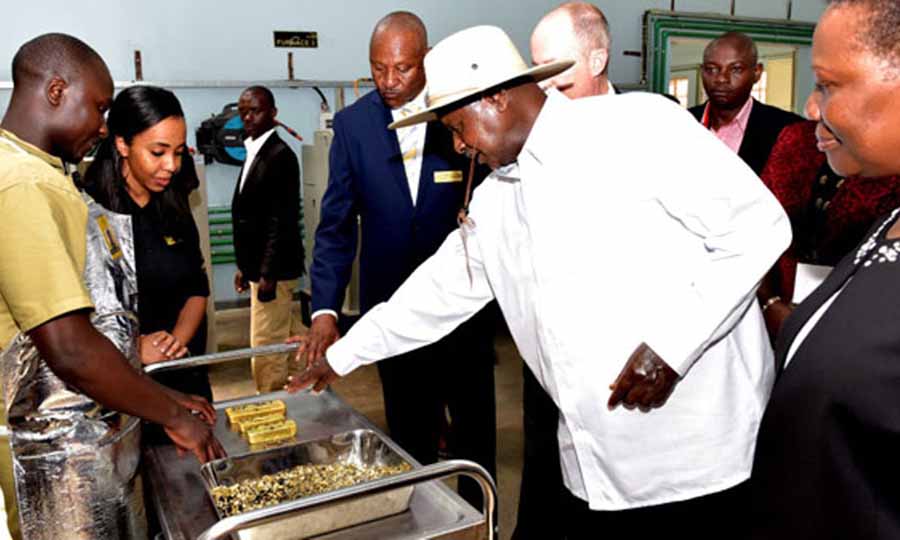
For the past decade, gold has quietly emerged as Uganda’s single largest export earner, reshaping the country’s trade profile and foreign exchange inflows.
But the journey has been anything but steady, marked by dramatic booms, abrupt halts, and now a historic peak.
Modest beginnings
Gold earnings, according to data from Bank of Uganda had in the five years to June 2014 averaged at $4.7 million annually.
But dramatically surged in the 2015/16 financial year to $204 million.
Volumes also rose to 5,423 kilogrammes and more than doubled to 11,038 kilogrammes, from which $433 million was earned in the 2016/17 financial year.
The growth reflected increased refining and entry of regional gold flows through Uganda due to liberalised trade policies and establishment of refineries.
But in the 2017/18 financial year there was a slight dip, with exports dropping to 8,553 kilogrammes, while earnings dipped to $343 million.
It is difficult to understand the cause of the drop, but in the 2018/19 financial year export volumes and value surged again to 26,711 kilogrammes.
The surge pushed earnings to $1.07 billion. For the first in Uganda’s export history, gold overtook coffee and fish as the largest source of foreign exchange.
This trend has since been maintained with Bank of Uganda showing that gold has now, for more than five years, become Uganda’s biggest export.
As of June 2025, coffee and fish contributed 20.8% and 1.4%, respectively.
This returned a combined export contribution of 22.2 percent, which was lower compared to the 39.6% for gold.
In the 12 months to June 2025, Uganda’s total exports stood at $10.6 billion.
This means that nearly four out of every $10 Uganda earned from exports came from gold alone.
The big leap
Uganda’s gold story systematic, registering new peaks in almost every financial year in the last 10 years.
In the 2019/20 financial year, earnings surged to $1.12 billion, while volumes rose to 21,746 kilogrammes.
This cemented gold as the backbone of foreign Uganda’s exchange earnings, with the sector becoming increasingly attractive to traders.
However, it also drew scrutiny from the international markets, with questions around transparency and origin.
The Covid-19 boom
With Covid-19 sending global gold prices soaring as investors sought safe-haven assets, Uganda rode the wave, exporting 43,009 kilogrammes.
The increase in volumes saw gold revenue cross the $2 billion, with earnings rising to $2.25 billion in in the 2020/21 financial year.
This remains one of the sharpest jumps in export performance in the country’s recent history.
However, in the subsequent financial year, in a dramatic twist, gold exports were recorded at zero.
 6 Ugandans Arrested in Connection to USD 3.4 Mn Equity Bank Rwanda Digital Heist
This stemmed from regulatory disputes and new tax measures, particularly the 5% levy on refined gold and 10% on unrefined exports.
This disrupted trade flows, after traders halted exports, leading to a temporary collapse of a sector that had powered Uganda’s balance of payments.
Recovery and resurgence
But in the 2022/23 financial year, exports resumed, though at lower levels.
During the year 19,903 kilogramme worth $1.07 billion were exported.
But subsequently staged a stunning comeback in the 2023/24 financial year, with volumes surging to 48,620 kilogrammes, while earnings rose to $2.98 billion.
The growth continued and almost doubled in the 2024/25 financial year.
Bank of Uganda data shows that in the 12 months to June 2025 gold earnings peaked to $4.21 billion, with volume rising to 49,085 kilogramme.
This makes gold not just Uganda’s top export, but a critical pillar of the national economy.
Uganda’s gold earnings have swung wildly, from zero in 2021/22 to $4.2 billion just in three years.
This complicates fiscal planning and exposes the economy to external shocks.
The 2021/22 export collapse also showed how sensitive the sector is to taxation, thereby demanding consistency and clarity in policy.
On the other hand, gold has transformed Uganda’s export profile, reducing the country’s overreliance on a single commodity.
Source of Uganda’s gold
Much of Uganda’s gold is sourced from neighboring countries.
This raises questions about traceability, compliance with international standards, and the country’s true production capacity.
Thereby to secure sustainable growth in gold exports, Uganda needs to balance taxation with competitiveness to avoid driving exporters away.
The country must also strengthen transparency and certification.
Beyond this, it must invest in local value addition and diversify exports to reduce vulnerability to global price swings.
Gold story in the last 10 years
Uganda’s gold export story over the past decade has been one of boom, bust, and rebound.
From modest beginnings to crossing the $4 billion, gold now dominates the country’s export earnings.
But without deliberate efforts to stabilize regulation, improve transparency, and diversify the economy, the sector’s glitter could quickly turn volatile.