


The billionaire Oswal family, long regarded as global investors with deep ties to Uganda, has vowed to pursue every legal avenue after enduring what they describe as an “unprecedented miscarriage of justice” that saw their daughter, entrepreneur Vasundhara Oswal, illegally detained for three weeks in Uganda on fabricated charges of kidnapping and intent to murder in October 2024.
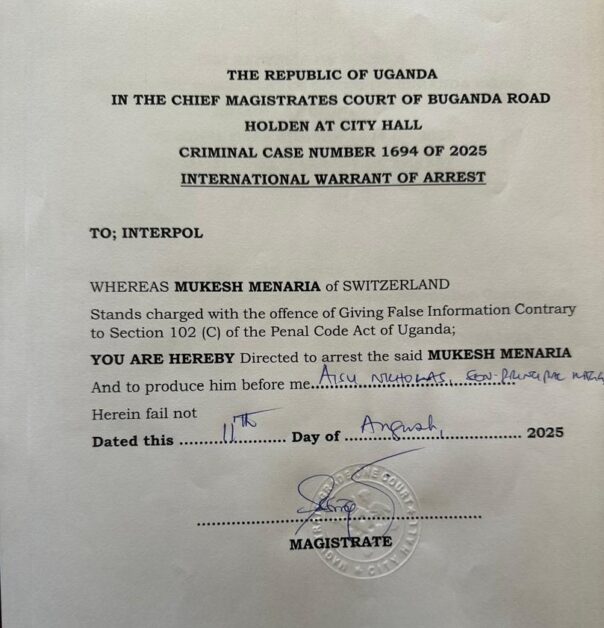
The episode, which began with false accusations by their former employee Mukesh Menaria, has since unravelled into a scandal of international proportions. Mukesh, as we speak, once a trusted household chef, is wanted in multiple jurisdictions for theft, bail-jumping, knowingly providing false information, and malicious prosecution in a bid to extort the Oswal family.
His son Vishnu Menaria, continuing the vendetta, faces criminal charges in India for trespassing on private property, physically assaulting Radhika Oswal, Vasundhara’s mother, and threatening her with rape and an acid attack in July of this year.
The Oswals argue that what happened in Uganda was not only an assault on their family but also a stark warning about the risks posed to international investors who choose Uganda as a destination for their capital and enterprise.
From accusations to arbitrary detention
The story began in 2024 when Mukesh Menaria, after being dismissed for stealing from the family and misconduct, launched a series of false allegations of mistreatment and kidnapping against his employers. The Oswals had supported him generously during his eight years of service, even financing a St. Lucian passport worth USD 200,000, which allowed him to travel with them globally.
Within weeks of his termination, Mukesh and his associates, including another former employee, fabricated claims of abuse. The series of false accusations, none of which have been substantiated, was orchestrated by the former employee to avoid repaying a USD 200,000 loan and to retain the St. Lucian passport, in violation of an agreement he had signed with the family.
These accusations triggered a dawn raid on 1 October 2024, when Ugandan police stormed the PRO Industries ethanol plant in Luwero — a USD 100 million investment spearheaded by Vasundhara Oswal, daughter of Pankaj and Radhika Oswal. Acting on an Interpol Yellow Notice that bore no reference to Vasundhara’s name, officers detained her without a warrant or credible evidence and transported her in an unmarked police vehicle.
She was held for nearly 90 hours (well beyond Uganda’s legal 48-hour limit for detention without charge) and not released despite an unconditional release order issued by the Chief Magistrate’s Court in Kampala on 3 October 2024. Vasundhara spent another 18 days behind bars, shuttled between detention centres and prisons, including Nakansongola, a maximum-security facility housing violent criminals.
This has raised grave concerns about potential violations of international law and misuse of Interpol procedures. Human-rights advocates and legal experts have described the incident as tantamount to a state-sanctioned abduction and a breach of Interpol’s own rules.
Vasundhara was denied medication, subjected to degrading treatment, and extorted for bribes. Her family paid USD 30,000 in bond money that the police never honoured and have still not returned. During the arrest, Ugandan officers also confiscated her jewellery, which remains unreturned to this day, despite all charges having been dropped and the case dismissed.
When the “murder victim” was found alive and well
The central irony of the case was that the man she was accused of kidnapping, Mukesh Menaria, was never missing at all. Records later revealed that he had left Uganda by crossing into Tanzania illegally and had also crossed the Kenyan border. On 10 October 2024, Tanzanian police arrested him at a motel where he had been staying for two days, even as an extensive search for him was underway. He was found in possession of his St Lucian passport and approximately USD 150,000 worth of stolen jewellery from the Oswals, which he was attempting to flee with. He was alive, free, and clearly not the victim of kidnapping.
Even more damning were two sworn affidavits signed by Mukesh in October 2024, in which he admitted:
- He left Uganda “of his own free will.”
- He was never kidnapped, tortured, or mistreated by the Oswals.
- His son Vishnu and accomplice Santosh Dwibhashi had acted “with falsehood and ill intent” to extort money from the family.
Yet despite these statements, Ugandan authorities kept Vasundhara incarcerated. She was only released on bail after 21 days, and the case dragged on for months before finally collapsing. On 19 June 2025, the Chief Magistrate’s Court in Luwero dismissed all charges against her, citing a lack of evidence and Mukesh’s repeated failure to appear.
“Vasundhara’s arrest was nothing less than state-sanctioned kidnapping,” said a family spokesperson. “The law was openly defied, and Vasundhara’s rights were trampled at every stage.”
A severe miscarriage of justice
The Oswals describe Vasundhara’s detention as a travesty of justice with real human consequences.
At just 26, the young female entrepreneur was making waves as a pioneer in business, successfully establishing East Africa’s largest ethanol plant. Yet her remarkable rise was overshadowed by a devastating ordeal: she suffered untold reputational damage, endured public humiliation, and saw her health deteriorate, all while her human rights were disregarded. Amid this turmoil, her family scrambled across borders to prove her innocence.
“It was terrifying to be treated like a criminal when neither I nor my family had done anything wrong,” Vasundhara said. “For three weeks, I lived in grave fear and uncertainty, with my rights and dignity violated at every turn.”
 Inside the Balance Sheet: CFO Doreen Kyomugisha on Building Capital Strength and Financial Discipline at SanlamAllianz General Uganda
Her lawyers argue that the Ugandan authorities not only failed in their duty to uphold the law but also actively participated in her persecution. International human rights organisations, including the UN Working Group on Arbitrary Detention, have been petitioned to investigate the case.
Vasundhara’s case echoes recent warnings by the Uganda Law Society (ULS) about the escalating and deteriorating respect for the rule of law by the state through security agencies. Earlier this month, ULS Vice President Anthony Asiimwe warned that continuous disrespect of the rule of law and court orders could lead to a return to the dark days of the past.
From accusers to international fugitives
If the Oswals’ account is one of survival and vindication, the Menarias’ trajectory is the opposite: from self-styled victims to internationally wanted fugitives.
- In Uganda, warrants have been issued against Mukesh, Vishnu, and their relative Rajmal Menaria for providing false and malicious information to the police. Uganda’s National Crime Bureau has requested Interpol offices in Bern and New Delhi to extradite them.
- In Tanzania, Mukesh faces charges for jumping bail after fleeing while under investigation for theft.
- In India, Mukesh and his wife face legal proceedings over bounced cheques linked to the passport loan, while Vishnu faces prosecution for the July 2025 assault on Radhika Oswal. Vishnu also faces a defamation case for the false accusations that led to Vasundhara’s illegal imprisonment.
“The tables have turned,” said one of the family’s lawyers. “Those who weaponised falsehoods against the Oswals are now fugitives facing justice in multiple countries.”
The July assault in India
The vendetta took a violent turn on 23 July 2025, when Vishnu Menaria allegedly trespassed onto private property in New Delhi and assaulted Radhika Oswal. According to the police report, he pushed her, tore her clothes, and threatened her with rape, an acid attack, and murder.
He was arrested and detained for 24 hours before being granted bail under strict conditions, including surrendering his passport. The Oswal family has since petitioned the court to cancel his bail, arguing he remains a threat. A hearing was scheduled for 25 September 2025.
For the family, the attack underscored the continuing danger posed by the Menarias’ campaign of intimidation.
Oswals’ contributions to Uganda
Beyond the courtroom drama lies the larger question of investor confidence. The Oswals are not mere visitors to Uganda. Through PRO Industries, Vasundhara spearheaded a USD 100 million investment in East Africa’s largest ethanol plant in Luwero. The facility, which started production amid Vasundhara’s illegal imprisonment in October 2024, employs more than 500 people, 80% of whom are Ugandan nationals, and plays a pivotal role in Uganda’s industrialisation and green energy ambitions.
With the government set to mandate ethanol blending in petrol from January 2026, PRO’s plant is central to reducing Uganda’s USD 2 billion petroleum import bill and advancing its Vision 2040 development plan.
“The irony is striking,” said a Kampala-based economist. “A family that brought jobs, technology, and sustainable investment to Uganda ended up being punished by a legal system manipulated by disgruntled ex-employees.”
A family’s determination to seek justice
Despite their ordeal, the Oswals say they remain committed to Uganda and to defending their reputation. Speaking recently, Vasundhara vowed:
“These false allegations have brought me great anguish and unfairly tarnished my family’s reputation. As a prominent investor in Uganda committed to contributing to the country’s socio-economic development, we remain confident that justice will prevail and the truth will uncover the deliberate malice driving these claims, which is, in fact, an extortion scheme. We refuse to be silenced and will ensure that those responsible are held to account.”
For many observers, the case serves as a cautionary tale. It highlights not only the vulnerabilities of high-profile investors in Uganda but also the urgent need for stronger safeguards against malicious prosecutions and arbitrary detentions.
As the legal battles continue across three countries and two continents, one fact is clear: the Menarias’ campaign of lies has backfired. What began as an extortion attempt has now left them fugitives, while the Oswals have emerged determined to see the law applied — fairly, firmly, and without fear.
