Weeks after French oil and gas major, Total S.A announced suspension of the 1,445-kilometer and USD3.5 billion East Africa Crude Oil Pipeline (EACOP), CEO East Africa understands Total has also halted, among other tenders, the tendering process for a main logistics provider for the Tilenga Project.
The ‘Tilenga Project’ refers to the development of six oil fields within Contract Area CA-1, License Area LA-2 (North) and Exploration Area EA-1A in the Albertine Graben, Western Uganda by Total Exploration & Production Uganda B.V., Tullow Uganda Operations Pty Ltd and China National Offshore Oil Company Uganda Limited (CNOOC)
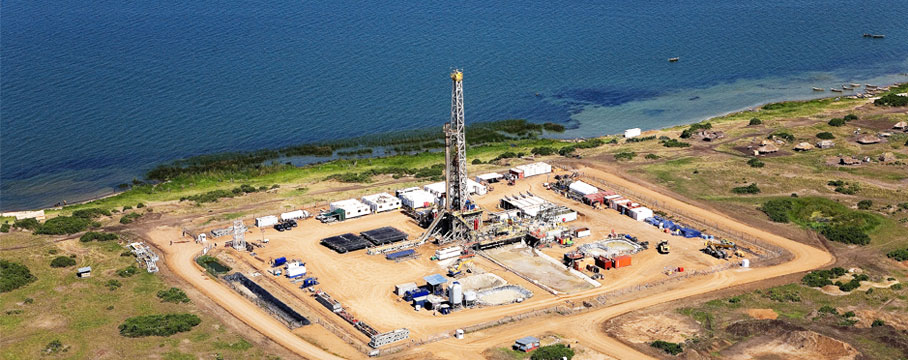
The project that forms a core component of the Albertine Graaben oil activities, consists of 34 well pads and a network of buried pipelines (Production and Injection Network) that will collect the oil produced from each well pad and transport it to a Central Processing Facility (CPF) located within the Industrial Area.
Operating on a 24-hour basis, the CPF will separate the produced oil, water and gas arriving from the well pads and also includes a treatment facility, power generation facility and export facilities. The Tilenga Project also includes a water abstraction system on the shore of Lake Albert, and the construction of new roads and upgrades to existing transport infrastructure.

“In consideration of the present state of uncertainty for the project, the company (Total) has therefore elected not to request for any further update and/or extension of your proposal, and hereby notifies the tenderer of the cancellation of the call for tender here above mentioned,” read a notice sent to bidders participating in the tendering process.
The notice, dated September 24th 2019 and signed by a Florent Sarrazy, a Contracts Engineer with Total and another Razif Jaffar, a Package Manager, however said that while Total remained “committed to advancing its activities in the Lake Albert Development projects” there were still “key outstanding issues to be addressed and resolved with the stakeholders in Uganda in order to secure a suitable legal and fiscal framework before progressing any technical and commercial process on the TILENGA Project.”
At the heart of the dispute, according to insiders, is a tax dispute emanating from the planned sale (farm down) by Tullow Oil of 21.57% its shareholding in the Ugandan joint venture to partners, Total & CNOOC?
Government has assessed a tax bill, said to be $185 million on the USD900 million farm down deal. While after another protracted standoff, Total, Tullow and CNOOC agreed to split the $185 million tax bill, another stalemate has ensued following government’s unwillingness to make this tax payment a deductible expense for income tax purposes.
Prolonged bargaining over this issue subsequently saw the Acquisition Agreement signed by the three oil firms expire, setting off a chain of terminations related to the development phase, starting with the crude oil pipeline and now the Tilenga Project.
Conclusion of the farm down is critical to the Financial Investment Decision (FID) as Tullow was relying on using the proceeds to finance its part of the joint venture and now that the farm down is in disarray, it remains to be seen how the parties shall progress.
Both Tullow and CNOOC have not said much since the expiry of the acquisition agreement.
Quick resolution is in the best interests of Uganda and Ugandans
In an interview with CEO East Africa Magazine, Denis Kamurasi, the Chairman of the Association of Uganda Oil and Gas Service Providers (AUGOS) said that the cancellations by Total, have “greatly affected local service provides as most contracts have either be down-graded or indefinitely suspended.
 Ruparelia Group Wins Key Entebbe Land Case, Clearing Path for the New Mega Speke Resort and Convention Centre, Entebbe
“I know a contractor that was told to scale down his operation by 85%. He has naturally had to lay off staff to accommodate the hit,” he said in a WhatsApp conversation with this reporter.
He however remained optimistic said that: “Government is revisiting contentious clauses of the law to see if there are legal mechanisms available to address the impasse. Predictions for breakthrough are positive. Though time frames are not clear.”
Mr Kamurasi, urged government to prioritise a solution to stalemate:
“You see, TOTAL for instance had revenues of over USD209 last year. They also acquired all the assets of Anadarko in Africa. CNOOC is the national oil company of China. We all know how powerful a company backed by the Chinese government is. In other words, these guys can wait 100 years, he said, adding: “They have no pressure at all as this project is not one to break them in any way. Uganda needs this project more than the international oil companies (IOCs) do. Quick resolution of this matter is in the best interest of Uganda and Ugandans.”
Kamurasi also said that given the global rush for clean energy alternatives, “Oil’s attractiveness is on the slide. We need to close this while we are still ahead.”
President Museveni digs in
It was reported in the papers recently that President Museveni, who met the oil companies on the side-lines of the Tanzania-Uganda Business Summit in Dar es Salaam, remained headstrong on the tax waivers, insisted the oil companies must pay each and every coin.
Writing on her Twitter page, Molly Kamukama, the Principal Private Secretary to President Museveni confirmed this position, saying that: “President Kaguta Museveni is determined to ensure that Uganda gets the best possible returns from its oil, & part of doing so is ensuring that any companies investing in our oil fields pay their fair share of tax. That’s an issue the President will not compromise on.”
Denis Kakembo, a Tax Specialist and Energy Lawyer and Managing Partner at, Cristal Advocates, however believes that the standstill over taxes is fixable, if only government was willing to give an “objective consideration and commercial outlook of the issues” at hand.
“The concerns raised by the oil companies are legitimate commercial issues that other oil companies would put up even if CNOOC, Total and Tullow were to exit Uganda’s oil sector. At Final Investment Decision stage all over the world, project viability is very sensitive to the tax and fiscal regime,” he wrote on his LinkedIn page, dispelling some suggestions that the oil companies were trying to deal Uganda a bad hand.
“The issues being raised are nothing about undermining Uganda’s sovereignty as some parties are currently misdirecting the debate complicating the possibility of a win-win settlement,” he said.