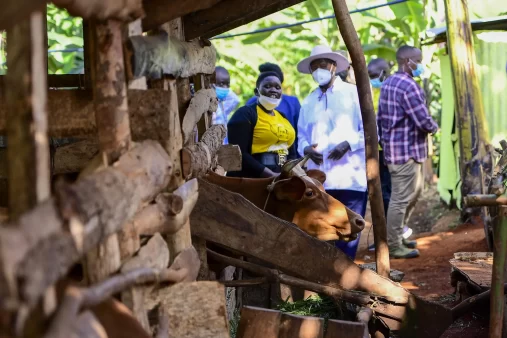
According to the Food and Agriculture Organization (FAO) of the United Nations (UN), Uganda loses an estimated 40% of its food to post-harvest losses, including spoilage. This means that for every 100 kilograms of food produced in Uganda, 40 kilograms are lost before it reaches the consumer.
There are a number of factors that contribute to food spoilage in Uganda, including poor infrastructure and poverty, which means that the majority of Ugandans do not have the resources to store food properly or to buy food that is not spoiled.
I was excited to learn that a young startup founder, Jean-Paul Nageri was solving this problem, and thus paid him a visit at his office in Ntinda. When I reached there, Jean-Paul showed me a tomato coated with his powder solution, KaFresh, that was over 60 days old. KaFresh is a biotech product produced and patented by Jean-Paul’s company Sio Valley Technologies.
We cut the tomato and he ate a piece of it to further demonstrate how good his solution is. Jean-Paul’s work is a culmination of a long journey of self-teaching and re-learning that he took to develop biotech solutions. But his life would have turned out differently had it not been for the intervention of his father.
“When I was much younger, I wanted to be a robotics scientist. I dreamt of getting sponsorship to Massachusetts Institute of Technology (MIT) to study robotics and computer science.” Jean-Paul tells me to kick off our interview. But his father, a farmer in Western Uganda, intervened to change his mindset. “My father opened my eyes to agriculture. We hadn’t innovated much in agriculture as a continent and I saw an opportunity to do impactful work.” This is how he ended up joining Uganda Christian University Mukono (UCU) to become an agricultural scientist.
In his first year at UCU, Jean-Paul got into solving problems in agriculture right away. He developed jam that you could spread on bread as soon as he stepped foot at the university. “We had a session where we visited tomato farmers. I learnt that they had grown so many tomatoes without a ready market yet they (the tomatoes) go bad very quickly. They had been advised to make tomato paste.” Jean-Paul went down a rabbit hole of figuring out how to make tomatoes last longer.
“I thought what if I turn the tomatoes into something else? That is how I thought of making tomato jam.” After watching a few tutorials on YouTube, he went to a friend’s room and started heating the tomatoes for hours overnight after adding some sugar. In the morning, he went to the dining hall and gave out samples to his friends to spread on their bread for breakfast and they liked it. This ended up being his first foray into building a biotech business. He sold the jam, called Wonder Jam, at shs 3,500 a bottle to fellow students.
In his final year, Jean-Paul started his second biotech business. This business doubled as his final year project. It was also a chance for him to experiment with plant-based science that had become his new obsession. He set his sights on mayonnaise, a popular creamy sauce used on sandwiches and other foods. Mayonnaise is usually made using raw egg yolks and vegetable oils. “The mayonnaise sold in Uganda is made from eggs, but at times there are egg shortages. I decided to make it out of plants. There are over 200,000 species of plants, so I wondered what kind of plants would work to develop the mayonnaise?”
He found his answer in peas. “Peas have protein, and the proteins have the ability to combine oil and water to form a sauce. I managed to extract the proteins using a process I had developed in-house and ended up with a mayonnaise product.” After graduation, he sold the mayonnaise to restaurants around Mukono town including Edgar’s, a booming restaurant at that time. He also supplied the mayonnaise to Kampala-based restaurants like Yamasen in Muyenga and The Brood.
 Entrepreneurship Is Not a Hustle: Ugandan Investment Executive Aaliyah Sekatawa on Building Disciplined Businesses in Africa
But this early success pales in comparison with his next act. And it was all driven by a personal story. His father is a matooke farmer, who used to harvest around Christmas time when the price of matooke is high. He would get in touch with traders who would promise to buy the entire garden. But this time around, the traders did not show up in time. “The whole harvest went from being green in the morning to yellow in the evening. We watched the matooke go bad in the garden. We couldn’t eat all of it. My father was so devastated.”
This propelled Jean-Paul to think of how to solve this. “I was tired of food spoilage. I wanted it to stop. So I began my research.” He wondered why oranges, for instance, lasted longer than avocados. He realized that oranges had oils that are arranged in a particular way that stop the decomposing process for some time. “But extracting those oils was difficult, and you will need a lot of oils”. he says. So he decided to turn the oil into a powder, mixed it with water and then coated the matooke with this mixture. “We were able to increase the shelf life of the matooke from a few days to over a week at the time. The challenge after this was how to get the powder to as many farmers as possible. So we decided to start a business”. He named his new company Sio Valley Technologies, and his new product, KaFresh.
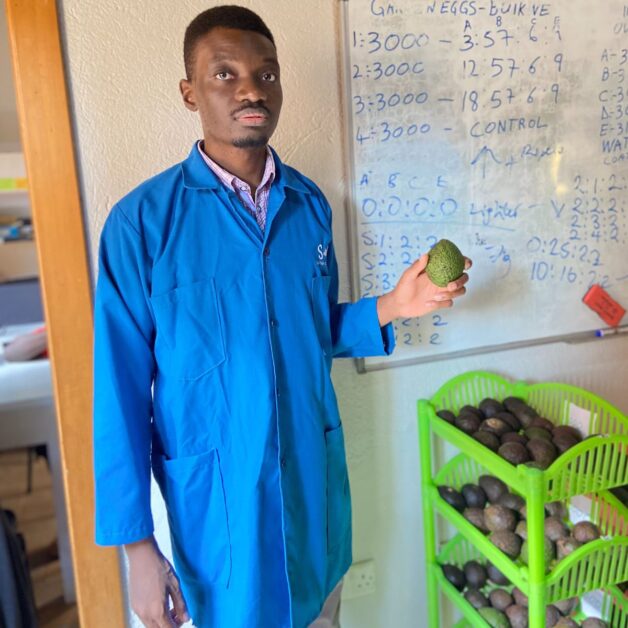
To be able to fund the business, he joined a few accelerator programs like the Stanbic Business Incubator, the NASE Youth Ideathon and the O-Farms program led by Bopinc and Village Capital. Through the O-Farms program, Jean-Paul met a US-based venture capital firm that took a keen interest in his idea. They eventually invested, and he used the funding to build a world-class warehouse and acquire some machines to scale his operations. He also pivoted from supplying individual farmers to working with exporters who lose about 40% of their produce due to spoilage.
The startup has been operating in stealth mode for the last couple of months focusing on refining their KaFresh product to serve various varieties of fruits and vegetables. But they have already lined up 10 exporters who are eager to use their product to cut back on their losses.
Jean-Paul recognizes that Uganda is not known for biotech startups. “A lot of the innovations in Uganda are mostly fintechs and other software-based startups. Building a biotech company in Uganda is extremely difficult and challenging, but it is extremely rewarding. We are creating something that has never existed, and now, we are turning it into a business. Also, we are solving a really difficult problem, and our solution can make a huge impact in our lives.”
He credits his team for the success they have achieved so far. “To impact people’s lives, I can’t do it alone. I have a lot of people working day and night.” The access to mentors has also helped Sio Valley to make calculated mistakes.
“If we can be able to end food spoilage, and end nutrition-based diseases like kwashiorkor, then we will have achieved our mission. With our solution, you don’t have to necessarily keep your food in the fridge. Ultimately, our success will be directly tied to how many people we can impact, and how far we can go in ending food spoilage. This is our end goal.” Jean-Paul concludes.