On most weekends in Nakabugu, a small village in Luuka District, you will not find Apollo Gabazira in Kampala’s quiet suburbs or relaxing at home.
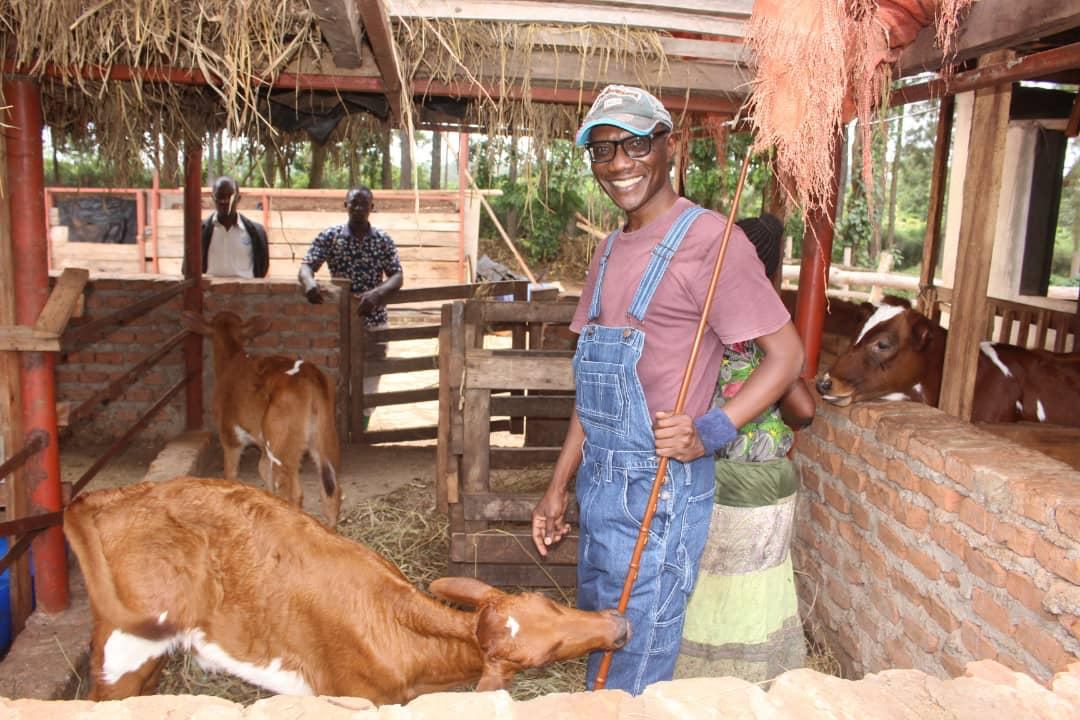
You will find him on his farm; in mud-caked overalls, walking between zero-grazing units, checking fodder plots, or demonstrating how to mix a feed ration to a group of students from St. Joseph Technical College.
The air hums with the rhythm of a place that knows exactly what it’s doing.
Ayrshire cows chew calmly in their stalls. A worker pushes wheelbarrows of manure toward the manure bank. Casual labourers slash fodder while farmers from nearby villages pass through a small building that, to outsiders, looks like a shop – but it’s a sustainable farming community hub, called AFS – Farmers Point and a model of sustainable public-private extension system.
To Mr Gabazira, it is not just a farm, it is a node of a network. A piece of a much larger idea. A centre of what he calls Asaba Farm System (AFS).
And to understand why it is a system, not just a farm, you have to go back to 1979.
A legacy he refused to let fade
“Asaba Farm is something that has been in our family for over 40 years,” he says. “It was for my mum and dad, but my mum was the brain behind it.”
The original farm was the kind of homestead agriculture that defined Busoga for decades—cows, crops, and survival. When his mother passed away in 2019, the farm was bequeathed to him and his wife, Lillian. Many would have continued the traditional way. Apollo chose reinvention.
“I wasn’t going to do farming that my parents did,” he says. “I had to bring new value to it.”
He renamed it Asaba Farm System (AFS) not for branding but for accuracy. What he wanted to build required integration, not isolated enterprises. It required dairy feeding into crops, crops feeding into dairy, skilling feeding into community resilience, and extension feeding into widespread adoption.
What he wanted was a system, engineered for modern and circular agribusiness.
The pursuit of proof
A quiet thread runs through his story—proof. “I’m here to prove to the world that farming can be profitable,” he insists.
People, he says, dismiss farming because they confuse subsistence survival with commercial agriculture. “People look at farming like it’s been done from their childhood,” he says.
They remember the small gardens their families tended “with a touch of enterprise here and there,” and conclude that farming is a dead end.
Mr Gabazira rejects that narrative with unmistakable precision. “There is an art, there is a science to farming,” he says. Gabazira has written authoritatively on this subject matter: https://gabazira.com/2020/09/06/we-are-all-retiring-into-farming-ugandas-new-social-security-fallacy/
That science guides everything at Asaba.
It is why he goes to the farm every weekend despite having a demanding weekday job. “Farming is not for the hobby farmer,” he says. “You’re going to go on the farm.”
It is why he takes the long view financially. “Farming is a long-term game,” he says. “Be patient… be very clear where your profit-returning endline is.”
It is why he and his wife have invested “hundreds of millions” into the enterprise—quietly, steadily, and without shortcuts.
It is why he still operates the tractor himself.
The Ayrshire gamble and the yoghurt edge
One of the most unconventional decisions he made early on was to choose Ayrshire cows—not the popular black-and-white Friesians that the family farm started with.
He imported foundation stock from Maakiu Farm in Kenya, known for breeding premium Ayrshire lines.
Ayrshires, he says, are better suited to the realities of Busoga’s shrinking land and fragile soils.
A Friesian, magnificent as it may be, is high maintenance. “I think a Musoga farmer in Luuka would be better going with an Ayrshire or even a Jersey,” he says
But his confidence in Ayrshires comes from more than resilience—it comes from yoghurt.
“Ayrshire milk is known to be one of the best for yoghurt making,” he says enthusiastically. Their milk gives yoghurt a natural “tangy taste… that you’ll never get from another milk.”
That tang is now becoming Asaba’s signature.
The system comes to life
To walk through the farm today is to see the four interlocking components that justify the name Asaba Farm System.
The dairy unit produces high-value milk but also manure, which enriches the crop fields. The crop fields produce fodder and cereals, some of which feed the cows while the excess is sold to neighbouring households.
Skilling happens everywhere; students learn how to handle equipment, farmers learn how to improve feeding, and youth find skills that could change their future trajectories.
Then there is the Asaba Community Extension System. Villagers call it “the shop,” but it is an engine of transformation. A hub for the emerging sustainable farming community – AFS Farmers Point, where Inputs, veterinary products, and expert advice flow out of it. Farmers gather, ask questions, and return to their gardens and animals with new knowledge.
All this is happening in a district heavily dominated by sugarcane growing, on small fragments of land, with farmers often struggling to break free from low-value cycles.
It is no accident that Asaba Farm System’s AFS – Farmers Point has become a centre of gravity.
When dfcu and Vision Group knocked
In 2024, the transformation taking shape in Luuka caught the attention of the dfcu & Vision Group Best Farmers Awards.
 PROFILE: Birungyi Cephas Kagyenda — The Making of One of Uganda's Leading Tax Lawyers
Curiously, Mr Gabazira never applied. “It’s the production office of Luuka District that submitted our farm,” he says. “I didn’t even know.”
The judges found more than cows; they found structure, discipline, innovation, and a culture of learning. Asaba Farm System was named Best Farmer in Eastern Region.
The award brought something that money cannot easily buy. “You’ve given us optics,” he says. “You’ve given us free PR.”
People who saw him in the media came looking for yoghurt, breeding stock, skills, and advice. Some came to witness what a farm “system” looks like.
But the award also delivered something far more powerful than visibility.
Holland: The 20% that will change 80%
As part of the prize, Apollo travelled to the Netherlands; the global capital of precision agriculture.
He treats the experience like a case study, dissected over weeks of reflection.
“For me, I take away 20% of what I learned,” he says, “and underline that only 20%; to come back and shift 80% of enterprise and business outcomes on Asaba Farm System.”
Two lessons shook him. The first was nutrition. “I think we are sleeping in Uganda,” he says. “Nutrition is about diligence and detail… cows never cheat.”
He saw cows producing 40 to 50 litres. He does not expect that from Ayrshires, but he now knows his herd can go into the 20s.
He learned that feed must be tested, and discovered that Koudijs Uganda offers a free laboratory for exactly that.
“I can take my feeds there… and be sure that I’m feeding my cows right.”
The second was reproduction discipline. “A cow should give you a calf every year,” he says. “If it’s not, it’s eating into your money.”
On one Dutch farm with 160 cows, 140 were in milk. “That was a big lesson for me.”
Back home, he is exploring heat-monitoring technologies to tighten breeding intervals—technology that only works if nutrition is equally tightened.
He also saw the power of cooperatives, something he now wants to reinforce through the AFS – Farmers Point model.
An unexpected gift: A Dutch consultant
One of the trip’s most surprising outcomes came not from a tour but from a conversation.
He was introduced to PUM Netherlands, a Dutch organisation that sends senior agriculture experts to support developing countries.
They will send a consultant to Asaba in January 2026 to help the farm deploy a massive 2,000-litre milk cooler donated by Luuka District Local Government.
A cooler that big needs market studies, logistics planning, and supply chain coordination.
“As a small farmer,” he says, “it’s money we don’t have.” The consultant will do it pro bono. “That,” he says, “is perhaps one of the biggest takeaways for us.”
Toward the end of our conversation, Apollo gently shifts from farmer to strategist.
He believes Uganda’s development sector has overlooked a critical piece: the power of stable, private rural enterprises.
“Farmers and researchers should be using farms like Asaba Farm System as enterprise hubs,” he says. “Our farms are private models… they are here to stay.” Agriculture Minister, Frank Karuhanga, echoed the same sentiment at the 2024 Best Farmers Awards when he said best-farmer farms should become training units across the country.
To him, donor projects fade. Enterprises endure. And through them, communities rise.

Why farmers should step forward
The Best Farmers Awards, he believes, are a multiplier of visibility, opportunity, and belief. “I know peer farmers already who said they would partake of the competition in 2025,” he says.
He encourages farmers to partner closely with their District Production Offices. “Partnership… is critical to you being able to access this competitive space.”
And to those hesitant about modern farming or value addition, his message is unforgiving but hopeful: “Hang in there. Farming is tough, but it can be rewarding if it’s done with discipline and purpose.”
The system and the man
What stands in Luuka today is not simply a dairy farm. It is a blueprint of what rural Uganda could become when legacy meets innovation, when science meets grit, and when local knowledge meets global exposure.
It is a cluster of interconnected units: dairy, crops, training, and extension, quietly reshaping how a district dominated by sugarcane thinks about land and livelihood.
And at the heart of it all is a farmer who still operates his own tractor, who rears Ayrshires in a land of Friesians, who spends weekdays at a desk and weekends in gumboots, who believes that a 20% lesson from the Netherlands can change 80% of outcomes in Luuka.
A farmer who still has not broken even but who knows exactly where he is going. “I will rest,” he says with a smile, “when we start turning a profit.”
Until then, the system keeps growing.