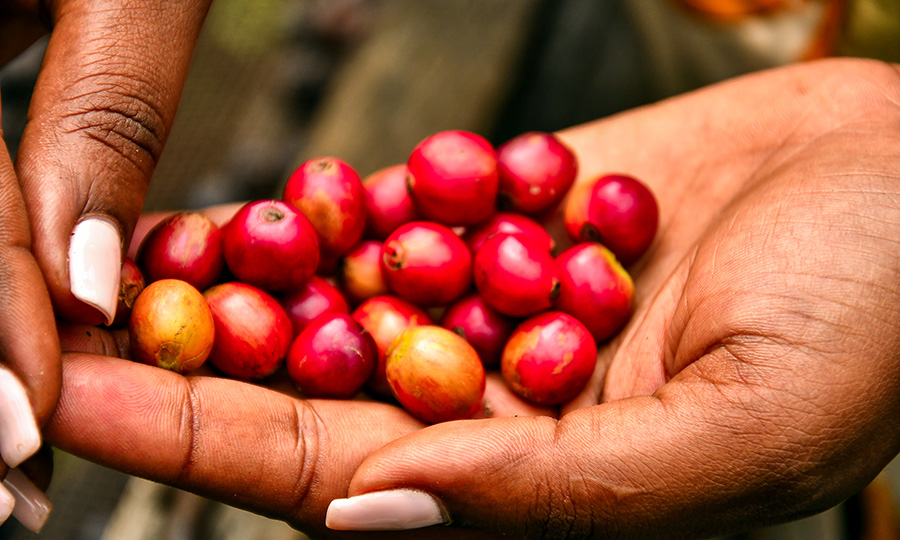
Uganda’s coffee season is unfolding in two very different chapters.
In July, the country shipped nearly a million bags, the second-highest monthly volume on record.
That oversupply of beans boosted foreign exchange earnings but also dragged down the average price per kilogramme.
Because supply had flooded the market, buyers were bargaining harder, and the mix shifted toward lower-value grades of Robusta.
By September, the picture had flipped. A spell of dry weather in Brazil threatened global supplies, and a stronger Brazilian currency discouraged farmers there from selling.
Those two forces combined to drive futures prices higher.
Uganda, though far from Brazil, benefited immediately: farm-gate prices rose, and exporters could command more dollars per kilo even with fewer bags to ship.
The contrast captures the tightrope African exporters walk. On one side, bumper harvests deliver volume but risk softening prices.
On the other hand, global supply shocks can create scarcity rents that lift values, but they are unpredictable and outside Uganda’s control.
The economics is simple yet unforgiving. When the world is oversupplied, Uganda earns less for more effort. When the world is undersupplied, Uganda earns more even if it ships less.
July’s big volumes, softer returns
In July, Uganda exported 997,105 bags of coffee, earning $250.6 million, according to the Ministry of Agriculture.
On paper, that looked impressive: volumes were up 21% compared with last year.
But the money didn’t grow at the same pace—export value rose only 19%—because the average price per kilogramme slipped to $4.19, its lowest in months.
The reason was simple: what Uganda sold mattered as much as how much it sold.
Robusta, the cheaper variety, made up 92% of shipments, with most beans graded at mid-level screens that fetched only $4.02 per kilogramme.
Arabica was the bright spot, averaging $6.06 per kilogramme, with premium washed lots such as Bugisu and Wugar reaching as high as $7.20 a kilogramme.
Yet Arabica accounted for just 8% of the total volume, too small to lift the overall average.
In other words, Uganda’s July coffee boom was a case of more bags but less value.
As Denis Mugambwa, a Kampala-based exporter, put it: “When the mix tilts too heavily toward lower-grade Robusta, volumes swell but earnings lag.”
Shifting buyers and power in the chain
There were also important changes in market dynamics—both on the selling and buying side.
On the export front, the top 10 companies handled 65% of shipments, down from 68% a month earlier.
At the same time, the top 10 foreign buyers accounted for 51% of purchases, down from 55%.
That easing in concentration meant that trade was slightly more competitive, with less dominance by a handful of players.
It even means that smaller exporters and new buyers could have manoeuvred to influence prices.
Destination markets shifted as well. Europe remained the anchor, taking 61% of Uganda’s coffee, with Italy still the single largest buyer.
But the notable change came from Africa, which absorbed 24% of shipments, up from 16% in June.
Sudan and Algeria stepped in to buy more Robusta, providing a ready outlet just as European demand slowed during the summer months.
This regional swing helped Uganda avoid a sharper fall in prices by ensuring excess supply had a home closer to the source.
September’s global rally changes the math
By mid-September, the market had turned sharply. Arabica futures in New York climbed to 396.85 cents a pound, their highest in four months, while Robusta in London reached $4,601 a ton.
The rally was triggered by dry weather in Brazil’s coffee belt during the critical flowering stage, raising fears of a smaller future crop.
It also resulted from a stronger Brazilian real, which discouraged farmers from selling their beans.
Together, those factors squeezed global supply and pushed prices up.
Uganda felt the effects immediately. Farm-gate prices jumped as traders paid more to secure beans.
Robusta cherries (Kiboko) rose to UGX 6,500–7,000 per kilogramme, up from UGX 5,000–5,500 in July, while Arabica parchment surged to UGX 14,000–15,000 per kilogramme.
That kind of increase puts more money in farmers’ pockets and raises export earnings across the chain.
Related
 Dutch Development Bank FMO Extends USD 20 Million Facility to I&M Bank Uganda to Boost SME Financing
If the rally holds, Uganda’s average export price could improve by nearly 18% compared with July.
That would help offset the seasonal dip in volumes that follows the Masaka and South-West harvest.
This shows how global price swings can matter just as much as local output in determining Uganda’s coffee income.
Economics of scarcity
The swing from July to September shows how commodity pricing really works.
In July, Uganda was hit by the downside of abundance. A heavy local harvest coincided with fresh supply signals from Vietnam and Brazil, pulling average prices lower.
By September, the pendulum swung the other way.
Concerns about a smaller Brazilian crop and a stronger real created a sense of scarcity, and traders bid up contracts in anticipation.
For Uganda, which is a price taker in the global market, the challenge is turning that temporary scarcity into real gains.
Without investing in better quality beans or using tools like forward hedging, much of the price premium risks slipping away.
It will instead be captured by middlemen and foreign roasters who are better positioned to exploit the rally.
What’s at stake
Coffee remains one of Uganda’s biggest sources of foreign exchange, bringing in $2.25 billion in the 12 months to July, a 59% jump from the previous year.
Those earnings are more than just numbers on a balance sheet.
They provide a cushion for the Ugandan shilling and help the central bank shore up reserves at a time when the country faces rising import bills for essentials like fuel and machinery.
Yet the sharp swings between July and September carry a warning.
Uganda’s heavy reliance on bulk Robusta exports makes its earnings vulnerable to local harvest gluts that depress prices and volatile futures markets driven by global supply shocks.
The lesson is that volume alone is not enough.
The real opportunity lies in moving up the value ladder. Premium washed Arabica and certified sustainable coffees, still only a small fraction of exports, consistently fetch higher prices.
Scaling those segments would not only lift average export earnings but also give Uganda more resilience when global markets turn rough.
The next play
The window of opportunity is open now, and the question is whether Uganda can seize it.
Exporters are expected to start by hedging more aggressively.
Locking in today’s high prices on New York and London exchanges would shield revenues from a sudden downturn. While premiums can still be earned through better grades and certifications.
At the same time, there is room to invest in quality. Shifting more Robusta into higher-value screens like 17/18, and scaling up washed Arabica, could add a dollar or more to the average price.
A meaningful boost when multiplied across hundreds of thousands of bags is some good dollars.
There is also a notion that policymakers and traders need to lean into Africa’s growing demand.
Buyers in Sudan, Algeria, and Morocco are proving counter-cyclical to Europe’s seasonal slowdown.
Their proximity means faster cash turnover and lower logistics risk.
The gains will only matter if they reach farmers, something that requires protecting rural margins through price transparency.
Tools like warehouse receipt financing need to be in place so that growers are not forced into distress sales at harvest time.
Uganda’s July exports showed the limits of chasing volume in a crowded market.
September’s rally, fueled by Brazil’s weather, offers a windfall, if Uganda can seize it.
The long game is clear: move up the quality ladder, hedge smart, and diversify demand.
Otherwise, the country’s coffee fortunes will remain hostage to Brazil’s rains and the vagaries of currency markets.