This morning, January 28th 2022 at exactly 1:02 AM, Rwanda’s Ministry of Foreign Affairs and International Cooperation announced that the Rwandan Government would re-open the Gatuna border post between Rwanda and Uganda from 31st January 2022.
This is after nearly 3 years since the border was closed in February 2019.
The Rwanda government said that the reopening follows the visit to Rwanda of Lt Gen Muhoozi Kainerugaba, Senior Presidential Adviser on Special Operations and Commander of Land Forces of the Uganda People’s Defence Forces (UPDF) on 22nd January 2022, after which visit, it was now convinced that there was progress on commitments by the government of Uganda to address the issues that led to the closure of the border as well as address the remaining obstacles. “In this regard and in line with the communiqué of the 4th Quadripartite Summit held at Gatuna/Katuna on 21′ February 2020, the Government of Rwanda wishes to inform the public that the Gatuna border post between Rwanda and Uganda will be re-opened from 31St January 2022,”
“As it is the case for other land border posts in the country, health authorities of Rwanda and Uganda will work together to put in place necessary measures to facilitate movement in the context of COVID-19. The Government of Rwanda remains committed to ongoing efforts to resolve pending issues between Rwanda and Uganda and believes that today’s announcement will contribute positively to the speedy normalization of relations between the two countries,” the Rwandan government announced.
The news is expected to reinvigorate a sense of optimism amongst Ugandan businesses, many of whom were grossly hurt by Rwanda’s hard stop closing of the border. Before that, Rwanda was Uganda’s 5th largest source of export revenue- at USD253.63 million in combined informal and formal trade.
Uganda loses USD600 million in export earnings from Rwanda
According to an analysis by CEO East Africa Magazine of the figures provided by the Uganda Bureau of Statistics (UBOS) and Bank of Uganda, it is estimated that Uganda could have lost up to USD600 million in lost export revenue in the three years, an equivalent of 2% of GDP.
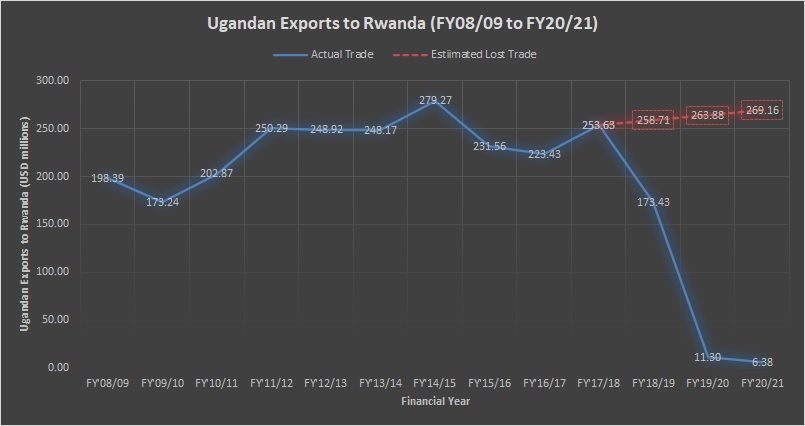
In the 10 years to FY17/18, according to UBOS and Bank of Uganda, Ugandan exports (both formal and informal), to Rwanda, grew at a Compounded Annual Growth Rate of (GAGR) of 2%, from USD198.4 million in FY08/09 to USD279.27 million in FY14/15, then hit some turbulence but regained, reaching USD253.63 million in FY17/18.
Upon the hard stop closure of the borders in February 2019, Uganda’s export earnings dipped by USD85.28 million in FY18/19- a reduction of 34%. In FY19/20 export earnings further nose-dived by 93.48% to USD11.30 million costing Ugandan businesses some USD252.58 million in lost earnings.
In FY20/21 earnings reached a new 24-year low of USD6.38 million, further causing Ugandan businesses to forego some USD262.77 in earnings. Available records show that the first recorded figures of trade between the two countries was in FY97/98 and in that year, Uganda earned USD6.38 million from Rwanda.
 Ruparelia Group Wins Key Entebbe Land Case, Clearing Path for the New Mega Speke Resort and Convention Centre, Entebbe
To arrive at the export earnings lost, we considered the fact that on average, in the 10 years to the closure of the borders, export earnings grew by 2%. Therefore, and barring for the Covid-19 impact, at this rate, Ugandan export earnings would have reached USD258.71 million in FY18/19; USD263.88 million in FY19/20 and closing FY20/21 at USD269.16 million.
In total, therefore, it is estimated that Uganda or Ugandan businesses lost some USD600.63 million in export earnings- an equivalent of 2% of GDP.
Rwandan losses estimated at USD61 million
Rwanda too lost a good amount in export earnings, but not as huge as Uganda did.
Again, according to figures from UBOS and BOU, in the 10 years to FY18/19 Ugandan imports from Rwanda rose from USD2.56 million to USD20.34 million in FY17/18; the highest ever. This is a Compounded Annual Growth Rate (CAGR) of 20%. But when in February 2019, Rwanda closed its borders to Ugandan businesses, imports into Uganda dropped by 20% to USD16.2 million, further falling to USD7.79 million in FY19/20 and reaching a 13-year low of USD3.81million, in FY20/21.
At a 10-year CAGR of 20%, if the borders had not closed and barring the impact of Covid-19, we estimate imports from Rwanda to have grown to USD24.41 million in FY18/19; USD29.29 million in FY19/20, reaching an all-time high of USD35.15 million in FY20/21.
Using these conservative estimates, it is projected that for the 3 years the borders remained closed, Rwanda lost about USD61 million in direct export earnings from Uganda.

Import and export trade aside, Uganda and Rwanda enjoy very close social ties with citizens on both sides of the border having families on either side and certainly very close social ties. Rwanda, in 2017 was the single biggest source of international arrivals and departures with the foremost reason for travel being visiting friends and family. In 2017, there were 442,000 arrivals from Rwanda and 408,000 departures to Rwanda, but this was decimated to a mere 23,000 arrivals and 20,000 departures in 2020, according to the Uganda Statistical Abstract by UBOS for 2021.
These broken social ties, can’t be quantified in money terms.
But while social and family ties will easily be revived, an even bigger question remains, will Ugandan businesses restore the lost business ties or have they been replaced totally by other competitors?