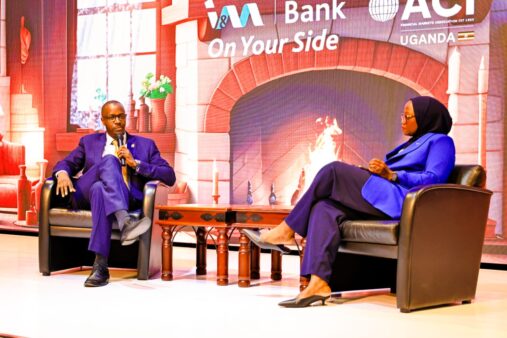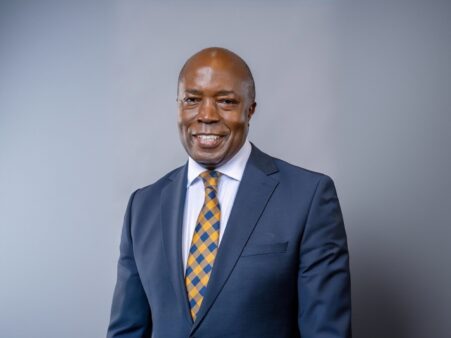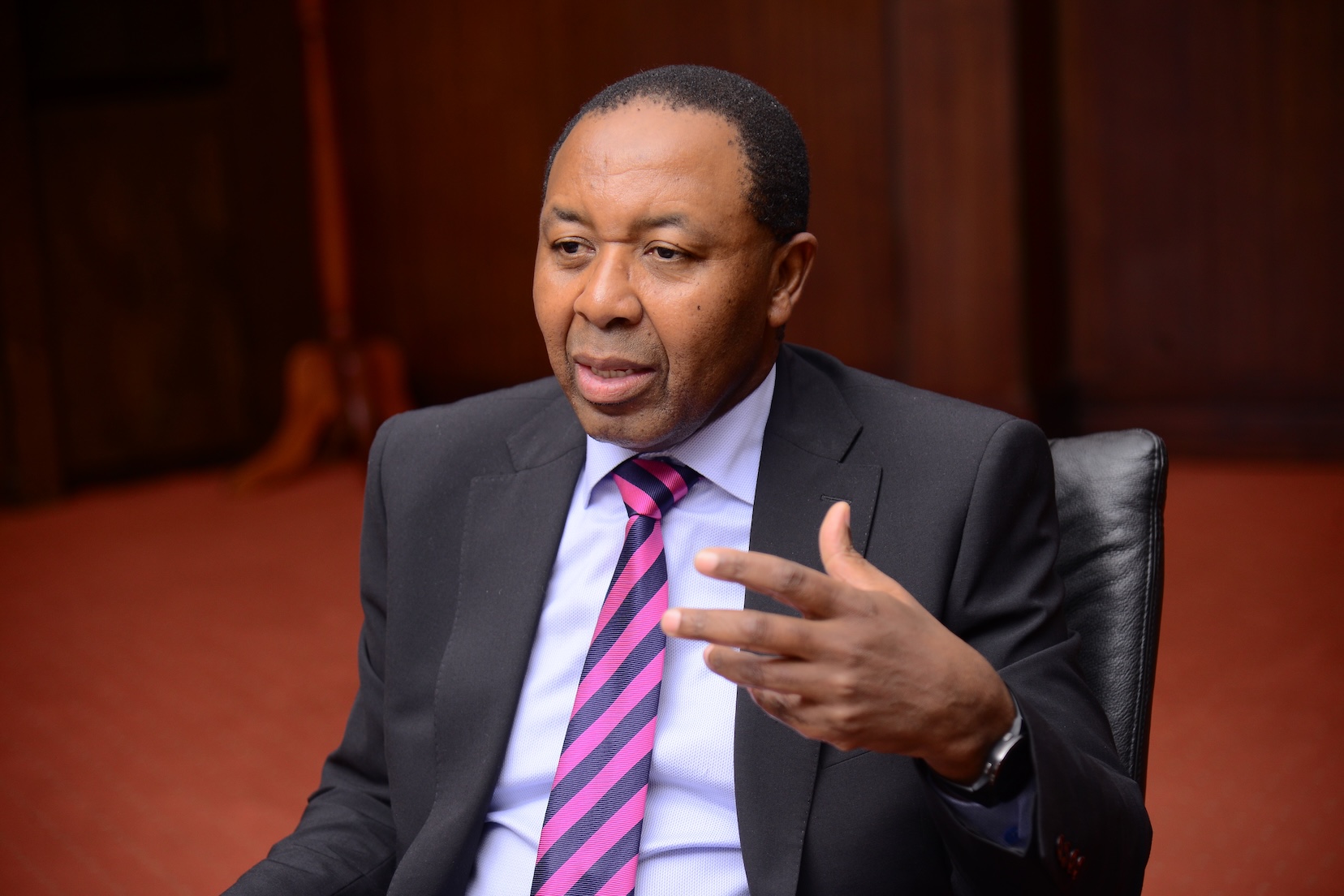
Thank you very much for the opportunity to speak with you. I’ve been following some of the remarks you’ve made since your appointment in June, and one recurring theme that stands out is Absa Group’s ambition to be a catalyst for Africa’s growth across multiple fronts. From your perspective, what does this mean in practical terms, and how do you personally intend to lead and bring this vision to life?
I think the starting point is that Absa has a presence in 12 African markets, and in 10 of those, we have fully fledged banks that are able to support customers, whether individuals, small businesses, or large corporates. That support enables these customers to unlock value within their respective economies, whether it’s someone buying a house, sending their child to university, purchasing machinery for a factory, or tractors for agricultural use, or even a major corporation looking to expand into new markets. Ultimately, all of those steps taken by individual customers contribute to economic growth, job creation, and, ultimately, taking Africa to the next level. As a bank on the African continent, we believe our role as a financial intermediary is critical in accelerating access to capital and ensuring that we can connect people to additional pools of capital, some of which may be sitting outside of the continent.
Looking at how this vision plays out across your markets, I’m curious—what proportion of Absa’s business currently sits in South Africa versus the rest of the continent? And specifically for my Ugandan audiences, how uniformly does this ‘catalyst for growth’ proposition apply across your markets? Are there differences in how it’s implemented, depending on the local context?”
The principle applies uniformly across all our markets, but the actual application is shaped by the specific sectors driving growth in each country. Take Uganda, for example—we ask: where is the biggest demand for credit, and how do we ensure our processes go beyond simple yes-or-no decisions? We aim to advise clients and guide them toward sectors where we believe the greatest growth potential lies.
It’s incumbent upon banks not just to assess opportunities at face value, but also to provide the insights we gather, because we have the benefit of a broader view of the economy. We see where the demand is coming from, and we’re aware of the gaps that exist, especially from an information point of view. Banks sit on enormous amounts of data, and if leveraged properly, this information can be translated into actionable insights that are extremely valuable to our clients.
So while the execution differs—market to market, sector to sector—the underlying principle of partnering with clients to drive Africa’s growth remains consistent across the Group.”
In the statement announcing your appointment, you spoke about your focus on creating a delightful experience for clients across the board, putting customer experience at the centre. How does that translate into action? If you could, please break it down for us in terms of the top three strategic priorities you’ve set for yourself over the next three to five years.
I’ve committed to spending around 30% of my time engaging directly with clients on client-related matters. That commitment isn’t just for me—it’s a message to all leaders across the organisation: we must prioritise client issues and transform the customer experience. We need to set the tone and signal clearly that customers come first.
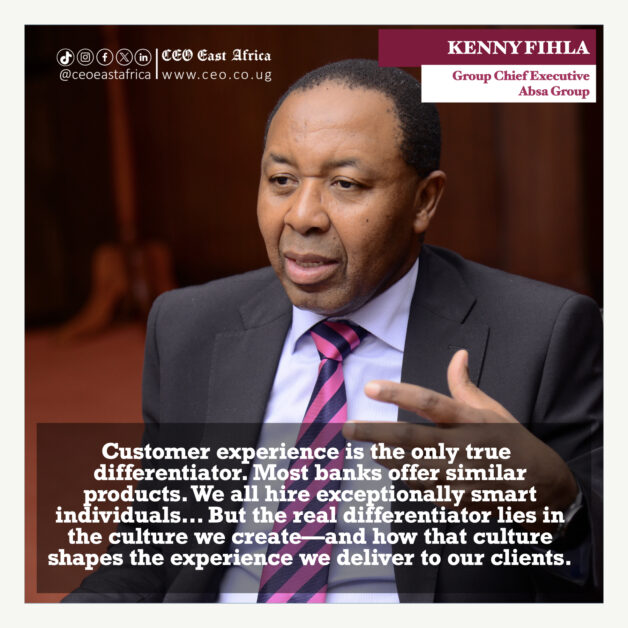
Customer experience is the only true differentiator. Most banks offer similar products. We all hire exceptionally smart individuals, and where we have gaps, we can bring in expertise from elsewhere. But the real differentiator lies in the culture we create—and how that culture shapes the experience we deliver to our clients.
So, my first strategic priority is just that: setting the tone and ensuring that the organisation is externally focused.
The second is about restoring confidence. Over time, due to some of the challenges we’ve faced at the Group level, the organisation has become more process-driven. When there’s instability in leadership, people focus more on self-preservation than on what really matters. But I’ve seen how markets like Uganda have done exceptionally well—they’ve maintained, and in some cases grown, market share by focusing on the meaningful. Imagine how much more we can achieve when the Group is stable and alignment improves.
So, the second priority is shifting the organisation from being process-driven to outcome-driven. That means building belief, instilling confidence, creating hunger to win, and reinforcing that winning depends on the experience we deliver to our clients.
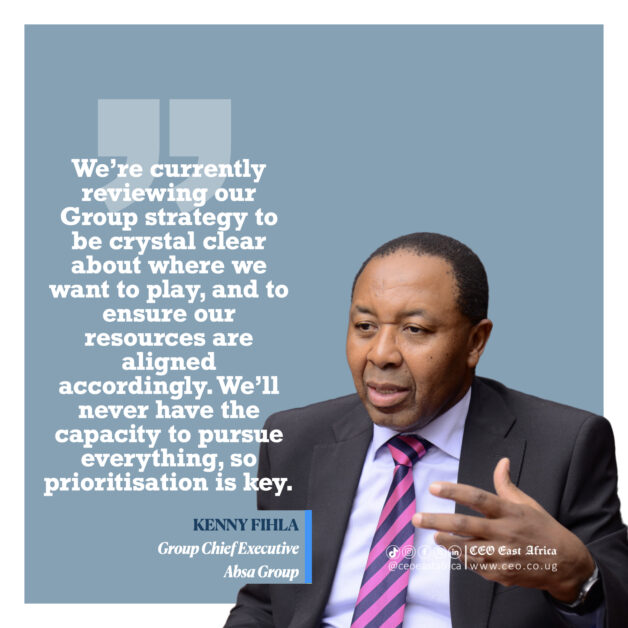
My third priority is about strategic clarity—knowing exactly which client segments and geographies we want to lead in, and if possible, dominate. We’re currently reviewing our Group strategy to be crystal clear about where we want to play, and to ensure our resources are aligned accordingly. We’ll never have the capacity to pursue everything, so prioritisation is key.
Fortunately, Uganda is one of the markets where I believe we can truly maximise impact—if we align effectively within the Group and partner well with key stakeholders, driving the local economy.
It’s clear that you’re deeply focused on delighting customers and empowering your people, and I’m sure shareholders are also an important part of that equation. But let’s zoom out to the broader idea of leading with purpose. In today’s world, organisations are expected to deliver more than just the bottom line. What is the Absa story in that regard, and how do you intend to shape and steer that conversation at the Group level?
Absa is a responsible organisation—we do business the right way, and that’s something we take very seriously. We don’t see any contradiction between creating value for our customers by transforming their experience and, at the same time, delivering value for our shareholders, our employees, and the communities where we operate.
In fact, the biggest disconnect often arises when organisations begin to believe there’s a conflict between the interests of these different stakeholders. From our perspective, there is no such conflict. What’s needed is clarity of thought—knowing how to align those interests and where to focus.
Let me give you an example: when we partner with an institution—whether it’s a government agency or a private company—on a road infrastructure project, we certainly add value by providing capital. But our responsibility doesn’t stop there. We care about how the road is constructed. Are safety standards being observed? What’s the environmental impact? Are social factors being considered? If communities are displaced, how are those negotiations handled? Is the compensation fair and appropriate?
There is no contradiction in wanting to create shareholder value while also doing things in the most responsible way. In fact, we believe every partnership we enter and every form of support we provide should leave both the individual client and the surrounding community in a better position than before Absa got involved.
So if I understand you correctly, you’re saying that when assessing large projects, Absa goes beyond just evaluating the client’s ability to repay. You also consider the broader community impact. For example, if a client plans to build a factory in a swamp, would there be cases where you decide to withhold funding based on environmental or social concerns?
We assess all of those factors. In fact, Absa has been at the forefront of advocating for ESG, and while we’re continually improving, we also recognise that it must be applied responsibly. The last thing we want is to make decisions driven solely by one objective.
Credit metrics remain critically important—if we ignore the warning signs in a credit assessment, especially around a client’s ability to repay, we could lose money. That matters. But equally important is understanding how the funds will be used. Where will they be applied? Will they be used responsibly? Are there environmental, social, or community-related risks that we need to consider?
We try to factor all of that in. Do we always get it right? Probably not. But we’re constantly working to improve—and where there are shortcomings, we actively seek to address them.
We’re also careful not to go to extremes. We don’t want to be known as a bank that rigidly prioritises one dimension—whether it’s credit, ESG, or anything else—at the expense of everything else. We always advocate for a balanced approach: supporting clients appropriately so they can deliver, while ensuring that what they deliver is done responsibly, creates value for shareholders, and uplifts the communities in which they operate.
If any one of those elements is taken to an extreme, it becomes counterproductive—because it places one objective above all others. And in the medium to long term, we believe that approach is damaging—both to the institution and to the economies in which we operate.
Given the scale of Absa’s operations across the continent and beyond, you’re inevitably exposed to global shocks—whether it’s geopolitical tensions or economic uncertainty. At the same time, you carry a responsibility to support your clients through these challenges. From where you sit, what has been—and what should be—Absa’s role in helping African economies navigate and withstand these global shocks?
We think that, in the short term, the world is an extremely difficult place to be in. At the moment, there is a lot of uncertainty—uncertainty that could materialise in all sorts of different directions—and the impact on some of our markets is unpredictable. Consequently, we worry about certainty, and we question how long the current uncertainty will persist.
Having said that, our role remains clear: to support clients, provide banking services, and ensure that we can extend credit. We also help clients manage risk from a global market perspective through the risk mitigation instruments we have—whether hedges, swaps, or other derivatives, we believe are appropriate under the circumstances.
Within the organisation, we emphasise that our focus must be on making commercial decisions based on the soundness of the deals before us, while of course being mindful of the risks we must navigate and mitigate as we structure these deals and agreements with clients.

It is not our role to enter politics or be drawn into the political fray. We are simply not in that game. We do not understand it, and it would be inappropriate for us to position ourselves there. Consequently, we make decisions purely on the commercial merits of each deal.
In the medium to long term, we believe conditions will normalise, and we are careful not to make short-term decisions that could harm the organisation’s long-term sustainability.
Still on that note—speaking from an Absa Group perspective—what are some of the issues that genuinely concern you? What’s been on your mind recently—say, the kind of thoughts that might have kept you up last night before going to sleep?
There are certainly a number of concerns, but I try to sleep like a baby by approaching things with a positive mindset. Of course, I’m exaggerating—there are nights when I don’t sleep quite as easily—but overall, I try to stay optimistic.
One of the major concerns is the impact of current geopolitical tensions. These issues worry every CEO. What does this mean for global trade? What happens to our clients who depend on access to markets that might suddenly impose tariffs? And more broadly, what’s the impact on GDP growth globally and in the specific markets where we operate? These factors affect inflation, interest rates, and overall economic momentum.
So we spend a lot of time thinking through scenarios—what’s likely to play out, how we position the organisation to navigate them, and how we prepare for both the risks and the opportunities. Ideally, it’s the more positive scenarios that materialise, but nothing is guaranteed. We must think across a range of possibilities and ensure the organisation is ready.
The second big concern is uneven economic growth across the continent. Uganda is fortunate—its GDP growth has been fairly strong—but other parts of Africa, especially the larger economies in Southern Africa like South Africa, are still struggling. Low growth makes it extremely difficult to create jobs, especially for young people. And when there’s no growth, even banks can’t thrive, because we operate as intermediaries in economies that must be active and expanding.
And third, there’s the intensifying war for talent. We’re all fishing from the same pond, and with these combined pressures—geopolitics, economic stagnation—our skilled professionals become even more vulnerable to global markets. Talent is poached more easily, and it becomes harder for banks to sustain their momentum.
So we have a responsibility to invest in the growth and development of our people, and to retain them, not just through vertical promotions, but by offering meaningful, challenging roles that expand their horizons. That’s why creating a positive internal work environment is so important. We can’t navigate these challenges unless we hold onto the most talented and experienced people in the organisation.
Speaking of talent, I’ve been curious about something. What’s Absa’s experience when it comes to managing Gen Z employees? I’ve heard all sorts of views from different CEOs—some say they’re brilliant, others say they’re crazy. But at the end of the day, they’re the future. Most of us won’t be here in 30 or 40 years, so we have to find ways to work with them and adapt to their way of doing things. What’s your take?
In many ways, I don’t think Gen Z is that different from how we were when we were younger. Just think about what our parents probably thought of us. Younger generations will always test boundaries—they tend to be more impatient, more curious, and quicker to embrace new developments like technology. That’s just the nature of things. But no one stays young forever. Eventually, they too will grow up, and the next generation will challenge them just as they are challenging us today.
As organisations, our responsibility is to create environments that are inclusive across generations. There is real strength in that kind of diversity. There’s also tremendous value in having people around who challenge the status quo—who ask, ‘Why are we doing it this way? Is there a better way?’ That questioning mindset is how institutions evolve and stay relevant.
It’s important to remember that Gen Z isn’t just our employee base—they’re also our customers, and tomorrow, they’ll be the leaders of businesses and institutions. If our internal environment doesn’t adapt to include them, we risk losing them both as talent and as clients.
Are we adapting well? In some areas, yes. In others, we still have work to do. But our mindset is clear—we welcome the fact that they are pushing boundaries. It challenges us to modernise faster, and that’s ultimately a good thing for the organisation.
You mentioned that you sleep like a baby, and I couldn’t help but smile, because with just a small team, there are nights when even I struggle to sleep. Yet here you are, leading a bank across the entire continent and beyond. How do you do it? What’s your strategy for staying organised and calm enough to switch off, put the phone down, and get a good night’s rest, knowing everything will be okay?
Well, I try to do all sorts of things. I think there are two answers to this question. The first is—what do I do personally? I force myself to do things like running. This morning, for instance, I was tired because I had already run for the last two days. So this was my third day of running this week. But I had to drag myself out of bed—because when you force yourself to do physical activity, by the time you get to 10 o’clock, you can feel your energy levels are drained, and that gives you a much better chance of falling asleep easily.
And it’s not just about running. It’s also about finding time to do other things that take your mind off work. I play golf on Saturdays, for example, and when I walk on the golf course, looking at that white ball, my mind is exclusively focused on that white ball. In fact, I don’t even carry my phone—I leave it in the car so that there’s absolutely no disturbance.
I think we have to do all of those things. My wife loves musical theatre, and so do my kids. She actually looks around for shows and things we can do. We don’t do them as often as she would like, but we do them often enough, and that helps in spending a bit of family time.
So yes, we have to force ourselves to do those things. Otherwise, it’s very easy to get completely sucked into work, where your entire frame of mind is just about work and challenges, and nothing else. But there’s a lot of good and positive stuff out there. We need to get involved in those things and learn to look at problems also as opportunities, for solutions that can be found.
The second part of your question is about the people. I’m new at Absa, but I’ve been really impressed by the quality of people I’ve found in the organisation. Of course, we’ll still inject more talent, but when you have good people around you, you don’t have to worry about every single problem yourself.
The worrying gets distributed across a wider group of people, and many of them are far more knowledgeable in specific areas than I am. They’ll come up with better answers and do so more quickly. That means even when stress enters the system, it’s short-lived, because the right people are already working on the problem.
I believe that when a leader worries about everything alone, it’s a sign they haven’t surrounded themselves with the right people. The answer lies in having good people around you, so the weight of problems gets distributed across the broader strengths of the team.
 Ruparelia Group Wins Key Entebbe Land Case, Clearing Path for the New Mega Speke Resort and Convention Centre, Entebbe
Now, speaking of your digitisation strategy, the banking landscape is clearly changing. We’re seeing a wave of fintechs coming up, and to be honest, even I sometimes move my money between the bank and telecoms so much that I’m not sure which one I use more. There are even growing concerns that, in the next five years, some telecoms might seek banking licenses—or we could see some form of convergence or mergers. So what’s your strategy in all this? What exactly is Absa’s digitisation agenda, and how do you plan to invest in technology to bring it to life?
I think there are a few key things banks must do. First, we have to modernise ourselves—move away from the old architecture and setup. Banks have traditionally existed in this format for two main reasons. One, we didn’t have the technology to do things differently. And two, banking products were historically delivered in standalone formats. If you wanted a credit card, it was processed on one system; a home loan, on another, and so on.
But with advances in technology, we can now integrate across product sets. Customer information should reside in one place, enabling seamless access to any service the bank provides. That means our IT setup and the speed at which we operate must be significantly better than before. So clearly, modernisation is not optional. At Absa, we’ve already done a lot of work to digitise our platform, ensuring that we have a single view of the customer and that customers have a single, instant view of all their interactions with the bank. No more waiting for days just to receive a statement. That’s the first non-negotiable.
Second, we must actively seek partnerships with fintechs, with big tech, because many of them have built strong competitive advantages and driven down costs. That’s the new normal. And this current normal will shift again in a few years to something even leaner. We won’t be able to reverse those cost structures. So, instead of competing head-on, we need to partner and find ways to complement what they offer, bringing our strengths into that equation.
Third, we have to expand our revenue pools by offering value-added services on top of core banking. We have an incredible customer base. Customers still trust banks, and trust is the foundation of banking. After all, why would you give your money every month to someone you don’t trust?
But as technology advances, cyber risks also increase. Banks operate under a much more stringent regulatory environment, and that gives us a responsibility to continuously upgrade our systems. Where fraud occurs and the customer is not at fault, we’re obligated to restore them to their original position. Few industries hold themselves to that standard. That kind of trust still gives banks a competitive edge, especially when it comes to deposit-taking.
And with deposits, we have the liquidity to lend. We also have access to data, which allows us to build risk products that can help clients mitigate the impact of market turbulence.
So yes, I believe banks still have room to be competitive—but we also have to accept that there are areas where we are no longer the most competitive players. In those cases, we need to evolve—migrating our models and adapting quickly.
You spoke about shifting trends and the evolving landscape of banking, especially with the impact of technology. Given your experience in the industry across the continent, when you look back at the last 10 years—and project ahead to the next 10—where do you see the biggest shifts happening? Where has the business come from, and where do you see it going in terms of how and where banking will operate?
“I believe Africa has massive growth potential. It’s a potential we’ve been talking about for the last 15 years or so—and when you look at regions like Asia, they’ve shown that this kind of transformation is possible. Unfortunately, for us, certain circumstances have prevented us from fully capturing that potential.
But now, we’re starting to see real signs of progress. Just look at the pace of infrastructure development across the continent. Even here in East Africa, it’s remarkable. Uganda, for instance, has rapidly developed infrastructure around Lake Albert, especially with the oil developments—that’s going to be transformational for the economy.
We were in Tanzania last week, and the level of infrastructure—roads, rail, and more—is also quite impressive. Kenya’s Roads Programme has delivered outstanding results. And the moment you have efficient logistics systems, the movement of goods and people becomes easier, which in turn stimulates economic growth. You can sell more, export more, and access raw materials faster. That reduces the cost of production and lowers the cost of getting goods to market.
So you can see that the opportunity we’ve long spoken about in Africa is now knocking at the door. There are clear, tangible signs that we are beginning to unlock it.
Of course, there are things we still need to get right—chief among them is maintaining stability. Investors want certainty. They want to know that the regulatory environment is predictable and that the rules won’t suddenly change in a year or two in ways that harm their returns. So we must ensure we maintain peaceful, stable economies and clear, long-term frameworks that encourage investment.
East Africa, in particular, presents a huge growth opportunity. And within that, the global energy transition creates another major opening for Africa. Access to electricity in Sub-Saharan Africa is still at around 50%, which means there’s enormous room for expansion. As people gain access to energy, consumption rises, manufacturing grows, and GDP accelerates.
We are blessed with abundant resources, whether it’s arable land or minerals that are in high global demand to support the energy transition. But this potential won’t realise itself. It requires partnerships—responsible collaboration between governments and the private sector. And it must be done in a way that ensures the benefits flow to local economies and uplift communities.
So yes, we are very optimistic about where this continent is headed. That’s why we remain committed to investing more, and why we’re constantly travelling, seeking out signs of progress, so we can shift capital to where the pace of development is strongest.
You know, in Africa, there’s this idea of the ‘big man’—and whenever the big man visits, he usually comes with a basket of goodies. So tell us, what goodies are you bringing to Uganda? What should we be excited about? I know you’ve met with the Bank of Uganda and other senior executives, so how important is Uganda in your broader strategy for the continent? And should we expect some big investments coming our way?
I’m not a big man, and I don’t have goodies, but what I do have is a message that Absa is here to stay, that we see Uganda as a growth market, and we will definitely partner with our local business, with a view of increasing the amount of capital that we allocate to projects that we think are very, very significant in unlocking the economic growth of Uganda, or accelerating the pace of economic growth in Uganda. The second was really more intended to sort of for our staff internally to say this organisation has the potential to sort of move from being number three to number two, and finally, number one. But we need to have a sense of belief that we can achieve it, and there’s no reason why we shouldn’t.
We have a decent franchise run by Amazing people. We have a group that has the capital resources with a lot of expertise that is sitting in different parts of the group, that expertise can be leveraged to the benefit of Uganda and ultimately make sure that our local subsidiary is able to partner and in a much more significant way, because it is no longer just relying on its local balance sheet and local talent; One can leverage the strength of the group effectively bring the strength of the group to bear on local projects and so on. And I think those are very powerful messages, if appropriately understood, and if people act on them,
You’ve spoken about the rise in infrastructure and the pipeline of transformational projects across Africa, many of which are funded either directly by governments or through public-private partnerships. But increasingly, we’re beginning to hear concerns—especially here in Africa—about governments turning more to banks for financing, which could crowd out the private sector from the credit market.
How do you strike a balance? On one hand, government lending often appears lower-risk and easier to support, but on the other, it’s critical to ensure that the private sector isn’t left behind. How do you see this playing out, and how does Absa approach the need to support strategic government projects while still ensuring the private sector gets adequate access to credit?
That’s something we have to manage on an ongoing basis. At Absa, we have internal processes that guide how we allocate capital, including how much of our total capital we’re willing to assign to sovereign-related exposure.
The first reason is risk management—we don’t want to be overly concentrated in a single sector. But just as important, this approach allows us to support other parts of the economy. It helps us maintain a balanced portfolio, diversify our risk, and ensure long-term sustainability.
That said, even government projects present massive opportunities for the private sector. Governments don’t build roads themselves—they contract private companies. The supporting services—whether it’s safety gear, catering for construction workers, or logistics—are also provided by private sector players. So, the knock-on effect of government-led initiatives on private enterprise is actually quite significant.
For us, the key is to always look at the entire value chain and ensure our capital is distributed across it. That’s how we help build long-term businesses that can thrive well beyond the lifecycle of any single government project. Because yes, government projects have start and end dates—but the economy must continue functioning well after that. And it’s our job—as banks, businesses, and partners—to ensure we’re looking beyond just government expenditure.”
You’re in a unique position where one decision or one signature from you can impact the lives of millions across the continent. If you found yourself in a room full of fellow executives, leaders whose decisions also have the power to shape Africa’s future, what would you tell them? What do you believe we need to do—collectively—to truly uplift this continent?
“I think it starts with attitude. One of the biggest stumbling blocks to fully unlocking Africa’s potential is our tendency to see problems as insurmountable, rather than asking: How do we solve this? What opportunities do these challenges present?
Many of the issues we face on the continent are, in fact, opportunities in disguise. Imagine what could happen if all of us—especially business leaders—chose to view challenges through that lens and devoted our energy to finding solutions. The value that could be unlocked would be massive.
We’ve seen examples around the world where companies have taken difficult local conditions, created innovative solutions, and completely transformed economies. Take M-Pesa in Kenya. At the time, financial services were underdeveloped. There were a few branches and a host of other challenges, including social unrest. But Safaricom responded by developing a simple yet powerful solution to a real problem: enabling people to send and receive money.
Today, the majority of payments in Kenya go through telcos and traditional banks, because someone chose to see a problem as an opportunity.
That’s exactly the mindset we need on this continent. We must become obsessed with finding answers to the problems Africa faces. That’s how we’ll drive meaningful change.”
Let me ask this on behalf of someone who may have just joined Absa—or any organisation—two years ago. They might be watching you speak to a town hall and wondering, What can I do to become like this man? Looking at your own career and everything you’ve been through, what advice would you give to young professionals still finding their way, those full of dreams and hopes? Based on your personal journey, what does it really take to rise to the top?
Coincidentally, we visited a branch this morning, and one of the employees there asked me this very question. My answer has always been consistent: be the best you can be in every role you’re given.
Whenever you get an opportunity, use it to put your best foot forward. And the truth is, there are plenty of opportunities—especially in an organisation like Absa. I’m always observing, always on the lookout for people who do remarkable things. Even when I’m at a petrol station, if an attendant runs to my car with a smile, that person is guaranteed a fat tip. No question about it. And if I were looking for amazing attendants, chances are I would remember that individual—their name or their energy would stick with me. I’d probably go out of my way to find them.
The same applies in banking. The people who consistently go the extra mile for clients or bring excellence to their work—those are the people who stand out. Clients remember them. And sometimes, a client will come back to the bank, not to transact, but to ask, ‘Who was that person? Can I offer them a job?’
Even within our own recruitment processes, when we’re hiring, someone will say, ‘Remember that person in the meeting? They were so prepared. They really took us seriously. They may not have had all the answers, but they were honest about it, promised to get back to us, and they actually did.’ That leaves an impression.
So my advice is this: always show up, do your best, take every opportunity seriously, and treat each interaction as a moment to stand out. Because when opportunities come up, people remember, and your name will be among those considered for the next role.
What’s your leadership philosophy—what keeps you grounded and organised? I imagine in your role, you face enormous pressure, and probably even get the occasional call from a president or two. So, how do you stay focused and guided, even under extreme pressure and influence?
“I try to think of my job as connecting the dots. That means understanding that there are other people across the organisation who are responsible for doing all sorts of important and interesting work. It’s not my role to second-guess them or to try to do their jobs. Instead, my focus should be on how I add value to the work they’re already doing.
That mindset forces me to concentrate on the few, significant things that really matter and can move the dial. It doesn’t mean I won’t go into the details if necessary, but that shouldn’t be my default approach. If I’m constantly involved in the weeds, then who is doing the CEO’s job? If I’m doing someone else’s work, I’m not doing mine.
So I always ask myself: Am I adding value here? Am I connecting the dots in a meaningful way? Am I making it easier for others to do their jobs and to deliver impact at scale?

The second part of my philosophy is something I’ve said before—surround yourself with good people. I’ve always tried to do that. I have an amazing team around me, starting with my PA, who’s basically my boss. I meet with her regularly to go through the diary, debate priorities, and align on the issues.
And beyond the PA, I have exceptional teams who support the office across different workstreams. That makes the job easier—because there are people who help you think through the tough issues and prioritise the work that truly matters.”
Alright, I think that’s all I had—just one question out of pure curiosity. As the CEO of one of Africa’s top five banks, how much money do you have in your pockets right now?
I do carry cash every now and then, but mostly just for tips and small things. Not much beyond that.
If I were a retailer dealing with customers who regularly use cash, then maybe I’d carry some. But I’m not in that business, and frankly, I don’t need to carry cash. Sure, I have a bit of cash somewhere in my room—but again, that’s mainly for tipping.
The reality is, I no longer rely on cash. And I think the market is moving in that direction, too. It might be gradual, but that’s definitely where we’re headed.
I was amazed when I visited China last year—actually, I’d been there before, but this time, the pace of transformation was striking. I was buying small gifts from roadside vendors—not with cash, but with a credit card. And even that seemed outdated. The vendor wasn’t quite sure what to do with the card—everyone there was just tapping with their phones. The world has moved on.”