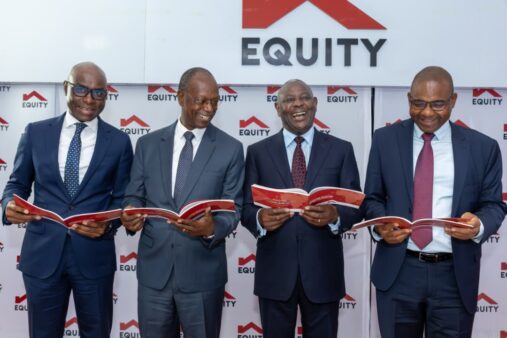
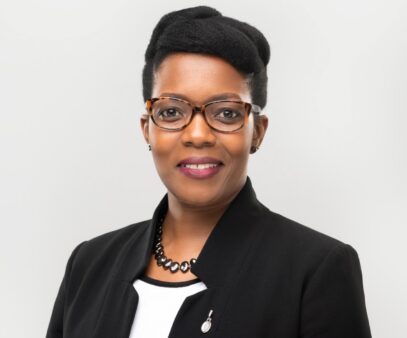
After a turbulent 2023 marked by a rare financial loss and significant executive turnover and a cautious 2024, Equity Bank Uganda is reinforcing its leadership bench with the appointment of two highly regarded executives: Claver Serumaga, who joins as Executive Director, Commercial Banking, and Catherine Psomgen, now appointed Director, Public Sector & Social Investments.
These appointments are part of Managing Director Gift Shoko’s strategic refresh aimed at restoring the robust growth trajectory the bank enjoyed between 2020 and 2022. That period saw Equity emerge as one of Uganda’s fastest-growing financial institutions before being derailed by internal control failures, rising credit risks, and talent attrition.
The appointments are pending Central Bank approvals.
Claver Serumaga to Lead Commercial Banking Turnaround
At the heart of this leadership reset is Claver Serumaga, who takes over as Executive Director, Commercial Banking. He replaces Kenneth Onyango, who was dismissed in late 2023 after being implicated in a UGX 65 billion digital lending fraud that contributed significantly to the bank’s record UGX 18.8 billion loss that year.
Claver brings over 17 years of banking experience across East Africa and is best known for his transformative leadership as Managing Director of NCBA Bank Tanzania. Under his stewardship, the bank returned to profitability, recording a net profit of TZS 25.5 billion in 2024. He also reduced non-performing loans from 18.1% to 5.5% and rolled out digital innovations such as NCBA Now, which enhanced customer experience and operational agility.
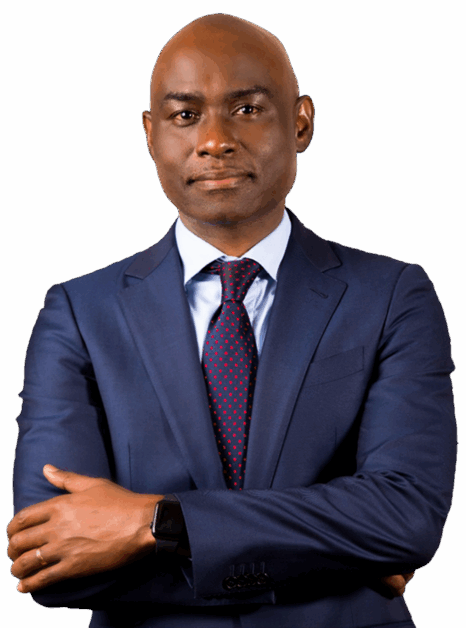
Before his time at NCBA, Claver held senior leadership roles at the Bank of Africa Group, including Deputy Managing Director at Bank of Africa Kenya and Chief Digital Officer at the Group’s Casablanca headquarters, where he oversaw digital transformation across 16 African countries. He previously served as General Manager for Business Development at Bank of Africa Uganda and as Head of Retail Banking and Marketing at Orient Bank Uganda.
Claver holds an Executive MBA from the University of Cape Town’s Graduate School of Business and is a Fellow of the Chartered Institute of Marketing (UK). At Equity Bank Uganda, he is expected to reinvigorate the commercial division, especially SME and enterprise lending, and rebuild the momentum that previously drove 63% loan growth between 2020 and 2022.
Catherine Psomgen to Deepen Public Sector and Impact Investment Engagement
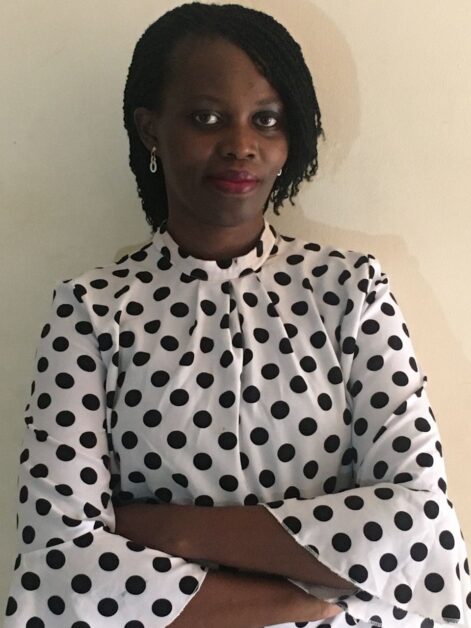
Joining Claver is Catherine Psomgen, who has been appointed Director, Public Sector & Social Investments. She replaces Elizabeth Mwerinde Kasedde, who left the bank in November 2024 to join Ecobank Uganda as Head of Commercial Banking.
Catherine brings over 20 years of experience in public sector banking and development finance. Prior to joining Equity, she served as Head of Public Sector and Development Organizations – East Africa at Standard Chartered Bank. There, she led high-impact infrastructure financing projects in aviation, roads, power transmission, and agricultural irrigation—work that required deep collaboration with governments, multilaterals, and donor agencies.
At Equity, Catherine will lead strategy and partnerships with government ministries, development finance institutions, NGOs, and ESG-aligned investors. Her role is pivotal to advancing Equity Bank’s commitments under the Africa Recovery and Resilience Plan, particularly in areas such as agriculture, health, education, social transformation, and climate finance.
Catherine holds a Bachelor of Arts in Political Science and Sociology from Makerere University and is certified in MBA Essentials. She is widely respected for her integrity, institutional knowledge, and ability to deliver sustainable finance solutions at scale.
A Strategic Reset After a Difficult 2023 and a Cautious 2024
Between 2020 and 2022, Equity Bank Uganda was among the country’s fastest-growing financial institutions. Customer deposits grew from UGX 1.62 trillion in 2020 to UGX 2.75 trillion in 2022—a 70% increase. Net loans expanded from UGX 1.26 trillion to UGX 1.63 trillion (up 63%), while total income surged from UGX 292 billion to UGX 469 billion, reflecting robust commercial activity and an expanding customer base.
This strong trajectory was interrupted in 2023. While total income rose 21.4% to UGX 569.6 billion and deposits increased by 8% to UGX 2.97 trillion, the bank recorded a UGX 18.8 billion net loss. This was largely driven by an extraordinary UGX 191.2 billion in loan loss provisions, including UGX 84 billion related to digital lending fraud, and further provisioning tied to delayed payments to government contractors.
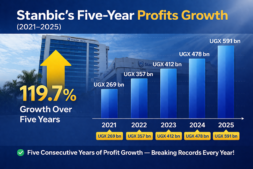 Stanbic’s Five-Year Scorecard: How Profit Growth, Deposits, Lending and Dividends Reshaped Performance
In response, 2024 was approached with caution. The bank curtailed lending and restructured credit models, leading to a 19% decline in net loans, from UGX 1.61 trillion to UGX 1.31 trillion. Deposits also fell by UGX 172 billion, down 6% to UGX 2.80 trillion, while total assets shrank by 10%, from UGX 3.75 trillion to UGX 3.39 trillion. Despite these contractions, the bank returned to profitability, reporting UGX 13.1 billion in profit before tax, backed by stronger cost discipline and improved credit control mechanisms.
The bank also brought down provisioning by over 50%, from UGX 191 billion in 2023 to UGX 88.5 billion in 2024, and improved its cost-to-income ratio, which dropped from 71.3% to 65.9%. However, the stock of non-performing loans (NPLs) remained elevated, rising to UGX 364 billion, while interest in suspense grew from UGX 38 billion to UGX 59 billion, reflecting ongoing challenges in asset quality recovery.
Despite the shrinking balance sheet, 2024 served as a vital reset year. The bank focused heavily on de-risking its loan book, streamlining credit processes, and fortifying controls across digital and unsecured channels. Strategic lending was redirected toward agriculture, education, and value-chain-linked enterprises, while financial literacy, customer segmentation, and agent banking expansion helped improve service delivery and client retention.
The appointments of Claver Serumaga and Catherine Psomgen now signal a shift—from containment to resurgence. Their leadership is expected to rebuild momentum and restore the growth engine that once powered Equity Bank Uganda into the top tier, this time underpinned by stronger governance, more disciplined credit, and sharper strategic alignment.
Reunion of Claver and Gift Shoko
The appointment of Claver Serumaga as Executive Director, Commercial Banking, marks the strategic reunion of a trusted leadership duo—Claver and Gift Shoko, now Managing Director of Equity Bank Uganda. The two previously worked closely at NCBA Group between December 2022 and October 2024, a period during which they helped steer the institution through a complex phase of post-merger consolidation and regional repositioning.
During that time, Gift Shoko served as Group Director for Regional Business (from March 2021 to October 2024), where she oversaw NCBA’s operations in East African markets including Uganda, Tanzania, and Rwanda. Claver Serumaga, appointed as Managing Director of NCBA Bank Tanzania in December 2022, was one of her key country-level partners in delivering performance turnarounds and reinforcing operational governance.
Together, they worked on de-risking lending operations, restoring profitability, launching digital platforms such as NCBA Now, and reshaping customer value propositions for the SME and enterprise banking segments. Under their combined leadership, NCBA Tanzania posted a net profit of TZS 25.5 billion in 2024, reduced its NPL ratio from 18.1% to 5.5%, and doubled shareholder equity in under two years.
Their reunion at Equity Bank Uganda comes at a critical moment, as the institution seeks to shift from recovery to accelerated growth following the setbacks of 2023. Industry observers view their return to the same executive bench not merely as a personnel move, but as a deliberate restoration of a high-trust, high-delivery partnership. With their shared background in performance execution, risk management, and digital transformation, Claver and Gift are poised to re-anchor the bank’s leadership around stability, confidence, and long-term strategic clarity.
Reigniting Purposeful Growth: Dismiss Equity Bank at Your Own Risk
With its leadership team now retooled and its foundation reset, Equity Bank Uganda is sending a clear signal—it may have stumbled, but it is far from out. The cautious recalibration of 2024, combined with the strategic appointments of Claver Serumaga and Catherine Psomgen, positions the bank not just for recovery, but for a powerful resurgence.
At the helm is Gift Shoko, who was appointed Managing Director in January 2025. Having come from outside the Ugandan market, Shoko carries none of the historical baggage that has weighed down past leadership. His detachment from internal legacy dynamics offers a strategic advantage: he brings clarity, impartiality, and boldness in implementing reforms that may have been delayed or resisted in the past.
Before Equity, Shoko served as Group Director for Regional Business at NCBA Group from March 2021 to October 2024, and prior to that, as Chief Executive Officer of Commercial Bank of Africa (Tanzania). He is widely respected across the region for his steady execution, risk management discipline, and ability to navigate post-merger integration and performance realignment across complex markets.
Now leading Equity Bank Uganda’s repositioning, Shoko is prioritising strategic sectors such as agriculture, SMEs, manufacturing, and climate finance—all aligned with both Uganda’s development blueprint and Equity Group’s Africa Recovery and Resilience Plan. The renewed focus is backed by stronger controls, governance reforms, and mission-aligned lending.
Dismiss Equity Bank at your own risk. With a fortified executive team, fresh leadership perspective, and purpose-driven agenda, the bank is positioning itself not just to grow again—but to do so with greater precision, accountability, and long-term impact.