The Ministry of Energy and Mineral Development is mandated to Establish, promote the development, Strategically Manage and Safeguard the rational and Sustainable Exploitation and Utilization of Energy and Mineral Resources for social and economic development. In pursuit of this, Energy and Mineral Development Sector has made significant progress towards the achievement of the National Development Objectives as spelt out in the National Development Plan II and in the NRM Manifesto 2016 – 2021
Commercialization of oil and gas resources is underway following conclusion of various studies and agreements and before the Final Investment Decision is taken to allow for construction of oil production and transportation infrastructure commence. The lead refinery investor was identified and the Front-End Engineering Designs are ongoing in Milan, Italy.
Over the last five years, Electricity generation capacity increased from 924.9 MW at the beginning of 2016 to 1254.2MW presently and additional 712MW from new power generation projects are under construction. Expansion of Power Transmission and Distribution Infrastructure is progressing well. The potential of generating power from solar, wind and geothermal energy resources is being promoted to diversify the energy mix and increase the proportion of renewable energy
Mineral investment promotion program has attained steady progress with an increase in various ore reserves and the airborne survey in Karamoja region.
SUSTAINABLE PETROLEUM DEVELOPMENT PROGRAM: Exploration and Investment Promotion
- Government is monitoring and supervising Petroleum Exploration activities by Oranto Petroleum Limited and Armour Energy Limited. Oranto Petroleum Limited acquired 326-line kilometres of new 2D seismic data and reprocessed 300-line kilometres of 2D seismic data, and 250 km2 of 3D seismic data of already existing data in the Ngassa Shallow and Deep Play Contract Areas. Armour Energy Limited reprocessed 450-line kilometres of 2D seismic data and commenced acquisition of 108-line kilometres of 2D Seismic data in the Kanywataba Exploration Area.
- Following the signature of various agreements for the East African Crude Oil production (EACOP), construction of infrastructure for production, processing and transportation of crude oil is now expected to commence at the end of 2021.
Geological, Geochemical and geophysical surveys: Government acquired 60 line-km of geophysical data and undertaken 300 sq. km geological and geochemical mapping of Moroto-Kadam basin bringing to a cumulative coverage of 3700Sqkms of geological and geochemical data and 680 line-kms of geophysical data amounting to 65% basin coverage.An Oil seepage was mapped and confirmed existence of a working petroleum system and a possibility of exploitable hydrocarbons.
Development of the Refinery
- Government is participating in the Front End Engineering Designs (FEED) study for the Refinery project, which is being undertaken in Milan Italy. The FEED is expected to be completed in July 2021.
- The RAP study for the Refined Products Pipeline from Hoima to Mpigi is at 95% complete
- . Cabinet approved the extension of the PFA from 24 to 41 months to enable finalisation of FEED, ESIA and sourcing of financing.
- GoU, in April 2018 entered into a Project Framework Agreement (PFA) with the Albertine Graben Refinery Consortium (AGRC) as the Lead Investor to develop a 60,000 BOPD in Kabaale, Hoima..
POWER GENERATION, TRANSMISSION AND DISTRIBUTION INFRASTRUCTURE: Electricity Generation Capacity

- Over the last five years Electricity generation capacity increased from 810MW to 1260.7MW. This was mainly from 183MW Isimba HPP, Agago Achwa II 42MW, Siti II16.5MW, Kyambura 7.6MW and Nagutu 5.9MW.
- Eleven (11) additional power generation projects are under construction with a total installed capacity of 712.4MW. These are: Karuma HPP (600MW), Nyamasagani I HPP (15MW), Nyamasagani 2 HPP (6MW) and Kikagati HPP (14MW), Achwa I (41MW), Muyembe 6.9MW, Nyagak III (5.5MW), Muzizi (44MW), Bukinda (6.5MW), Kakaka (4.6MW) and Busitema University solar (4MW).
Once completed, total installed power generation capacity in the country will be nearly 2,000MW.
- The Isimba HPP 183MW was completed ,
- Construction of the Kayunga – Kamuli Public Bridge was commissioned in January 2021.

CURRENT STATUS OF TRANSMISSION AND DISTRIBUTION NETWORK;
The transmission network expanded by 13% to cover 2,989Kms as at end of 2020. The increment is from the commissioning of the following transmission lines.
- 137km, 220kV Kawanda – Masaka transmission linne.
- 65km, 220kV Mbara – Mirama transmission line
- 226km, 220kV Nkenda (kasese) – Hoima transmission line
- 115km, 132kV Lira – Opuyo (Soroti) transmission line.
- 42km, 132kV Isimba – Bujagali transmission line; and
- 157km, 132kV Mbarara – Nkenda transmission line

Increasing Access to Electricity
- A total of 2,550Km Medium Voltage Networks, and 2,596 Km of Low Voltage Networks were added onto the grid.
- In addition, a total of 252,460 connections were achieved under the Electricity Connections Policy since it was launched in 2018.
- A total of 15,000 ready boards have also been completed for the first phase.
- Government has also commissioned electricity transmission substations with transformation capacity of 440MVA that include Queen’s way, Masaka, Mbarara North, Hoima, Iganga, Mukono, Namanve, Luzira, Kapeeka and Kawanda
Electrification of 570 out of 620 Sub-counties to accelerate access is on progress
c) PROMOTION OF RENEWABLE ENERGY SYSTEMS (SOLAR, WIND AND PICO HYDRO RESOURCES)
Over the last five years, Ministry has continued to promote the use of renewable energy technologies in the country with a view to broadening the power generation mix. This is mainly through the following projects;
 Tax Appeals Tribunal resolves 146 disputes, unlocks UGX203bn in first half of 2025/26
Biofuel Development and Promotion: Biofuel Act 2020 was gazetted in the Uganda Gazette of August 2020 and draft Biofuels Industry Regulations have been developed. The objective of the regulation is to set out the requirement for licensing the biofuel producers, and oil companies to enable blending of biofuels with petroleum products.
NAMA Biogas Project: The Ministry is implementing NAMA biogas project with the aim of generating electricity from municipal solid and liquid waste in the cities of; Mbale, Jinja, Masaka, Mbarara and Kampala City Council Authority.
Solar fruit driers were constructed and installed in Kikyusa, Luweero District to facilitate fruit drying and crop value addition. In Kasese District, construction of a Solar dryer at Nyakatonzi commenced. This dryer will be used to serve as a demo to the surrounding areas.
A total of 60 solar street lights were installed in Nagongera Town Council, Lumino Town Council, Buikwe Town Council, Rwentuha Town Council, and Mukono Municipal Council.
Solar lighting and solar mosquito killers in schools and health units were installed in; Gangmig Primary school, Barotukei Primary school, Awach Secondary School, Gotapwou Primary School, Golotwolo Primary school,Bukewa Health center III, Lwanjusi Health Center III, and Bugobero Health center.
d) NUCLEAR ENERGY DEVELOPMENT:
- .Technical and economic studies on nuclear energy development were completed.
- A National Radioactive Waste Management Strategy was drafted.
- MoU between Ministry of Energy and Mineral Development and the Russian State Atomic Energy Cooperation on Peaceful uses of Atomic Energy was signed on 19th June 2017.
- The focus of the MoU is on development of nuclear power infrastructure, education and training, nuclear and radiation safety, non-power application of atomic energy, nuclear research centers and design and construction of nuclear power plants.
- MoU between Ministry of Energy and Mineral Development and China National Nuclear Corporation on nuclear energy development was signed on 11th May 2018 in Beijing, China.
- A nuclear power roadmap was prepared and stakeholder’s consultative meeting held from 20th – 21st February, 2020
PROMOTION OF ENERGY EFFICIENCY AND CONSERVATION
Government continued to promote the efficient utilisation of energy through promotion programs which aim at ensuring sustainable utilisation of energy in all sectors of the economy;
- Development of the Energy Efficiency and Conservation Bill: The Bill and the corresponding Regulatory Impact assessment (RIA) were prepared and will be resubmitted to Cabinet for approval after the lockdown.
- Power Loss Reduction: Distribution loses stand at 16.8% from 18.6% in 2016.
- Installed Power factor correction equipmentin 45 clusters of Small and Medium Enterprises
- 30 Ugandans were trained and accredited as internationally certified energy auditors.
- 20 professionals trained as ISO 50001 Lead energy auditors. .
- Integrated the ISO 50001 Energy Management Standard for high energy consumers in their industries and facilities.
- Distributed 700,000 Light Emitting Diode (LED) bulbs for free to electricity consumers.
- Sustainable energy campaigns were held such as the annual energy week and quarterly regional campaigns across the country.
- The Energy Efficiency Roadmap of Uganda was developed in 2017.
MINERAL DEVELOPMENT PROGRAM
Tremendous progress in mineral exploration, development and value addition has been made as indicated below;
- Mining and Minerals Bill 2020; The Mining and Minerals Bill 2020 that will address key challenges and bottlenecks in the mineral sector was approved by cabinet on 12th April 2021 and it will be tabled in parliament for discussion and then forwarded to the president for signature.
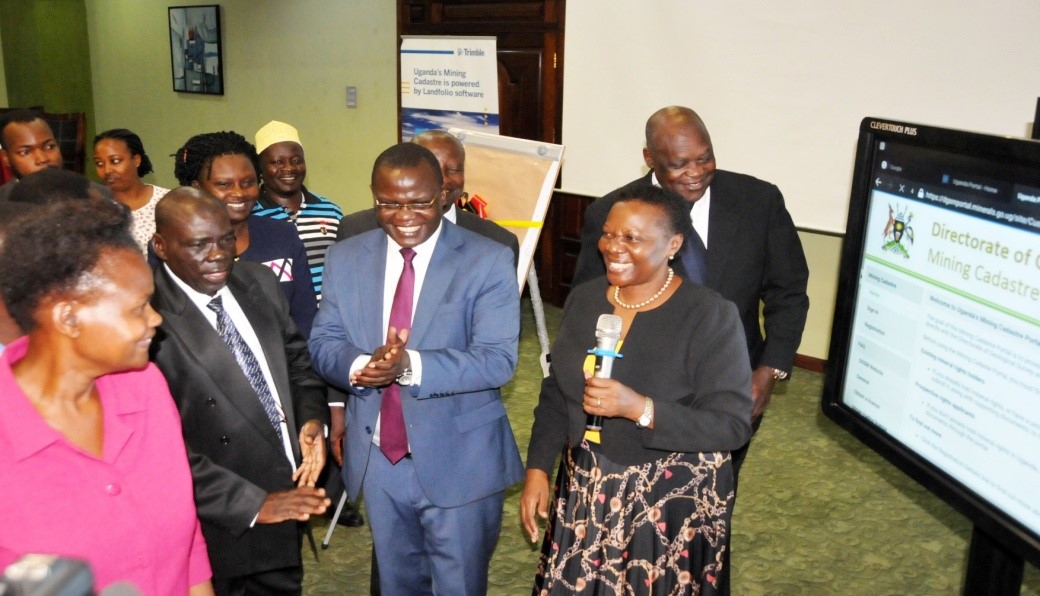
- Online Mineral Licensing System; An online mineral licensing platform which eliminates the delays of the paper-based licensing system has been developed.
- International conference on great lakes region (ICGRL) mineral certification mechanism; To regulate illegal exploitation of natural resources, Government has commenced on the drafting of Regulations that will enable implementation of ICGLR Regional Certification Mechanism.
- Mineral Investment Promotion; Government has promoted investment in its mineral resources and attracted private funding that ran successful exploration programmes. The projects are now at mine development stage. These projects are: Wagagai Gold Project in Busia; Graphite Project in Orom, Kitgum; Rare Earth Elements (REE) Project in Makuutu, Bugweri District; Jervoir Base metals in Rwenzori, Kiboga and Karuma; and Nickel Project at Akelikong, Lamwo District.
- Government of Uganda has contracted X-Calibur, a Spanish company to carry out Aerial Surveys of Karamoja Region to establish the mineral potential of the region. These commenced in March 2021.
- Establishment of the Geological and Mineral Potential of the Country; 103 million tonnes (MT) of iron ore in Kabale District and 15MT in Rubanda District have been established, bringing the total iron ore reserves in south western Uganda to 318 MT with estimated resource of up to 1billion tonnes. The iron ore in Kabale and Muko is associated with gold, Nickel, Zinc, Tin, Titanium and wolfram. Feasibility study for establishment of an integrated iron and steel plant in Uganda has been done.
- Formalisation Of Artisanal Small Scale Mining; Over 13,185 Artisanal and Small- scale Miners were registered in Mubende, Kasese, Kabarole; Ntungamo, Karamoja and Eastern Uganda. They were trained in best mining practices, environment, health and safety in mining and business skills.
- Geothermal investigations; Eight (8) Temperature Gradient Holes were drilled at Kibiro in Hoima District. The data and information will be the basis for drilling deep exploration wells. Surface studies at Panyimur, Buranga and Katwe have been completed and geothermal conceptual models developed for Panyimur and Buranga. The models will be used to locate drilling sites. Environmental and Social Impact Assessment (ESIA) is being undertaken at Panyimur and Kibiro before deep exploration drilling is undertaken.
Mineral laboratories; Government Established a functional mineral analysis laboratory at Entebbe, and New equipment (ICP-OES & Iron Chromatography) is being added.
Kilembe Mines Project; Government put in place an inter-ministerial committee to identify a private investor for the development of the mine. The process of identifying the investor under a Public-Private Partnership has commenced. Draft Expression of Interest and Request for Proposal has been prepared.
PRIORITIES FOR THE NEXT FIVE YEARS, (2021-2026)
In order to contribute effectively to the national economic recovery, the sector has identified within its policy goals the key areas of focus as follows: –
- Energy resources sub-sector: Focus will be to develop power generation, transmission and distribution infrastructure to support value addition.
- Reduce the cost of power perticularly for manufacturers to 5 cents per unit from 8.7cent
- Promotion of Renewable energy and energy efficiency will also be prioritised.
- Reducing the share of charcoal and fire wood from 85% to 50%.
- Oil and gas sub sector: Emphasis will be on construction of production, transportation and processing infrustructure
- Mineral development sub-sector: Complete the airborne geophysical survey of the Karamoja Region, put in place a modern mineral laboratory as well as mineral beneficiation centers in the country, and add value to the mineral reserves being discovered