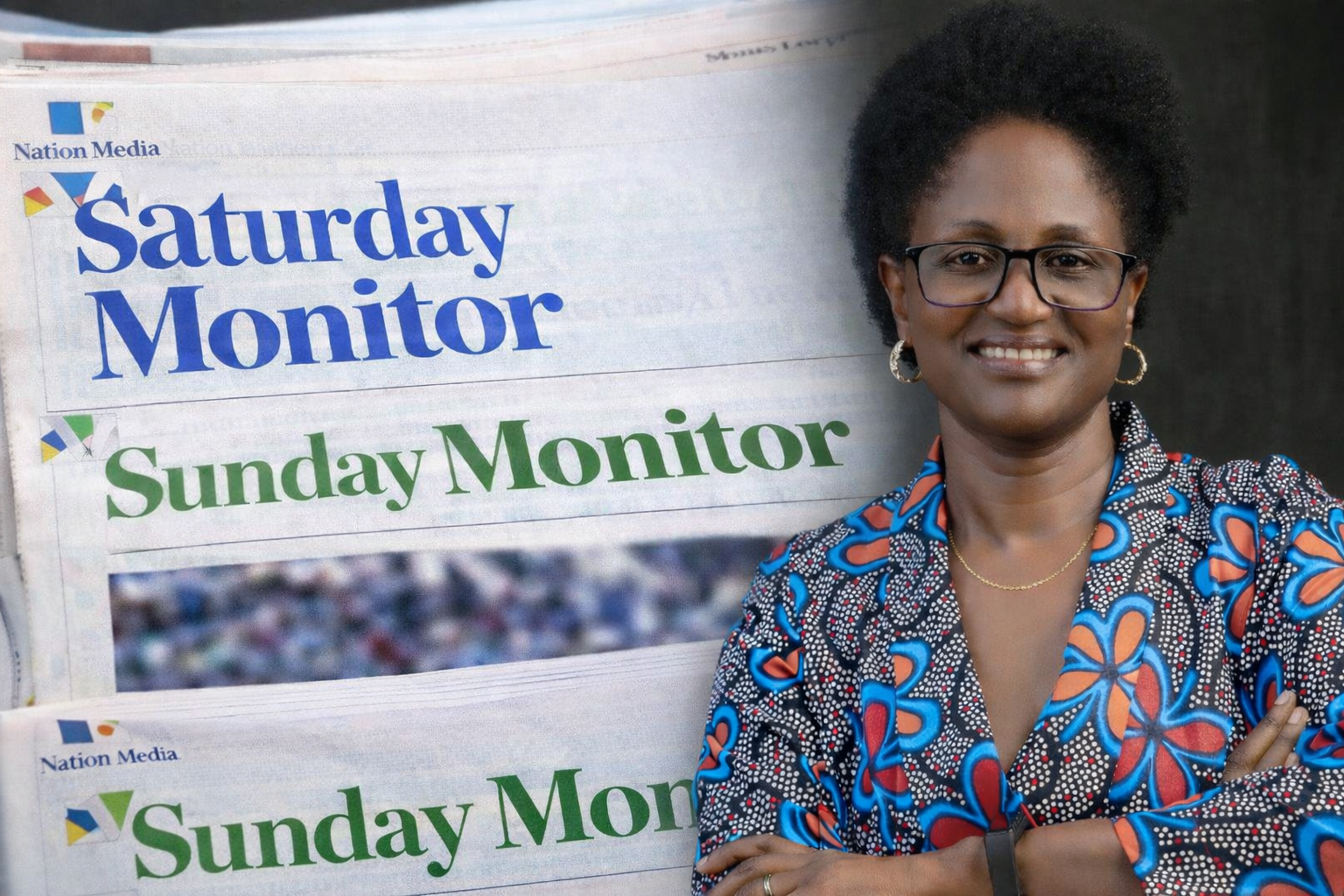
Nation Media Group has in Uganda announced that it will, effective March 7th, 2026, publish a single consolidated weekend newspaper, merging the Saturday Monitor and the Sunday Monitor into one unified Weekend Monitor edition.
With that announcement, one of Uganda’s most recognisable print identities — the Sunday Monitor, long associated with its green masthead and bold investigative culture — will cease to exist as a standalone title.
What may appear, at first glance, as a routine publishing adjustment is in fact the culmination of a decade-long economic recalibration, a political pressure cycle, and a regional corporate restructuring that has been quietly reshaping Nation Media Group (NMG) across East Africa.
This is not merely the retirement of a weekend brand. It is a strategic inflection point — both for Monitor Publications Limited in Uganda and for the wider NMG group, which has spent the last ten years navigating the most disruptive era in its history.
A Group Under Strain
To understand the Ugandan decision, one must begin at the group level.
Over the last decade, Nation Media Group has transitioned from a highly profitable market leader into a company confronting structural financial strain.
From a profit peak of over KSh 2.5 billion in 2013, earnings have steadily eroded. In 2023 and 2024, the group reported consecutive annual losses — the first back-to-back losses in more than a decade.
In 2024 alone, NMG posted a net loss of KSh 254.4 million, following a KSh 205.7 million loss in 2023.
Group turnover fell 12.5% in 2024 to KSh 6.23 billion. Revenue from the Daily Nation — historically the company’s “bread and butter” — and broadcast segments like NTV Kenya have come under sustained pressure from digital disruption, falling print circulation and weakening advertising demand.
Compounding this has been a major liquidity challenge: the Kenyan government’s failure to settle advertising debts, which reached an estimated KSh 800 million owed to NMG alone as of 2024.
At the same time, high inflation, weakened consumer spending, and sharp depreciation of the Kenyan shilling have increased operational costs, particularly for imported newsprint and fuel.
This is the environment within which Uganda’s weekend consolidation must be understood.
When a publicly listed regional media house faces consecutive losses, unpaid state advertising bills, rising input costs and declining legacy revenues, capital discipline becomes non-negotiable.
Every cost centre must justify itself. Every duplication must be questioned.
The merger of the Saturday and Sunday Monitor is part of that discipline.
The Shrinking Print Core
Even before the group losses crystallised, print erosion had become visible.
In December 2023, then Managing Director of NMG Uganda, Tony Glencross, offered a candid assessment of the business. “Over the years, our advertising revenue has shrunk,” he said.
More starkly, he revealed that “our circulation revenue has come down to about 60% of what it was.”
That statistic explains much.
When circulation revenue declines to roughly three-fifths of its historical level, the economics of print production become strained. Printing and distribution costs do not fall proportionately with circulation.
Fewer copies mean higher per-unit cost. Weekend editions — typically larger, heavier on features, and more expensive to print — become particularly vulnerable.
After COVID-19 disruptions, hard copy circulation in Uganda “recovered to about 15,000,” Glencross noted, but remained “about 4,000 copies down from pre-COVID numbers.”
The plateau suggested that pandemic disruption had accelerated a longer-term structural decline.
“The analogue product revenue has shrunk, but other revenue sources have grown, and that’s how we have been able to maintain profitability,” he explained.
Those other revenue sources included radio growth, courier services, interest income and events generating between UGX700 million and UGX1 billion annually. But diversification can only offset shrinking print for so long. Eventually, cost realignment must accompany revenue decline.
Merging two weekend print cycles into one reduces duplication in production, pagination, logistics and staffing.
It concentrates advertising inventory into a single flagship product. It streamlines distribution. In an era of thinning margins, that is rational management.
Digital First, Late but Urgent
At the group level, the restructuring has been anchored in what NMG calls its “North Star” strategy (2022–2027) — a digital-first transformation designed to reposition the company as a modern content platform.
By the end of 2024, NMG reported that 83% of its content was delivered digital-first, meaning stories are published online before print.
The group launched paywalls across markets, including the Nation. Africa platform in Kenya, and expanded subscription products such as Tanzania’s MwanaClick app.
Digital revenue grew 11% in 2024, even as overall group revenue declined. The group has set ambitious targets, including reaching USD 55 million in digital revenue by 2027.
In Uganda, Glencross admitted that digital acceleration could have begun earlier. Reflecting on his tenure, he said that if he could advise his 2014 self, he would “drive digital first.”
He acknowledged that management had initially focused on restoring profitability in the analogue business, “forgetting that we needed to develop a business for the future.”
The paywall rollout, though progressing, was still maturing. At the time of his interview, digital subscriptions were growing at around 40 per day, but “it’s not enough to achieve our North Star yet.”
The weekend merger must therefore be seen as a resource reallocation.
Capital, editorial energy and management attention cannot simultaneously sustain duplicated print operations and accelerate digital investment. Choices must be made. Consolidation in print frees oxygen for digital growth.
Cost Cutting, Bureau Closures and Workforce Restructuring
The Ugandan decision mirrors broader operational restructuring across the group.
Over the past decade, NMG has implemented multiple rounds of workforce reductions — in 2016, 2020, 2021, 2024 and again in late 2025.
In early 2026, the group announced the closure of its Mombasa regional newsroom, transitioning staff to a remote working model to cut overheads. Similar downsizing occurred in regional bureaus such as Kisumu and Eldoret.
 From Two Papers to One: The Business Math Behind the Merger of Weekend Newspapers
 In 2023, NMG impaired its printing press assets, reflecting declining utilisation as print circulation continued to contract.
The board suspended dividend payouts for the 2024 financial year to conserve cash for digital investment.
In 2023, the group launched a share buyback programme, purchasing approximately 19 million shares to address stock undervaluation and stabilise investor confidence.
These are not cosmetic adjustments. They are structural repositioning moves.
Within that context, maintaining two separate weekend print editions in Uganda becomes harder to justify. The merger aligns Uganda with the group’s cost containment trajectory.
Political Risk and Revenue Exposure
Beyond economics lies political risk.
In Uganda, the government remains a critical advertiser in print. Glencross noted that “Government… is still our biggest advertiser, by far, in the newspaper.” Yet under the current Managing Director, Susan Nsibirwa, tensions with the state have intensified.
Appearing on the Hard Questions talk show in February 2026, Nsibirwa acknowledged that being labelled “enemy media” has consequences. “That affects the revenue,” she said.
She described how bans on covering the President were delivered verbally — “It was a verbal order. It’s not written.” — creating ambiguity that “everybody then interprets… in their own way.”
Advertisers, she noted, ask: “If we advertise with you, are we going to be slapped on the hand? We don’t know.”
In such an environment, revenue volatility increases. Weekend editions, which depend heavily on advertising density, become exposed to political-commercial fluctuations.
Consolidating the weekend product reduces exposure. It simplifies the advertising proposition. It strengthens a single flagship edition rather than spreading value across two titles.
Elections as Stress Cycles
Election cycles amplify these pressures.
“In the 2021 elections, there was pressure from all sides,” Glencross recalled. Independent media houses, he said, “come under so much scrutiny by the politicians, their supporters and the government.”
After navigating that period, he remarked, “I said, I’ll have to leave before the next election.”
Elections are not merely editorial events. They are business stress cycles. Legal risk rises. Political scrutiny intensifies. Safety concerns increase. Advertising patterns shift unpredictably.
Nsibirwa captured the dual burden succinctly: “You’ve got an organisation to run, you’ve got to keep the doors open… and obviously it’s money that keeps the machine running.”
In such cycles, operational efficiency is protective. Leaner structures absorb shock better than bloated ones.
The Legacy Factor
The emotional weight of the Sunday Monitor cannot be dismissed.
It was the site of defining moments in Uganda’s media history, including the 1997 constitutional battle following a controversial headline under its green masthead.
It cultivated bold voices and investigative journalism that shaped national debate. Vendors once returned by mid-afternoon seeking additional copies after sell-outs.
Yet nostalgia does not offset imported newsprint costs. The strategic question is not whether Sunday Monitor mattered — it did — but whether maintaining it as a separate print product remains economically viable in 2026.
Veteran observers have argued that print is a format, not journalism itself.
The decline of a format does not equate to the death of the craft. In that sense, merging Saturday and Sunday editions does not extinguish the institution; it compresses it into a more sustainable configuration.
For many readers, what matters is that The Monitor endures, not the specific day on which it appears.
Crossroads for a Regional Giant
The formation of a single Weekend Monitor is best understood as a node in a wider transformation.
Nation Media Group has refreshed its leadership — appointing Geoffrey Odundo as Group CEO in 2025, overseeing board transitions and shareholder restructuring under the Aga Khan Fund for Economic Development. Governance has been recalibrated to steer a digital agenda.
The group’s strategy is clear: pivot from legacy print broadcaster to digital-first content company; diversify revenue; reduce physical overhead; invest in analytics, subscriptions and mobile-first delivery; and restore profitability.
Uganda’s weekend merger aligns with that strategy.
It signals that print will not disappear, but it will be optimised. It signals that heritage will not override economics. It signals that capital discipline now trumps ritual.
Most importantly, it reflects a recognition that survival in the current media economy requires adaptation at both local and regional levels.
The Sunday Monitor may fade from the newsstands, but the underlying brand — The Monitor — is being repositioned for endurance.
If the last decade has taught NMG anything, it is that the cost of delay in digital transition is high, that political risk can ripple into commercial instability, and that structural change cannot be postponed indefinitely.
The merger of its weekend editions is therefore not a retreat. It is a recalibration.
In a region where legacy media houses are confronting global digital disruption, rising costs and volatile state relationships, consolidation is not a sign of collapse. It is an executive decision to protect the core.
And in the boardrooms of Nairobi and Namuwongo alike, that is the calculation that now matters most.