
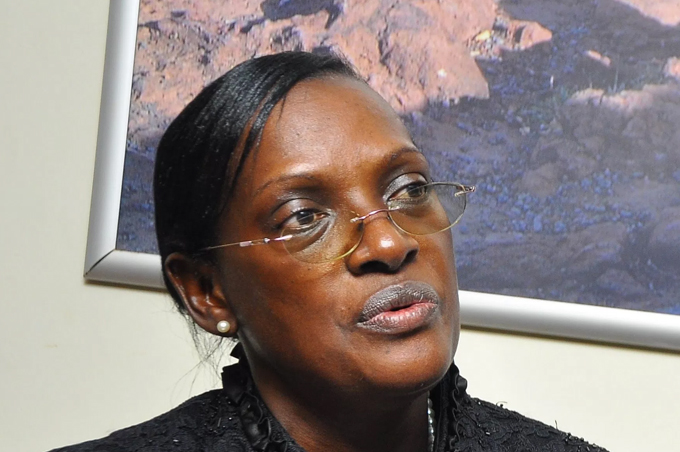
UCC’s Twinemanzi replaces Justine Bagyenda as BoU Commercial Banking Supervision boss in a shake-up believed to be linked to Bagyenda’s mishandling of Crane Bank and personal reputation issues

In the banking corridors, she was known as the iron-lady; a no-nonsense lady who understood and took her job too seriously.
She was known to blow both hot and cold–she was always there almost for every commercial bank branch opening of every bank; big and small, but away from the fanfare and merry-making that often goes with such branch openings and other milestone celebrations, inside the boardroom, she was known to ask very hard questions.
All was well, till the closure of Crane Bank in late 2016, when everyone started asking hard questions about the competence and reliability of Bank of Uganda as a supervisor, but more so, the individual role; either by commission or omission that Justine Bagyenda and her department could have had in the failure of Crane Bank and or failure to detect its alleged issues way in advance.
Bagyenda’s reputation came under further scrutiny as allegations after allegations of her unexplainable riches came to light, culminating in a number of petitions, including even to the Inspectorate of Government, to have her investigated for possible ill-gotten wealth. These accusations did not only taint Bagyenda, but, of course, dragged the reputation of the central bank into the mud and, according to pundits, her early retirement was only a question of when and not if.
According to a staff shake-up exercise announced Wednesday by the Governor Bank of Uganda, Dr Emmanuel Tumusiime-Mutebile, Bagyenda will be replaced by a one Dr Tumubweine Twinemanzi, who formerly worked as the Director for Industry Affairs and Content (Economic Affairs) at Uganda Communications Commission (UCC).
Little is know about Dr Tumubweine, but that BoU, which is known for its strict inward looking HR policy that favours own bank-grown talent especially for such senior positions, is willing to source from the outside is an indicator of how the central bank is keen on restoring confidence in the commercial banking supervision role.
Tumubweine’s job is already cut-out. He comes in a time when the financial services industry is at its lowest ebb. Today the industry is choking with bad loans- in December 2016 the industry Non-Performing Loans to gross loans reach 10.47%- the worst ever, since September 2000, when it reached 13.57%.
As a result of bad loans, banks have depressed private sector lending- according to Bank of Uganda industry lending in the 9 months to September 2017, only grew by 3.3% from Shs11.4 trillion to Shs11.8 trillion and this is largely expect to eat into industry profitability.
 Deepak Pandey Set for Comeback as CEO of Reorganised Jubilee Life Insurance
Already there indicators that industry profit margins are looking down- according to the BoU Financial Soundness Indicators Report, industry returns on assets in the nine months to September 2017, stood at 1.52%, the lowest ever, since 2000 when Bank of Uganda started recording these parameters.
She, however, leaves the industry strong with sufficient capital adequacy ratios. As per the BoU report for September 2017, average industry scores for regulatory capital to risk weighted assets and regulatory tier 1 capital to risk-weighted assets was 23.81% and 21.54%, respectively.
Regardless of the above, during her time, the banking industry drew by and large, reaching over 570 branches and 842 ATMs.
Bagyenda will also be remembered for successfully overseeing the industry raising of minimum capital requirements from Shs4 billion to Shs25 billion something that fortified the banks’ ability to withstand credit shocks that shook the industry in 2008-2011.
As a result, today, the industry has capital adequacy ratios. As per the BoU report for September 2017, average industry scores for regulatory capital to risk weighted assets was 23.81% – way above the minimum required of 10%.
During her time, she also oversaw the launch and supervision of mobile money into a behemoth operation with more than 22 million users, over 1 billion transactions, worth over Shs24 trillion annually.
