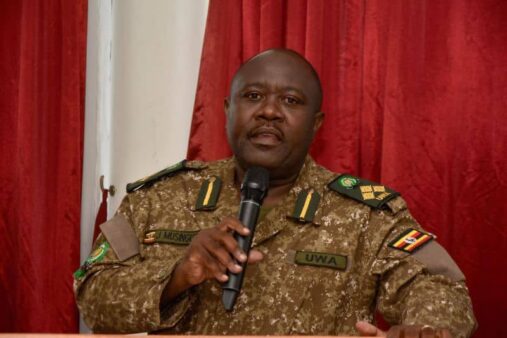
Dr James Musinguzi’s Uganda Wildlife Authority (UWA) sits at the core of Uganda’s ambition to radically scale its tourism economy.
Under the Uganda National Tourism Policy (2025), the government is targeting a fourfold expansion in tourism foreign exchange earnings, from $1.025 billion in the 2025/26 financial year to $4 billion by the 2029/30 financial year, alongside a rise in domestic tourism expenditure from UGX 3.7 trillion to UGX 5.4 trillion over the same period.
These are not incremental goals; they represent one of the most aggressive growth bets in Uganda’s medium-term economic strategy.
The centrality of UWA to this ambition is structural, not symbolic. More than 75% of Uganda’s tourism is wildlife- and nature-based, making protected areas, biodiversity conservation, and wildlife experiences the primary drivers of visitor demand, value, and length of stay.
To lift average inbound expenditure per leisure tourist from $1,550 to $2,500, and extend the average length of stay from 7.6 nights to 10 nights, Uganda must offer deeper, richer, and more reliable wildlife experiences.
That places extraordinary pressure on UWA to deliver, not just conservation outcomes, but tourism value at scale.
Yet as official records consistently show, including the Auditor General’s Report for the 12 months to June, the Uganda National Tourism Policy (2025), the Parliamentary Budget Committee Report on the National Budget Framework Paper 2026/27–2030/31, and successive Tourism Development Programme Annual Performance Reports,the operating environment Dr Musinguzi inherited is anything but forgiving.
A career conservationist steps into a national economic role
He assumed office as Executive Director of UWA in April 2025, stepping into one of the most consequential leadership roles in Uganda’s public sector.
A trained veterinarian and conservation professional, he rose through the wildlife management system rather than entering it from politics or general administration.
Before UWA, Musinguzi spent nearly two decades at the Uganda Wildlife Conservation Education Centre (UWEC), where he oversaw a steady institutional turnaround.
During his tenure, the UWEC experienced steady growth on both the visitor and revenue fronts.
Annual visitor numbers nearly doubled, rising from approximately 337,000 in 2017 to over 660,000 by 2024, while non-tax revenue increased from about UGX 3.2 billion to UGX 5.2 billion over the same period, an indication of improved commercial performance alongside expanding public engagement.
At UWEC, he demonstrated an ability to balance conservation integrity, visitor experience, and revenue growth, a combination that made his elevation to UWA appear both logical and well-timed.
But UWA is not UWEC scaled up. It is a far more complex institution, managing 10 national parks, 12 wildlife reserves, five community wildlife management areas, and 13 sanctuaries, and sitting at the intersection of ecology, public finance, community livelihoods, investor confidence, and national branding.
Wildlife under pressure: the ecological reality behind the ambition
Few challenges confronting Musinguzi illustrate the stakes more starkly than the state of Uganda’s flagship species.
Recent official wildlife population estimates paint a sobering picture of mounting ecological pressure.
Lion numbers have declined by more than 40% from their mid-2000s peak, falling from about 493 individuals to roughly 292, while elephant populations dropped by approximately 19% between the 2018/20 and 2021/23 census cycles.
Over the same period, hippopotamus numbers also fell by around 19%, and buffalo populations declined by about 14%, underscoring the scale and breadth of pressure facing several of Uganda’s flagship species.
 Tax on Used Clothes to Increase to 30%
These declines are attributed to habitat loss, human–wildlife conflict, poaching, and enforcement constraints.
While some species, notably mountain gorillas (stable at 459) and Rothschild’s giraffes (now over 2,400), show conservation success, the overall picture is one of uneven ecological stress.
For a country whose tourism proposition is built around the “Big Five + Two”, lion, leopard, rhino, elephant, buffalo, chimpanzee, and mountain gorilla, declining wildlife populations are not merely an environmental concern.
They represent a direct threat to tourism competitiveness and revenue ambition.
Governance, revenue, and trust: an institution under scrutiny
Ecological pressure is only part of the challenge.
The Auditor General’s 2025 report found that UGX 18.8 billion in concession fees remained delayed or uncollected due to weak contract enforcement, undocumented or expired concessions, and inadequate monitoring.
At the same time, UWA has been grappling with the fallout from a UGX 9.3 billion gorilla permit fraud scandal, which exposed weaknesses in internal controls and systems.
Compounding this is UWA’s growing reliance on self-generated tourism revenue to finance conservation, as direct exchequer support remains limited.
This makes conservation spending pro-cyclical, rising when tourism performs well, and tightening when shocks occur, precisely when ecological protection should be most stable.
Delayed compensation for human–wildlife conflict has further strained community trust, weakening the social compact on which conservation ultimately depends.
Why Musinguzi is firmly in the hot seat
He did not create these structural problems. Many are decades in the making. But he is now the leader expected to stabilise governance, restore confidence, reverse ecological decline, and enable tourism value growth, all at the same time.
And he must do so while working closely with other institutions, particularly Uganda Tourism Board (UTB), whose global branding and market repositioning efforts depend fundamentally on the integrity, availability, and quality of the wildlife product UWA manages.
This is the paradox of his tenure: Uganda’s tourism ambitions cannot be realised without UWA performing exceptionally well, yet UWA is being asked to deliver under conditions of tight funding, heightened scrutiny, rising ecological pressure, and elevated public expectations.
A defining phase
For Dr Musinguzi, the fanfare of appointment has passed. What remains is delivery, measured not in speeches or plans, but in restored governance discipline, recovering wildlife populations, improved community relations, and credible conservation financing.
With more than three-quarters of Uganda’s tourism anchored in wildlife and nature, the success or failure of UWA will shape not just conservation outcomes, but whether Uganda’s bold tourism growth targets prove realistic or rhetorical.
That is why Dr Musinguzi is in the hot seat, and why the next few years will define both his legacy and the future trajectory of Uganda’s tourism economy.