
As Uganda’s economy gains momentum in its post-pandemic rebound, a quiet contradiction is taking shape in the financial sector.
On the surface, there’s cause for celebration.
Mobile money volumes are hitting new highs, credit is being disbursed through phones, and digital financial services are reaching corners long ignored.
It feels like a revolution—fast, efficient, and inclusive.
But behind this progress lies a growing unease. The same technologies fueling growth are opening doors to new threats.
Cyber risks have evolved from distant worries to immediate dangers.
Fraudulent digital transactions, system outages, and data breaches are no longer anomalies but signs of deeper structural vulnerabilities.
Bank of Uganda’s March 2025 Quarterly Financial Stability Review captures this tension well.
It paints a picture of a banking sector in robust health: profitable, liquid, and well-capitalized.
Yet between the lines, the report signals a sector quietly grappling with the unintended consequences of its evolution.
The Digital Surge: Mobile money and digital credit on the rise
At the heart of this shift is mobile money, which continues to dominate as the primary platform for financial transactions.
Bank of Uganda shows active accounts have risen by 166% to 33.7 million, suggesting not just increased uptake, but growing confidence in digital channels.
Yet it’s not just about moving money; it’s increasingly about borrowing it too.
Nowhere is the digital boom more evident than in the credit space.
Digital lending has exploded, with loan disbursements more than doubling to 102.4 million in volume and UGX2.9 trillion in value.
That’s nearly triple the UGX1.04 trillion recorded just a year earlier in March 2024.
This signals a financial system evolving rapidly, leaning more on technology to drive inclusion, unlock access, and close long-standing gaps.
But as with any rapid evolution, the gains come with growing pains.
The same speed that has widened financial access has also outpaced the guardrails meant to protect it.
Cyber vulnerabilities, data breaches, and poor digital literacy are beginning to cast shadows over the progress.
While the platforms are new, old risks, such as over-indebtedness, fraud, and regulatory blind spots, are taking on new shapes.
Cyber shadows: Operational risk now front and center
Yet amid this digital leap, regulators are sounding a quiet alarm.
Bank of Uganda cautions that “operational risks remain a concern, particularly from cyber threats and system vulnerabilities.”
In a landscape once dominated by worries about credit defaults and liquidity runs, the threat matrix is shifting.
It is now on digital sabotage, fraud, and infrastructural fragility, which demands investment in stronger security protocols.
Bank of Uganda has already issued Cybersecurity Risk Guidelines and is pushing for amendments to the National Payments System Act to plug regulatory gaps.
For now, systemic risk in the payments ecosystem remains low, but not low enough to ignore.
“While past service disruptions have not endangered overall financial stability, [we] will continue to exercise vigilance,” the central bank notes.
In other words, the foundation is still steady, but the architecture above it is being stress-tested in real time.
Liquidity rebounds, bolstered by confidence and policy
Importantly, Uganda’s banking revival isn’t just being driven by digital dynamism.
The traditional fundamentals—those bedrock indicators of financial sector health—are also trending upward.
Customer deposits rose by 4% to UGX38 trillion, reversing a 2.7% dip, a quiet but powerful sign of restored confidence.
Both foreign currency deposits and shilling-denominated accounts posted gains—6.6% and 2.7%, respectively.
Deposits now account for 83.4% of total banking liabilities, up from 81.6% in December 2024.
This is a shift that reflects not just depositor trust but a stabilising financial ecosystem.
Meanwhile, banks are becoming less dependent on Bank of Uganda’s emergency liquidity window.
Usage of the Standing Lending Facility dropped from UGX3.8 trillion in April 2025 to UGX2.3 trillion.
 Inside Ramathan Ggoobi’s Plan to Raise UGX 2.3 Trillion in New Taxes and UGX 2.54 Trillion Through Enforcement
This points to improved internal liquidity management across the sector.
The ratio of liquid assets to total deposits rose slightly to 51.8%.
While the Liquidity Coverage Ratio—a key metric of a bank’s ability to weather short-term shocks—stood at a remarkable 494%.
That’s nearly five times the regulatory minimum of 100%, offering a clear signal that most Ugandan banks are becoming structurally resilient.
Credit growth rebounds, but cautiously
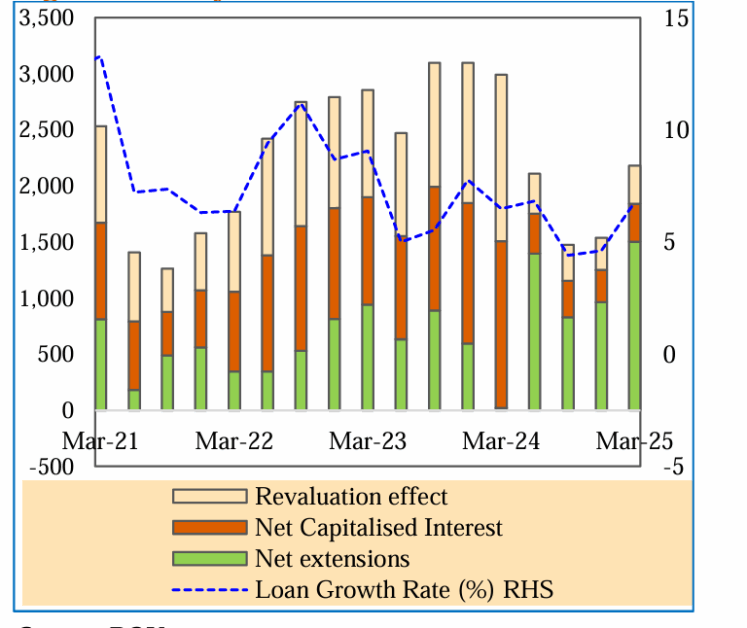
Credit growth, too, is quietly regaining momentum.
Total loans extended by Supervised Financial Institutions rose by 6.8% to UGX22.9 trillion, a modest but meaningful increase
The improvement is being partly driven by lower borrowing costs, with average lending rates easing to 17.7% from 18.3%.
Repayment behavior is also improving: loan repayment rates climbed to 28.7%, up from 25.6%, signaling healthier credit discipline among borrowers.
Beneath the aggregate numbers, however, are some striking shifts.
Credit institutions posted the sharpest lending growth, soaring 50.5% from just 13.2% previously, due to the reclassification of three Tier I banks as Tier II institutions.
Micro Deposit-taking Institutions, which had previously seen a dip, also rebounded with 8% credit growth, hinting at a renewed appetite for lending at the base of the pyramid.
Sector-specific trends also tell an interesting story.
Residential mortgage lending rose by 8.6%, while loans for land purchases surged by 14%—an indication that real estate remains a key destination for credit even amid broader economic uncertainty.
Yet this enthusiasm isn’t without risks.
Bank of Uganda has flagged several institutions for breaching the 85% Loan-to-Value ratio limit—a guardrail introduced to prevent households from becoming over-leveraged.
Asset quality and profitability strengthen
Asset quality is improving. Non-Performing Loans ratio dipped to 4.2%, down from 4.6% in March 2024, though slightly up from 3.9% in December.
More importantly, the actual stock of NPLs dropped by 14.5% to UGX954.2 billion, with the more troubling categories—substandard and doubtful loans—shrinking.
This suggests that banks aren’t just growing their loan books; they’re doing so with better risk assessment and follow-through.
Encouragingly, the outlook appears sustainable.
Expected Credit Losses, a key forward-looking metric, fell by 12.6% year-on-year, pointing to stronger borrower behavior and more disciplined underwriting across institutions.
In short, loans are being extended more prudently, and clients are repaying more reliably.
Profitability has also rebounded sharply.
The sector’s Net Profit After Tax rose by 13.8% to UGX1.7 trillion, up from UGX1.5 trillion a year earlier.
The growth was driven by an 8.2% rise in interest income and a nearly 20% reduction in provisions for bad debts, a double win for banks.
Operational metrics are improving too.
Return on Assets ticked up to 3.2%, and the cost-to-income ratio tightened to 71.3% from 73.7%, signaling that banks are spending less to earn more.
Capital adequacy and market stability hold strong
Beyond profitability, banks are proving structurally sound and well-capitalized.
The Core Capital Adequacy Ratio for commercial banks stood at 25.4%—more than double the 12.5% prudential minimum.
This capital cushion gives banks room to absorb shocks without destabilizing the system.
While two institutions are still working toward meeting the revised minimum capital threshold of UGX150 billion for Tier I banks, both are on approved recovery plans and closely monitored by the regulator.
Even market concentration—often a source of systemic fragility—remains comfortably low.
The Herfindahl-Hirschman Index, which measures asset concentration, edged up slightly to 940.4, well below the 1,500 threshold that would signal concern.
Meanwhile, the top five Domestic Systemically Important Banks control 49.9% of total banking assets, but regulators affirm that they remain “adequately capitalized to absorb potential shocks.”
Together, these indicators suggest that Uganda’s banking sector is not only riding the digital wave but doing so from a position of strength.
The fundamentals are firm, the risks increasingly understood, and the regulatory architecture responsive.
The challenge now lies in sustaining this momentum, without losing sight of the emerging risks that come with innovation, speed, and scale.