Rwanda is set to commence the construction of its ambitious Kigali Innovation City (KIC) in September 2024 after key details regarding the project’s financing were agreed upon on the sidelines of the Africa Development Bank (AfDB) Annual Meeting in Nairobi, Kenya.
The $300m project was agreed upon by Rwanda’s Finance and Economic Planning Minister Uziel Ndagijimana and the Africa50 CEO Alain Ebobisse. Africa50, the continental infrastructural financier of which Rwanda is a member, will make its biggest investment in this project and will be joined by the Arab Bank for Economic Development (Badea).
Badea will fund the construction of the shared infrastructure in the facility and the first and subsequent buildings but the total sum of their investment still needs to be discovered.
The Kigali Innovation City project has been in the works for over two decades. Long negotiations and financing have slowed down any progress in the past. The project was supposed to be one of the centre-pieces of Rwanda’s Vision 2020 launched in 2000.
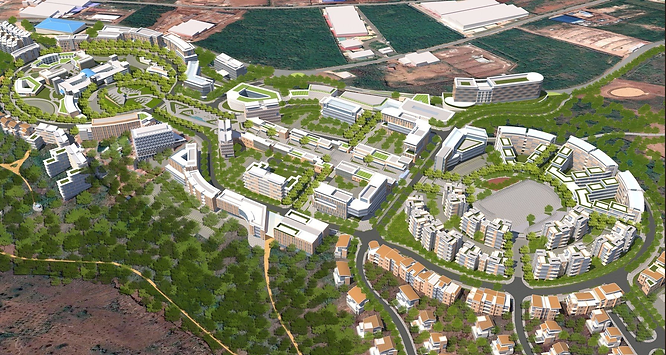
Kigali Innovation City (KIC) is an innovation hub in Rwanda’s Special Economic Zone. The 61-hectare site will integrate university campuses, office spaces, research facilities, hotels, retail spaces, student housing and residential accommodation, all of which will be designed with green and sustainable features.
The KIC project is expected to create over 50,000 jobs, generate $150 million in ICT exports annually and attract over $300 million in foreign direct investment. The city will be home to four universities, including Carnegie Mellon University Africa, the University of Rwanda and Africa Leadership University. The universities will provide a pool of tech talent for the ecosystem.
 Nicholas Mukasa Appointed Bank of Namibia Deputy Governor
Dr Ndagijimana added that the project will “contribute greatly to our strategy to promote digital technologies to contribute to our ambitions to build a knowledge-based economy”.
KIC will become one of the 24 projects in 28 countries in Africa that Africaa50 has been financing since its establishment in 2017.
Several African countries are developing innovation cities and hubs to foster technological advancement and entrepreneurship. Examples include Kenya’s Konza Techno City, a $14.5 billion project, Nigeria’s Eco City, a $2 billion project, and South Africa’s Silicon Savannah. These cities aim to provide infrastructure, resources, and support for startups, tech companies, and research institutions.
Additionally, other notable innovation hubs include the African Institute of Mathematical Sciences in Senegal, Garden City Business Park in Ghana, a $500 million project, and Naspers/Prosus HQ in South Africa, a $100 million project. These innovation cities and hubs are poised to drive innovation and economic growth in the continent, positioning Africa as a competitive player in the global tech landscape. They will also provide opportunities for skills development, job creation, and innovation in various sectors.