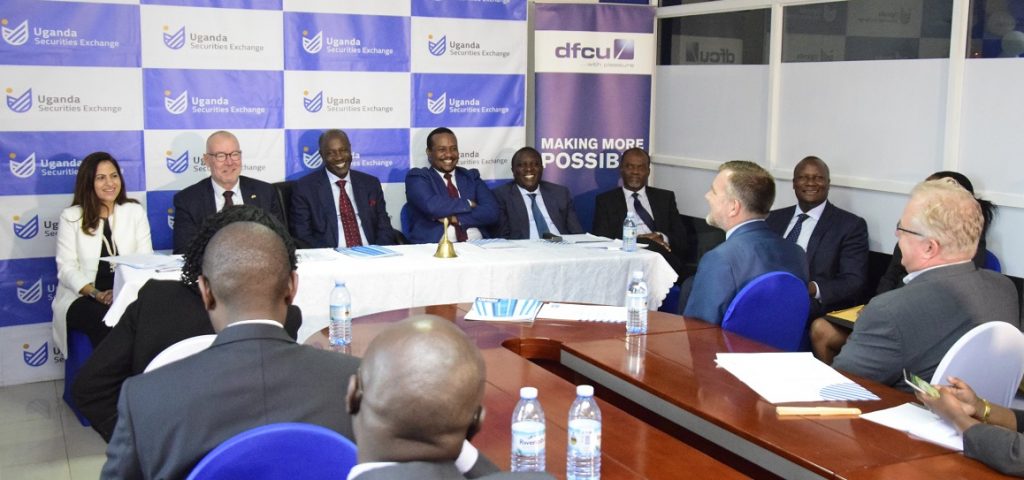
dfcu Bank has confirmed that IFU – the Danish Development Finance Institution has acquired the 9.97% shareholding held by CDC Group Plc in dfcu Bank, Uganda’s 4th largest bank, by assets as at End of December 2018.
In announcement in the dailies today, by Ligomarc the bank’s secretary, dfcu confirmed that CDC “has sold all the 74,580,276 shares it held in dfcu to the Investment Fund for Developing Countries (IFU), a Development Finance Institution owned by the Danish Government”.
According to a source at the Uganda Securities Exchange (USE), IFU reportedly paid UGX645 per share, meaning they paid UGX48.1 billion for the 74,580,276 shares. The deal values dfcu at UGX482.5 billion.
Two days ago, CEO East Africa Magazine exclusively broke the story of an impending sell to IFU, but all officials were tight lipped, over the matter pending approval from Bank of Uganda.
IFU who is now the second biggest shareholder, now joins Arise B.V (58.7%), National Social Security Fund (NSSF) of Uganda (7.46%) and Kimberlite Frontier Africa Naster Fund that holds 7.35% to the table of the major shareholders.
However, CDC Group Plc which is wholly owned by the UK Government had in June 2018 indicated that it was “undertaking a review of its investment in dfcu Limited which may lead to the disposal of some or all of its shares in dfcu over the short to medium term.”
If CDC had sold at the time, when dfcu shares stood at UGX970, they stood to make UGX72.3 billion.
There has been a general share price decline on the USE. According to a Uganda Securities Exchange (USE) report seen by this reporter, there was a 12.6% decline in the volume of shares traded- from 674,594,177 shares in 2017 compared to 589,579,887 shares in 2018. Turnover too reduced by 53.24% from UGX95.6 billion to UGX44.7bn while the number of trade deals also went down by 52% from 12,652 to 6,072
2019 doesn’t look significantly better either- although it is set to be better than 2018. Turnover, as of September 2019 stood at UGX40.9bn- 5.1% above the UGX38.9bn in the same period in 2018. The number of deals however went down by 18.3%- from 4,791 deals to 3914.
The highest turnover recorded at USE in the last seven years was UGX466.4bn in 2014
Stronger dfcu Bank

In a statement, CDC’s Chief Executive, Nick O’Donohoe said: “Our partnership with DFCU has perfectly demonstrated our credentials as a provider of patient capital. And I am delighted that in IFU, we are passing the baton to a like-minded investor that, alongside Arise, the largest existing shareholder in DFCU, will be as equally committed to DFCU’s long-term stability and success.”
“DFCU is now a stalwart of the Ugandan economy so we felt it was the appropriate time to deploy our capital elsewhere. Uganda is an incredibly important country for CDC and we look forward to the opportunity to reinvest the proceeds from the sale of our DFCU stake into other businesses here.”
IFU ́s Chief Executive Officer, Torben Huss said: “IFU is pleased to become a shareholder in DFCU as we share the ambition to expand access to financial services, which will lead to productive investments, the creation of decent jobs and improve people’s welfare. Moreover, we see this acquisition as a strategic step to increase our engagement in the private sector in Uganda and further promote the Sustainable Development Goals.
 Equity Group Posts Record 55% Surge in Profit to KSh75.5b: Uganda Bounces Back With 500% Growth in Net Profit - A Defining First Year for MD Gift Shoko
Elly Karuhanga, the Board Chairman of dfcu Limited said: “dfcu has made a significant contribution to the economic development and transformation of Uganda, over the last 55 years because of among others – our strong shareholders. With IFU as one of the shareholders, we are confident that dfcu is well on track to achieving its vision of being the preferred financial institution in Uganda. We take this opportunity to express our deep appreciation to CDC who have walked this journey with us since 1964. Their commitment and support over the last 55 years has enabled us to make real tangible progress towards the achievement of our vision. We look forward to continued collaboration with CDC in other areas in the future.”
Speaking on behalf of CDC this morning at a press conference held at the Uganda Securities Exchange (USE) Seema Dhanani, the CDC Head of Office & Coverage Director, Kenya said that CDC has been a committed supporter of Uganda’s private sector and will remain so after its exit from dfcu.

“CDC is actively looking for new investment opportunities in the country to build upon its US$120 million portfolio of 35 businesses. Those business backed by CDC’s capital – include Bujagali Hydropower,” she said.
CDC, through Actis which initially owned 60.08% of dfcu Bank in 2013 first sold off 27.54% and 17.54% to Rabobank from the Netherlands and The Norwegian Fund for Developing Countries (NORFUND) respectively for a total consideration of $42 million (then UGX111.9bn). While Rabo Bank was buying into dfcu for the first time- Norfund was buying to increase its stake to 27.54 percent.
Late 2016, Norfund, Rabobank and FMO- the Dutch Development Bank formed Arise B.V a partnership to manage all their investments in various African countries. Arise thus became the majority shareholder in dfcu Bank with 55.08%.
RaboBank owns 25% of Arise B.V while Norfund owns 48% and Dutch Development Bank- FMO 27%.
After a rights issue, which concluded on 25 September 2017 resulting in more than UGX 190.8 billion before expenses being raised, CDC opted not to exercise their rights, therefore further reducing their holding from 15% to 9.97%.
Arise increased their shareholding from 55.08% to 58.71% while NSSF increased from 6.28% to 7.69%.
About the Danish Development Finance Institution
The Danish Development Finance Institution? – was founded in 1967 as a self-governing fund established by the Danish government. It joined the Association of bilateral European Development Finance Institutions (EDFI) in 1992. The Minister of Foreign Affairs appoints the board of IFU and the CEO. IFU’s objective is to promote economic activity in developing countries in collaboration with Danish trade and industry. Danish investors, a Danish interest in project or a DFI investor is required for IFU’s participation.
As at end of 2018, it held a portfolio of Euros 779 million in 203 projects across the world. 22% of its investments are in financial services, 14% in infrastructure projects other than power. 9% was specifically held in power infrastructure and another 9% in industry and manufacturing. Only 5% of investments as at end of 2018 were held in Sub-Saharan Africa