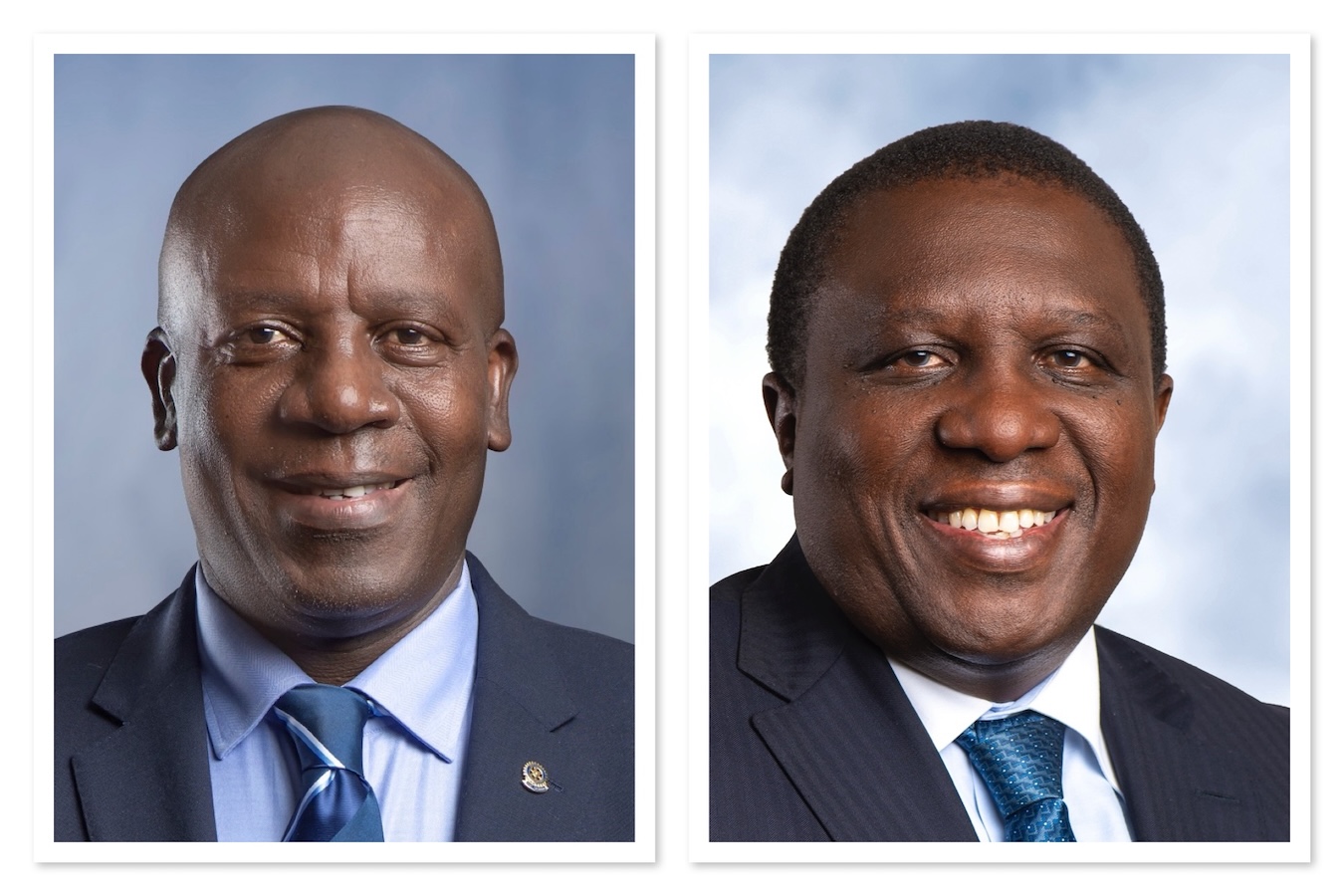
dfcu Bank has this morning released its full-year 2025 financial results, delivering a third consecutive year of recovery and growth under Chief Executive Officer Charles Mudiwa, with net profit rising to UGX 81.5 billion from UGX 75.1 billion in 2024.
But beyond the headline profit figure, the results tell a far more compelling story.
For the first time in nearly a decade, dfcu is now recording three straight years of consistent, consecutive growth across all its core banking fundamentals—customer deposits, lending, total income, and assets—marking a decisive break from the instability and uneven performance that defined the period between 2018 and 2023.
Three years after Mudiwa took over the reins in April 2023, the bank appears to have moved from recovery to rhythm—transitioning from a phase of stabilisation and repair into one of structured, broad-based growth.
A Third Year of Broad-Based Growth
The 2025 results confirm that dfcu’s turnaround is no longer transitional—it is deeply rooted.
Customer deposits grew by 15% to UGX 2.7 trillion, signalling renewed depositor confidence and a stronger liquidity position. The loan book expanded by 12% to UGX 1.3 trillion, reflecting a cautious but deliberate return to credit growth after two years of disciplined restraint. Total income rose by 16% to UGX 526 billion, supported by a 20% increase in non-funded income, while total assets climbed to UGX 3.7 trillion.
This alignment across all major banking metrics is significant.
It represents the first sustained period in recent years where dfcu is not relying on isolated gains or one-off improvements, but instead delivering synchronised growth across its balance sheet and income statement—a hallmark of a bank that has regained operational stability and strategic clarity.
As Mudiwa explains, this performance is not accidental: “These results are the outcome of a deliberate and phased transformation. The Bank first refocused to stabilise performance and restore control, and reorganised to strengthen leadership, rebuild governance, and address structural inefficiencies… These actions restored credibility, improved resilience, and created the conditions for the growth that is now evident in the business.”
The Anatomy of a Turnaround
To fully appreciate dfcu’s current trajectory, one must go back to 2023—the year Mudiwa took charge.
Rather than pursuing aggressive expansion, Mudiwa’s first year was defined by restraint and recalibration.
Lending was deliberately scaled back, the balance sheet tightened, and the bank undertook a strategic reset under the “Fired-Up” transformation agenda. Leadership was reorganised, governance structures strengthened, and operational inefficiencies addressed.
| 2018 | 2019 | 2020 | 2021 | 2022 | 2023 | 2024 | 2025 | 2025 Growth (UGX billions) | 2025 Growth (%) | |
| Customer Deposits (UGX billions) | 1,979.0 | 2,039.0 | 2,595.3 | 2,282.2 | 2,410.6 | 2,318.6 | 2,356.3 | 2,714.6 | 358.3 | 15.2% |
| Loans & Advances (UGX billions) | 1,398.2 | 1,539.3 | 1,775.3 | 1,508.4 | 1,361.4 | 1,125.8 | 1,132.2 | 1,265.8 | 133.6 | 11.8% |
| Assets (UGX billions) | 2,888.3 | 2,958.1 | 3,498.6 | 3,177.6 | 3,282.7 | 3,204.0 | 3,468.3 | 3,743.8 | 275.5 | 7.9% |
| Total Income (UGX billions) | 410.3 | 416.8 | 414.7 | 450.1 | 431.7 | 449.2 | 455.4 | 526.3 | 70.9 | 15.6% |
| Net Profit (UGX billions) | 61.7 | 73.4 | 24.1 | 13.2 | 30.6 | 34.0 | 75.1 | 81.6 | 6.5 | 8.7% |
With the groundwork laid, 2024 marked a sharp rebound.
Net profit more than doubled to UGX 75.1 billion in 2024, up from UGX 34.0 billion in 2023—a 120.9% surge that marked the bank’s strongest earnings rebound in years. This performance was underpinned by a decisive clean-up of the credit book, with loan impairments swinging dramatically from UGX 82.7 billion in 2023 to a net recovery of UGX 12 billion in 2024. At the same time, the non-performing loan (NPL) ratio fell sharply from 9.2% to 4.4%, signalling a significant improvement in asset quality and risk management discipline.
The balance sheet was also strategically repositioned, with increased allocation to low-risk, high-yield government securities, which rose by over 35% to UGX 1.31 trillion—supporting more stable interest income and improved liquidity management.
Yet even at this stage, growth remained deliberately cautious.
Net loans and advances were held flat at approximately UGX 1.13 trillion in both 2023 and 2024, reflecting management’s conscious decision to prioritise credit quality over rapid expansion. Instead of chasing volume, the bank focused on selective lending—particularly within the SME segment—while strengthening underwriting standards and aggressively recovering legacy non-performing assets.
The priority was clear: fix the engine before accelerating.
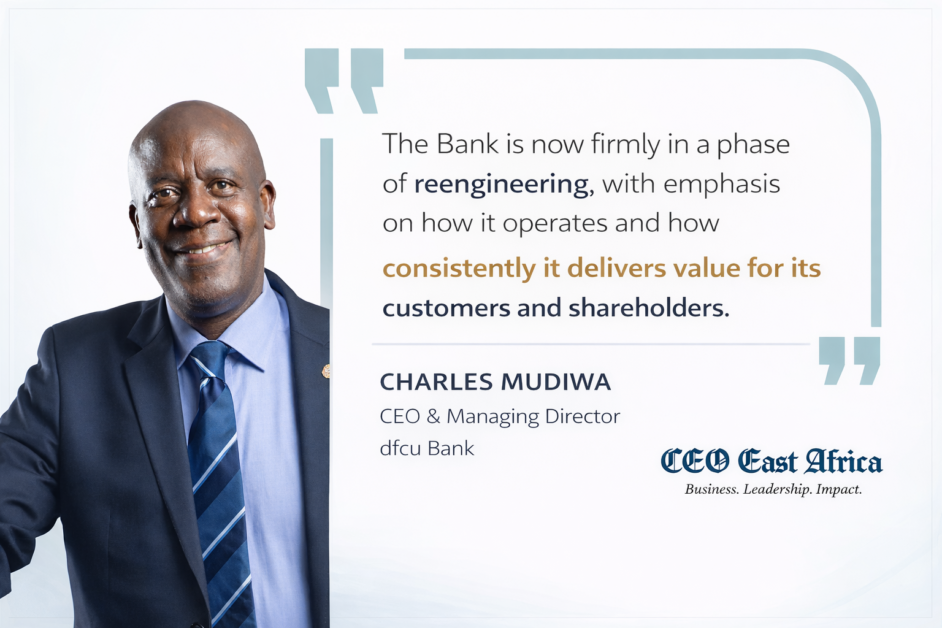
By 2025, dfcu has entered what Mudiwa describes as a new phase: “The Bank is now firmly in a phase of Reengineering, with emphasis on how it operates and how consistently it delivers value for its customers and shareholders.”
This phase is underpinned by four strategic pillars, including a deliberate focus on sector specialisation, accelerated digital transformation, a renewed emphasis on customer experience, and enhanced operational productivity. Together, these are reshaping how the bank competes, serves customers, and generates value.
From Defensive to Balanced Growth
One of the clearest signals of dfcu’s transition is the return of loan growth.
After two years of deliberate restraint, loans and advances grew by 11.8% in 2025, rising from UGX 1.13 trillion in 2024 to UGX 1.27 trillion. This reflects renewed confidence in both the bank’s credit processes and the broader economic environment.
 NCBA Posts 7% Profit Growth, Unveils Ambitious Five-Year Plan
At the same time, deposit growth outpaced lending, increasing by 15% from UGX 2.36 trillion in 2024 to UGX 2.71 trillion in 2025, strengthening liquidity and providing a stable funding base.
This balance is critical.
It suggests that dfcu is no longer in defensive mode—focused solely on risk containment—but is now pursuing measured, sustainable expansion, anchored in prudent risk management.
Income Growth and Diversification
The bank’s income performance further reinforces this shift.
Total income grew by 16% from UGX 455.4 billion in 2024 to UGX 526.3 billion in 2025, supported by strong growth across multiple income lines. Interest income from loans and advances rose to over UGX 223 billion, up from approximately UGX 193 billion, reflecting the recovery in lending activity. Income from government securities remained a significant and stable contributor at UGX 182.5 billion, underlining the bank’s continued benefit from its treasury positioning.
Non-funded income also recorded strong growth, rising by 20% to UGX 108 billion, driven by increased transaction volumes and improved customer engagement across digital and physical channels. In addition, foreign exchange and trading income nearly doubled from UGX 23.7 billion to UGX 43.7 billion, signalling higher market activity and improved treasury performance.
This diversification reflects a bank that is no longer reliant on a single income stream but is building a more resilient and balanced revenue model.
The Bigger Picture: From Instability to Consistency
For much of the period between 2018 and 2023, dfcu’s performance was characterised by volatility.
Profitability fluctuated, lending contracted, deposits were uneven, and the bank steadily lost ground in key market rankings. For shareholders, this translated into inconsistent returns, muted earnings growth, and limited visibility on long-term value creation.
What the 2025 results now show is a clear break from that cycle.
dfcu is no longer reacting to past challenges—it is operating with a clear strategy, disciplined execution, and improving momentum. This shift is increasingly being reflected not just in operational performance, but in shareholder returns. Earnings per share rose to UGX 100.2 in 2025, up from UGX 96.4 in 2024, while the Board proposed an increased dividend of UGX 21.8 per share, up from UGX 20.1 the previous year—signalling renewed confidence in the bank’s earnings quality and future outlook.
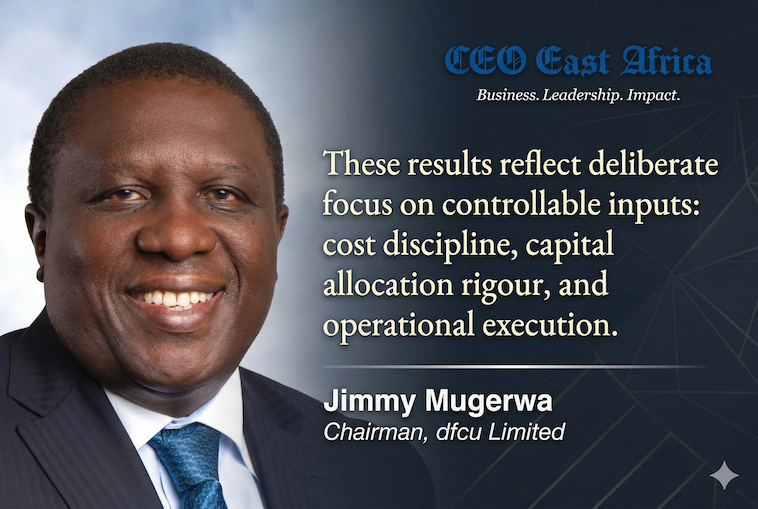
As the Group Chairman Jimmy Mugerwa noted, the performance reflects:
“deliberate focus on controllable inputs: cost discipline, capital allocation rigour, and operational execution.”
Importantly, this disciplined approach is now translating into a more predictable and sustainable return profile for shareholders—marking a shift from recovery-driven performance to long-term value creation.
The Road Ahead: From Growth to Scale
While the progress is significant, Mudiwa is clear that the journey is far from complete.
The bank is now positioning itself for the next phase—scaling growth, deepening sector focus, and leveraging technology to expand reach and efficiency. But even as dfcu returns to growth, one structural reality remains: the balance sheet is still heavily anchored in government securities, which have provided stability, liquidity, and predictable returns through the turnaround phase.
That strategy has served its purpose.
However, with most of the foundational gaps now addressed—credit quality restored, capital strengthened, and operational discipline embedded—the next test for Mudiwa will be to fully unlock the bank’s balance sheet toward private sector lending, where capital is needed most to drive economic activity, enterprise growth, and job creation.
This will require a careful balance.
The bank must expand lending without eroding the hard-won gains in asset quality, even as it seeks to grow its market share and relevance in key sectors such as agriculture, manufacturing, trade, and SMEs. In essence, dfcu must now transition from a low-risk, treasury-led growth model to a more assertive, yet disciplined, intermediation role within the economy.