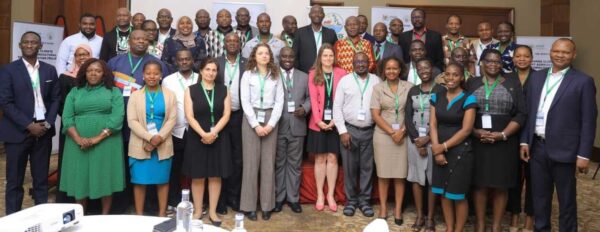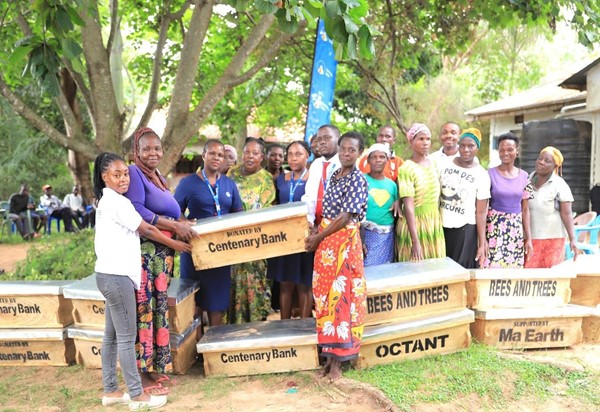
Centenary Bank and Bees and Trees Uganda launched the Coffee Agroforestry for Environment and Livelihood Enhancement initiative, aimed at restoring degraded land, promoting environmental conservation, improving livelihoods, and strengthening financial inclusion.
The initiative aims to tackle the challenges of environmental degradation and rural poverty by blending tree planting, coffee farming and beekeeping as a pathway to restoring degraded land while creating new income opportunities for rural households.
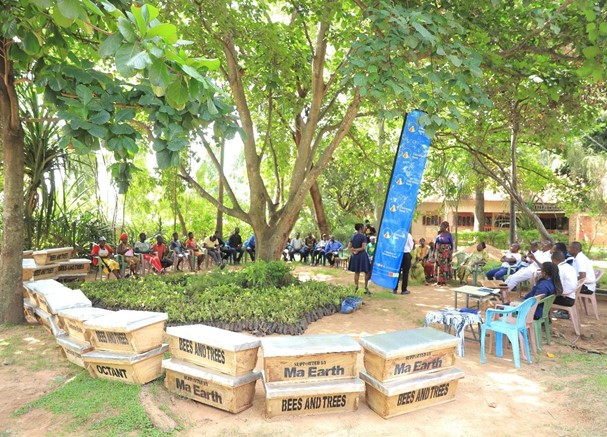
The partnership that was officially launched in Wokukiri village, Mbale district is bringing together farmers, women’s groups, youth leaders, local officials and bank staff to participate in tree planting, financial education and hands-on training in coffee agroforestry and sustainable beekeeping.
As a part of the initiative, Centenary Bank has so far contributed UGX 27 million to fund the planting of more than 6,000 coffee seedlings and 3,000 indigenous trees in Wokukiri. Additionally, the bank has provided 80 modern Kenya Top Bar (KTB) beehives to youth and women’s groups in the village, who received not only seedlings and hives, but also practical training in coffee agroforestry, sustainable beekeeping and financial management.
The farmers of Wokukiri village, like many across Uganda, depend heavily on smallholder agriculture. Mbale district, known for its hilly terrain and coffee-growing heritage, has seen vast areas of land degraded due to unsustainable farming practices and population pressures.
By integrating coffee, trees and bees into their farms, the project offers them not just a chance to heal the land but also to secure reliable incomes. Coffee provides a cash crop, trees improve soil fertility and micro climates and the bees enhance pollination while producing honey for sale.
Bees and Trees Uganda, a youth-led social enterprise has long championed the integration of beekeeping and agroforestry on small farms. Their model focuses on farmers diversifying their incomes by producing crops and honey while also restoring tree cover and building resilience to climate change.
“Our farmers are able to earn from crops and apiary at the same time,” Connie Olives, the Finance Manager of Bees and Trees Uganda said adding, “By planting trees, we increase resilience against climate change while boosting tree cover in degraded landscapes.”
Stephen Bright Sakwa, co-founder of Bees & Trees, also announced plans to further incentivize farmers to care for trees through the creation and sale of EcoCerts. Through this initiative, individuals around the world can contribute financially to long-term tree stewardship. Farmers will receive quarterly payments, with compensation linked to the number of trees that survive on their farms.
Centenary Bank’s role went beyond funding. As part of its broader commitment to inclusive growth, the bank mobilized its staff to participate in the field activities, interact with the community and deliver financial literacy training. Over 50 community members were introduced to formal banking for the first time, equipping them with the knowledge to save, responsible borrowing and the range of products that the bank offers to support smallholder farmers.
 Movit Attains UN Global Compact Sustainability Certification, Strengthening Responsible Growth Agenda
Looking ahead, the long-term impacts of the project are expected to be wide-ranging. Environmentally, the more than 9,000 plants, both coffee and trees will contribute to land restoration in Wokukiri village, reversing years of soil degradation. The beehives will boost pollination, improve yields of crops across the area while supporting biodiversity.
Economically, the honey and coffee harvested in future seasons will provide reliable streams of income for farmers who have struggled with fluctuating harvests. By deliberately targeting women’s and youth groups, the initiative has also created a platform for empowering marginalized groups to take leadership in conservation and agribusiness.
Agnes Nandutu, a farmer from Wokukiri Women’s Group expressed hope that their land, long exhausted by poor farming methods would once again become productive. “For many years, we struggled with poor harvests and limited income. Now with coffee, trees and bees, we have hope that our land and families will be productive again,” she said.
For the youth, the arrival of modern beehives represents a chance to enter agribusiness in a way that is affordable, practical and promising, given the ready markets for honey and Uganda’s strong coffee sector.
Ms. Annet Nandelenga, Branch Manager at Centenary Bank Mbale, reaffirmed the bank’s commitment to sustainability and financial inclusion. She said that the initiative fits into the bank’s wider strategy of championing financial inclusion while promoting social and environmental responsibility.
“We believe that financial inclusion must go hand in hand with environmental sustainability. When we empower communities to restore their environment while building viable enterprises, we create lasting change,” Nandelenga said.
Every year, Centenary Bank dedicates 2% of its net profit towards impactful Corporate Social Investment initiatives such as this which transform lives in education, health, livelihoods, and the environment. The bank has also participated in various environmental sustainability initiatives, including tree planting campaigns and green financing initiatives, to combat climate change. In the past two years, the bank has planted over 70,000 trees in different parts of Uganda with an aim to build a greener and more sustainable Uganda.
As tree mapping and monitoring continue in Mbale, partners are confident that community ownership of the initiative will ensure high survival rates of the seedlings and long-term sustainability of the hives. Plans are underway to provide follow-up training so that farmers maximize the benefits of agroforestry and beekeeping.