
By Juliet Hildah Namulundu.
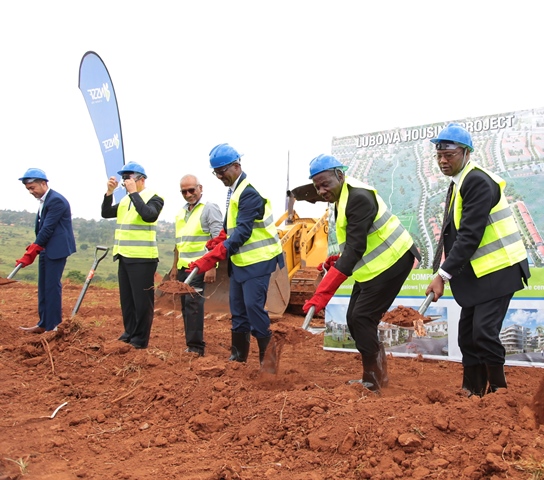
The National Social Security Fund (NSSF) last month commissioned the construction of the 2,740 unit housing project in Lubowa, Wakiso district, in an effort to expand its investment portfolio and give its members competitive returns on their savings.
The real estate project which will cost an estimated US$ 400 million over a 10-year period will be developed on the Fund’s 565 acres of land along Entebbe road and will be one of the most upmarket housing estates in Uganda.
Speaking at the groundbreaking ceremony in Lubowa, Richard Byarugaba, NSSF Managing Director said that the Lubowa Housing Estate is in response to demand for quality housing for Uganda’s middle class as well as an investment opportunity that will deliver competitive returns on members’ savings.
Byarugaba said that the Fund will make an initial investment for phase 1 after which the project is expected to be self-financing with projection to complete the first phase in three years.
He also said that upon completion, the houses will be sold on an open market to both the fund members and the general public. However, priority will be given to the members at prevailing market rates at the time of completion.
Byarugaba however noted that even though Real Estate was a viable venture, the Fund will continue to diversify its investments thereby minimizing any risks within its asset classes that can impair the Fund’s ability to achieve its investment objectives.
The development will have retail and office space, school, hospital, leisure and commercial areas, police and fire stations and places of worship, a central park, and a Plantation Garden Park, creating a desirable environment for the residents.
A stalled project
The Lubowa Housing Project has been one of those on NSSF’s books for over 16 years. The project has stalled for several reasons, key among them, the land ownership was being contested leading to delays. Additionally, NSSF blamed the lengthy procurement procedures for the delays. Construction of the project and eventual completion will place Byarugaba in the record books and cement his legacy as one of the most efficient MDs the Fund has ever had.
Growing the Real Estate profile
The NSSF Board Chairman, Patrick Byabakama Kaberenge said the Fund’s Real Estate strategy going forward will focus on low-cost housing which will target a significant number of NSSF savers.
He also added that the planned affordable housing projects include off-taker projects in and around Kampala, 5,000 housing units projects at Temangalo, Wakiso and a planned estate in Nsimbe land which the fund recently redeemed back and acquired in total.
Real Estate remains the lowest proportion of NSSF’s asset base. Only 2% of NSSF’s Ushs 8 trillion asset base is currently being held in real-estate assets. Additionally, NSSF most of these Real Estate assets are undeveloped.
 Strong Vote of Confidence: Mbire Reappointed MTN Uganda Chairman
The fund’s other key Real Estate investments include the Ushs 15.5 billion shillings, Mbuya housing projects, the Ushs 3.3 billion Jinja commercial complex in Jinja, the upcoming Mbarara commercial complex, Workers House, Social Security House and Pension Towers.
Kaberenge appealed to the Minister of Finance, Hon. Matia Kasaija to review and make some changes in the procurement bill which has a lot of bureaucracies that led to delay of procurement because this is one of the serious challenges faced by the fund in procuring assets.
Low-cost housing?
Speaking at the same event, Hon. Matia Kasaija, Minister of Finance commended NSSF upon the commencement of the landmark project and investing in a robust housing market which is in line with Government’s plan to provide decent housing for Ugandans.
He, however, challenged the Fund to also focus on building decent houses for the low-income earners especially those in the slums around Kampala city rather than focusing only on the middle and high-class people who are even less compared to the low-income people. However, for low-cost housing to take center stage, lower costs of construction have to first emerge.
The Lubowa Housing Estate will only be a drop in the ocean as the housing deficit in the country continues to grow by an estimated 300,000 units per annum, currently standing at about 2 million units, according to the 2015-2020 National Development Plan II.
The Fund which currently boasts of Ushs 7.9 trillion in assets also increased its stake in power utility firm, Umeme, to 23% up from 15% by making an additional investment of about Ushs 59.4 billion and is also the largest institutional investor on the Uganda Securities Exchange.
Members earn 11.23% interest
Last month, the NSSF also announced that members would be earning 11.23% on their funds, the lowest in four years, as returns on fixed income assets continue to decline due to reduced yields on government securities.
This is on the back of a good financial performance that saw the earnings grow by 35% from Ushs 674 billion in 2015/16 to Ushs 912 billion in 2017, itself powered by a 19% growth in interest income from Ushs 659 billion to Ushs 781 billion and a 39% growth in dividend income from Ushs 38 billion in 2015/16 to Ushs 52 billion in 2016/17.
The Fund’s fundamentals also grew. Total contributions grew by 17% from Ushs 785.5 billion in 2015/16 to Ushs 917 billion in 2016/17 (monthly contributions grew by 18.5% from Ushs 65 billion to Ushs 77 billion) as compliance improved from 77% to 80% and the number of employers and members registered, grew by 14% and 9% respectively.
As a result, there was a 20% growth in the Fund’s Assets Under Management, from Ushs 6.6 trillion in 2015/16 to Ushs 8 trillion, keeping NSSF as Uganda’s largest financial institution. Byarugaba attributed the Fund’s good performance to its aggressive but prudent investment strategy and improved compliance levels from members.
“We have once again outperformed the economy, meeting and in many instances surpassing our targets. This performance is also above-industry performance, demonstrating that we are delivering value to members, clearly distinguishing the Fund as a preferred savings vehicle. This year, there has been a 12% increment in money allocated to paying interest to our members, from Ushs 606 billion to Ushs 681 billion, but cumulatively, over the last 6 years that we have been in charge of the Fund, there has been a 246% increase (three and a half times) in interest paid from Ushs 197 billion in 2011 to Ushs 681 billion in 2017. With an income of Ushs 912 billion on Ushs 7.924 trillion, NSSF’s Return on Assets (11.51%) is above the industry average of 8%,
