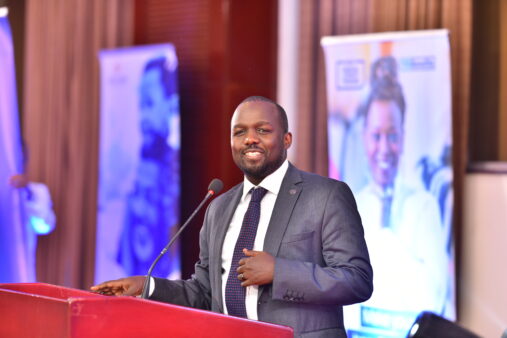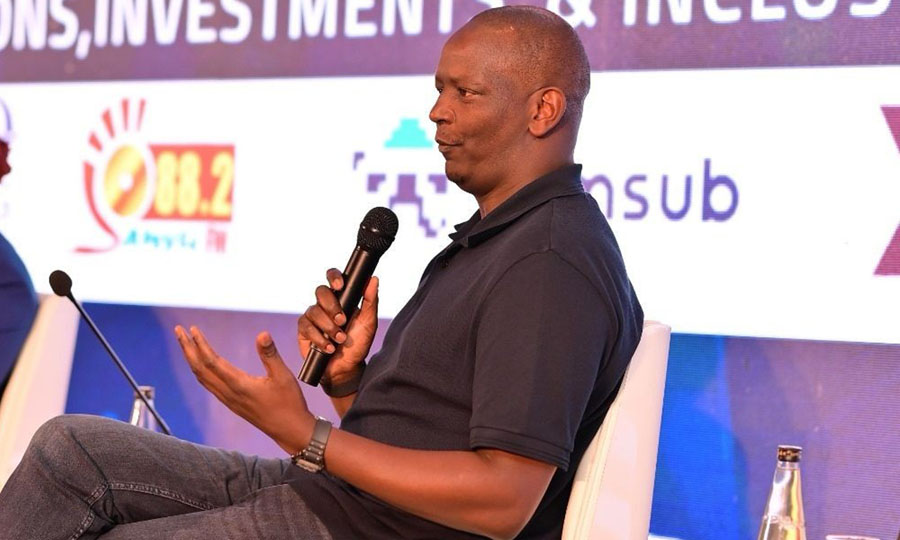
At the 2025 Fintechs Annual Gathering in Kampala, Sitoyo Lopokoiyit, the M-PESA Africa managing director, delivered one of the event’s most compelling keynotes, part warning, part vision, and wholly inspiring.
From personal anecdotes about his teenage son’s stock trading to sobering reflections on digital sovereignty and the risks of “AI colonialism,” Lopokoiyit painted a vivid picture of Africa’s financial and technological crossroads.
In this write-up, Jeff Winters extracts his insights on M-PESA’s vision for Africa’s fintech future, the challenges of digital disruption, and why empowering youth and small businesses will define the continent’s next growth chapter.
Coming back to Kampala felt like coming home
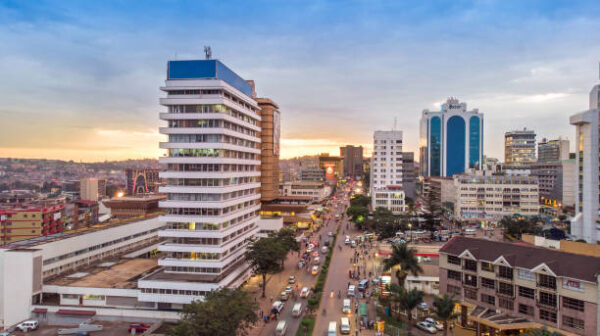
The last time I was here was about 18 years ago. There was no expressway, no new airport, this – Shelton Kampala Hotel – was the only big hotel in town.
I used to come quite often, almost every month. I still know some places. Even now, I still Google “what to do in Kampala.” The same results, Jinja, mostly, always pop up. It’s amazing how much and how little has changed.
Young Africans see no barriers; they think globally
My son called me during a volatile time in the US markets and told me to buy Nvidia stock. It had fallen to about $94; today, it’s worth around $182. But the story isn’t about the profit; it’s about mindset.
Young Africans are engaging with money in ways their parents never imagined. My son has managed my financial account since he was 13. Last year, he made $25,000.
This generation invests, tracks markets, and sees no borders. That’s what we must harness.
Africa’s youth is its greatest global advantage
By 2050, Africa will have 2.6 billion people, 65% under 25. That’s the largest youth population in the world, with the skills to power global growth.
Compare that to Japan’s aging society or China’s shrinking population.
The best place to be in the world today is Africa. But technology is a double-edged sword. If we are not careful, our story will be rewritten by people in Silicon Valley who have never been here.

Digital colonialism is the new frontier
Look at Cambridge Analytica, a company that used data to manipulate democratic outcomes. If that was possible in 2018, imagine what’s possible now with AI.
Data is power. If Africans are not the ones building and governing their own digital platforms, someone else will control the narrative and the future.
The line between banks and telecoms is disappearing
The boundaries between banks and telecoms are vanishing. Look at Nubank and Revolut, both worth over $70 billion. They are not just apps; they own banking licenses and telecoms.
 Standard Chartered Kenya Targets Nakumatt Properties in $14.3 Million Debt Recovery Battle
M-PESA moves 220 million transactions a day, five times PayPal’s volume. Yet, PayPal is valued at $90 billion, while our valuation is far lower.
If we were American, it would be ten times higher. That’s the perception gap we must close.
Crypto without control is digital dollarization
Africa already sees $150 billion in annual crypto activity, with $18 billion in stablecoin transactions. Kenya alone recorded $3.3 billion in inflows last year.
But we risk losing sovereignty if we dollarize our economies through private stablecoins like Tether and Circle.
Every M-PESA shilling is backed 1:1 in a bank — we built that model 18 years ago. Africa must create its own regulated digital currencies.
SMEs are the engine of Africa’s economy
Seven out of 10 jobs in Africa come from SMEs. Governments can’t create jobs at that scale; it’s farmers, traders, and boda-boda riders driving 40–50 percent of GDP.
At M-PESA, we have separated personal and business wallets so small traders can manage finances better. That opens access to credit, savings, and insurance tailored for them.
Our work with Kenya’s fertilizer subsidy programme reached 6.3 million farmers, delivered $400 million directly, boosted maize yields by 40%, and kept inflation under 4%. That’s the power of digital systems working for people.
Africa’s fintech future must be open and collaborative
We will open M-PESA’s APIs, agent networks, and compliance systems — because we can’t do it all. You build for your customers; we’ll compete, yes, but on an open platform.
Africa’s digital future will be built by partnership, not isolation.
Africa is already writing its own story
Africa is the future of global growth. We have the people, the culture, the resources. But we must protect our data, resist dollarization, and empower our SMEs.
The big tech companies know it; if they are not in Africa now, they won’t be big tech in 20 years.
The continent is no longer waiting to be told its story; it’s already writing it.