Less than a year after Standard Chartered Bank announced plans to exit its Wealth and Retail Business (WRB) segment as part of a global restructuring strategy, the long-anticipated transaction has now materialized.
Absa, just like many had projected, has stepped in as the acquirer, with the deal formally announced on 24 October, expected to transfer all Standard Chartered’s WRB clients, assets, and employees to Absa.
It is one of the most significant realignments in Uganda’s banking sector in recent years, following Standard Chartered’s November 2024 declaration of intent to divest from retail operations to focus on its Corporate and Investment Banking (CIB) and cross-border markets.
For Absa, the acquisition represents more than a portfolio expansion; it’s a strategic leap that solidifies its foothold in the retail and wealth management space, aligning with its broader Pan-African growth agenda.
By absorbing WRB’s UGX 926 billion in deposits and UGX 372 billion in assets, Absa will effectively consolidate its position among the country’s top three banks by both asset base and retail market share.
Doubling down on deposit strength
As of December 2024, Absa reported UGX 4.57 trillion in customer deposits, up by 11.5% from UGX 4.09 trillion the previous year
The integration of WRB’s UGX 926 billion retail deposits will lift Absa’s total deposits to roughly UGX 5.5 trillion, a 20% jump in its deposit base.
This injection significantly strengthens Absa’s liquidity position, lowering its cost of funds through access to a broader base of low-cost savings and current accounts.
Whereas Stanbic, which holds UGX8.4 trillion in customer deposits, still carries the trophy, it is a big leap for Absa as the new additions take its deposit strength above Centenary Bank’s UGX 4.21 trillion.
The integration also diversifies Absa’s funding sources away from corporate and institutional deposits, which typically carry higher interest expense.
In Uganda’s rising interest rate environment, this will enhance the bank’s net interest margin and improve balance sheet stability.

Asset expansion and loan portfolio diversification
At the close of 2024, Absa’s total assets stood at UGX 5.43 trillion, up by 19.1% from UGX 4.23 trillion in 2023
The inclusion of WRB’s UGX 372 billion in retail assets will push total assets toward UGX 5.8 trillion, marking a near 7% immediate expansion in Absa’s balance sheet.
But this remains lower than Stanbic’s UGX 10.4 trillion and Centenary Bank’s UGX 7.1 trillion.
Beyond the headline growth, this acquisition deepens Absa’s exposure to personal loans, mortgages, and SME credit, segments that were the cornerstone of Standard Chartered WRB’s book.
While retail lending typically carries higher credit risk than corporate loans, it also offers superior yields and recurring fee income, which align with Absa’s goal of boosting non-funded income, already up 37.9% in 2024
Moreover, the integration of WRB’s retail accounts strengthens Absa’s cross-sell potential, allowing it to package wealth, insurance, and digital investment solutions under its “Your Story Matters” brand.
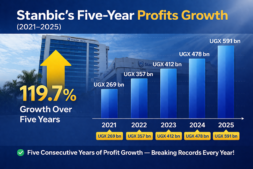 Stanbic’s Five-Year Scorecard: How Profit Growth, Deposits, Lending and Dividends Reshaped Performance
This is a natural complement to Absa’s already diversified portfolio in trade, manufacturing, and agriculture lending.
Capital and profitability impact
Absa ended 2024 with a total capital ratio of 22.72%, comfortably above the regulatory minimum of 12%
Even after absorbing WRB’s loan book, Absa’s capital adequacy will remain strong, thanks to its UGX 814 billion equity base and UGX 177.9 billion profit after tax, a 22% annual increase.
The WRB acquisition is expected to be earnings accretive or improve earnings per share by the 2026 financial year.
WRB generated UGX 56.2 billion in profit before tax in 2024, equivalent to roughly one-third of Absa Uganda’s own pre-tax profit that year.
Post-merger, Absa’s consolidated profit before tax could rise from UGX 178 billion to above UGX 230 billion, positioning it near industry giants such as Stanbic, which posted UGX 478 billion in 2024 and just within the margins of Centenary Bank’s UGX 297.1 billion.
In addition, the cost-to-income ratio, which improved from 60% in 2023 to 56% in 2024, could initially edge higher due to integration costs, but the long-term synergy from digital scaling and shared operations should push it lower by 2026.
Strategic synergy and retail rebalancing
Strategically, WRB’s inclusion bolsters Absa’s retail franchise, giving it immediate access to tens of thousands of affluent and mass-market clients, an area where Standard Chartered excelled.
These new accounts will accelerate Absa’s digital banking adoption, especially in wealth management, mobile banking, and investment products.
Absa’s Managing Director, David Wandera, has emphasized that the acquisition will “broaden retail and wealth management offerings and deliver increased convenience and value to customers.”
In practical terms, it also aligns with Absa Group’s Pan-African expansion strategy, under which Uganda is a priority market for scaling inclusive finance and customer-driven innovation.
The acquisition of Standard Chartered Uganda’s WRB business, thus, marks a transformational leap for Absa.
Financially, it injects over UGX 1.3 trillion in new assets and deposits, strengthens liquidity, enhances profitability, and broadens its retail base.
Strategically, it propels Absa toward becoming Uganda’s most diversified universal bank, capable of balancing corporate banking muscle with deep retail reach.
If well integrated, the transaction will not only reshape Absa’s balance sheet but also its market positioning, shifting it from a growth contender to a frontline leader in Uganda’s banking landscape by 2026.
This visualization highlights how the WRB acquisition materially enhances Absa’s scale, profitability, and retail depth, positioning it as one of Uganda’s most diversified and growth-ready banks going into 2026.