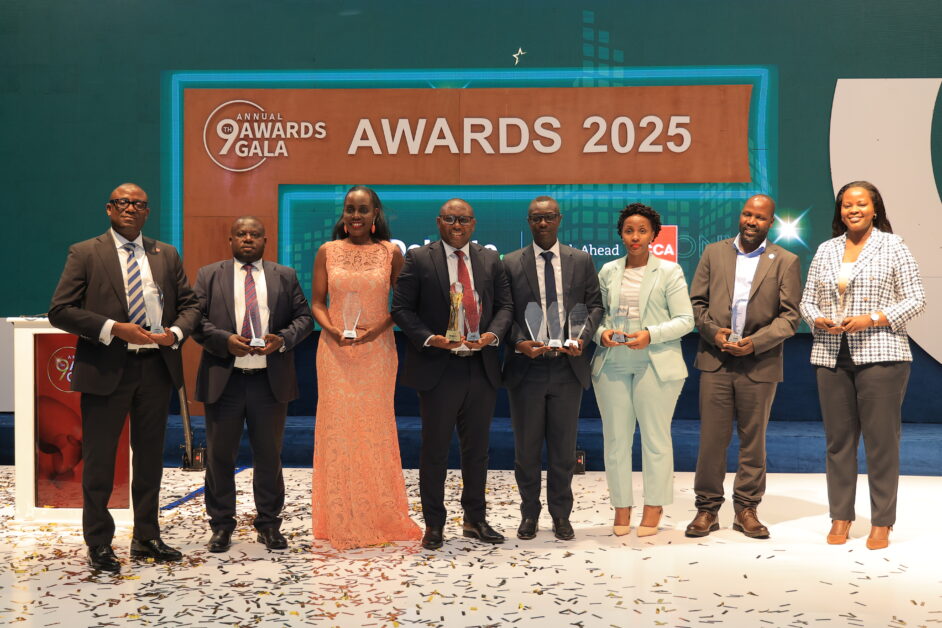
Eight finance professionals won ten awards at the 9th edition of the Chief Financial Officer (CFO) Awards 2025 with Peter Ssenyange, CFO, Pearl Bank Uganda Limited emerging the overall CFO award 2025. Peter also won the Sustainability Award.
The other double award winner was Ronald Makata, CFO, Stanbic Bank Uganda emerged CFO of the Year (First Runner-Up) and won Finance Transformation & Technology Award and Compliance & Governance Award.
The other winners were:- Emmanuel Mugagga, CFO, Uganda National Oil Company – Strategy Execution Award, Irene Mwoyogwona, Head of Finance, Pride Bank Limited – Leadership Award, Bob Okodi, Finance Manager, Amref Health Africa – Not-for-Profit Award, Amanda Ayebare, CFO, AutoXpress Uganda Limited – SME Award, Fredrick Kakooza, CFO, Quality Chemical Industries Limited – Compliance & Governance Award and Robinah Siima, CFO, FINCA Uganda – Young CFO Award.
About the Uganda CFO Awards
The CFO Awards is an initiative that ACCA Uganda and Deloitte launched to highlight the critical role played by CFOs or heads of the finance function in driving financial stewardship, strategic decision-making, and sustainable growth within their organizations.
By honoring exceptional leaders in the finance community, this initiative serves as a platform to inspire, connect, and elevate the standards of financial excellence in Uganda and beyond.
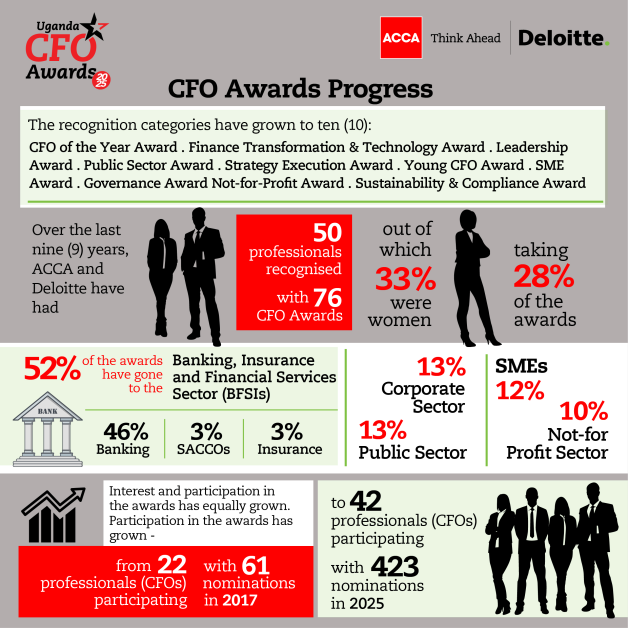
CFO Awards progress
Significance of the 9th edition of the CFO Awards theme; “CFO Vision: Creating Impact and Legacy
The theme spotlights the future of finance leaders who are not only driving organizational growth but also shaping sustainable personal and business practices and leaving lasting legacies within their industries and communities.
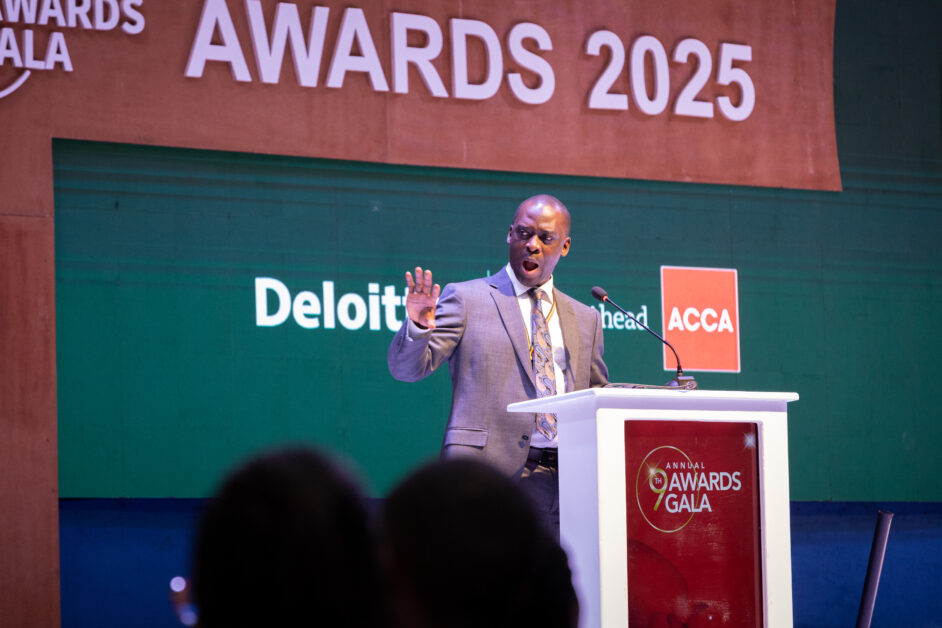
Delivering the Keynote Address on the theme, Patrick Ayota, Managing Director of the National Social Security Fund (NSSF), urged finance leaders to look beyond ordinary number crunching and focus more on creating legacies that drive long-term impact and value.
He urged CFOs to think differently by asking themselves where and how they’re adding value in the organization, and encouraged them to get out of their comfort zones, meet customers and cross department teams to be able to contribute to the overall organization’s performance.
Speaking as Chief Guest, James Bantu, Assistant Auditor General at the Office of the Auditor General, commended ACCA and Deloitte for their continued efforts in empowering the finance profession and promoting ethical leadership and encouraged them to take pride and continue to play the leading role in Uganda’s 10-fold economic growth agenda, highlighting their responsibility to ensure fiscal discipline, transparency, and innovation across both public and private sectors.
“CFOs are expected to unlock tenfold growth of Uganda’s economy, from the $50 million GDP to somewhere around 500 and of course, your role as CFOs in making that reality is going to be critical. Let us continue to create environments where CFOs can thrive with autonomy, with accountability and access tools and data they need to drive transformation.”
Other key stakeholders of the awards process who commit time and expertise in the shortlisting and interviewing finalists to identify the winners were an esteemed panel of judges; Sanjay Rughani FCCA, CEO, Standard Chartered Bank, Dorothy Kabagambe Ssemanda FCCA, CEO ATC Uganda, Julius Kakeeto FCCA,CEO Post Bank (U) Ltd, Alfred Brian Agaba FCCA ACCLAIM Africa, Ambrose Promise Commissioner Public Sector Accounts Department MOFPED, Dickens Otim Financial Management Specialist, MOFPED – Accountant General’s Office.
Creating Impact and Legacy
In the high-stakes world of finance, the role of the Chief Financial Officer (CFO) is often narrowly defined by ledgers, quarterly results, and fiduciary compliance.
Yet, the vision celebrated at the recent CFO Awards—themed “CFO Vision: Creating Impact and Legacy”—tells a far richer story: one where financial acumen is the foundation for profound, measurable and sustainable transformation.
They are moving financial leadership out of the “back-office” and into the strategic core of their organisations, demonstrating that true success is measured not just in margins, but in the sustainability of the enterprise and the growth of its people.
This feature unpacks the collective wisdom of these leaders, revealing a shared philosophy where purpose and profitability are not opposing forces, but complementary drivers of long-term value.
Their journeys illustrate that the modern CFO must be a strategist, a cultural architect, a steward of integrity, and a mentor, forging a legacy that will shape Uganda’s economic landscape for the next generation.
The future of finance, they argue, is rooted in the courage to lead with both conviction and humanity.
The Evolving Mandate: From Bookkeeper to Strategic Value Creator
The journey into finance for most of these leaders began with an appreciation for precision and logic. For Frederick Kakooza, it started with the discipline and commitment to accuracy he saw as an apprentice.
Peter Ssenyange was drawn to it as the “language of business”. However, the defining moment for all of them was the realisation that their technical skill was merely a means to a much greater end.
Beyond Technical Acumen: Telling the Value Story
The role of the CFO has changed dramatically from simply managing ledgers to shaping corporate vision.
Today, the finance leader must be able to tell a “value creation story” of the organization from start to finish through the eyes of all stakeholders, not just shareholders.
Peter Ssenyange, 2025 CFO of the Year, emphasises that a modern CFO needs a blend of four crucial skills: business, technical, value, and leadership acumen.
This realisation requires the finance function to move beyond mere “number crunching and analysis”, which Amanda Ayebare, the SME CFO Award winner, notes is only half of the profession. The other half is using that information in the real world to contribute to business strategy and innovation.
Robinah Siima, winner of the Young CFO Award, embodies this strategic evolution, viewing finance not just as technical work, but as stewardship—protecting value, informing decisions, and supporting livelihoods. She states that the function should not only measure performance but must actively enable it.
For organisations like Amref Health Africa Uganda, the purpose is explicitly outside of profit; Bob Okodi, the Not-for-Profit Award winner, measures impact in “lives, not margins”. This purpose is what drew him to the sector, offering him the deep sense of satisfaction that comes from seeing lives transformed.
Makata’s experience at Stanbic amplifies this transformation. He asserts that the modern CFO “must influence not just outcomes but the strategic path that delivers them.”
This has required him to go beyond traditional reporting and focus on shaping both short-term priorities and long-term institutional direction through collaboration across the bank.
 How dfcu Bank Helped Agnes Mbabazi Turn Agrifarm Into a Ugandan Agribusiness Force
The Leadership Philosophy: Balancing Humanity with High Standards
The most compelling insights from these leaders concern the art of leading people in a results-driven environment. They unanimously agree that sustainable success hinges on a blend of empathy and uncompromising accountability.
The Complementary Forces of Empathy and Accountability: Irene Mwoyogwona, who won the Leadership Award, asserts that true leadership validates that “sustainable results come from investing in people, fostering trust, and leading with purpose”. She learned that “pressure and results don’t have to come at the expense of humanity; they can be amplified by it”.
Her personal philosophy is that empathy and accountability are “complementary,” not opposing forces. Empathy helps her understand the context behind performance issues, while accountability ensures the organisation maintains standards and integrity. She warns that “accountability without empathy is harsh, but empathy without accountability is enabling”.
Similarly, Robinah Siima’s leadership is shaped by two core influences: audit, which taught her discipline and accuracy, and motherhood, which taught her empathy and the balance of firmness with care. This grounding allows her to lead with clarity and respect, building trust regardless of age.
Leading with Integrity and Resilience: For finance professionals, integrity is the bedrock of credibility. As Bob Okodi advises young professionals, integrity is what “earns you trust from colleagues”. It means standing up for what is right and making decisions that safeguard your reputation, recognising that “one small mistake can ruin your career for years to come”.
This integrity is tested under pressure, and the CFOs rely on resilience and grounding.
Amanda Ayebare, whose career began at PricewaterhouseCoopers, credits the firm for laying a great foundation for resilience and teaching her how to find a way out of demanding situations.
Peter Ssenyange, amid the pressures of leadership and public expectation, is anchored by his faith and a philosophical reminder: “Your goal is to deliver within that pressure”.
Makata’s leadership philosophy aligns closely with this balance. His approach is grounded in people first, systems second, technology third.
He insists that “integrity is non-negotiable.” Operating in an environment where customers demand bold solutions and regulators expect unwavering discipline, he sees these not as trade-offs but “dual responsibilities”.
The Foundation of Trust: Governance as an Enabler
In the current financial climate, governance and compliance have transitioned from being necessary burdens to being strategic differentiators.
Governance is a Leadership Statement: Frederick Kakooza, the Compliance & Governance Award winner, states unequivocally that governance has always been a “leadership statement” for him. He was drawn to the realisation that companies enforcing good governance consistently outperformed others. His award is a strong stamp of confidence in ensuring the company’s rules and processes are visible and aligned with best practices.
Kakooza’s approach is to view compliance as a “foundation for trust” in systems, leadership, and the organisation’s ability to deliver sustainably. He leads with integrity by fostering a culture where ethical choices are celebrated and where governance is seen not as a constraint but as a foundation for long-term success.
Makata’s governance track record reflects the same conviction.
He is particularly proud of the shift from manual processes to a “highly automated finance function,” which has improved productivity, reduced inefficiencies, provided a clear audit trail, and strengthened trust with regulators and customers. This evolution has enhanced transparency and improved institutional confidence internally and externally.
Principle Secures Lasting Profits: When profit and principle seem to collide, the CFOs choose the path of integrity. Kakooza recognises this tension is real but insists that principles create the foundation for sustainable profit because “profit and principle are not opposing forces; they are interdependent”.
He explains that cutting corners may yield a short-term gain, but it inevitably undermines trust, and once trust is lost, value follows. His strategy is to rely on transparency, strong internal controls, and open dialogue, ultimately choosing the path that protects integrity because “Principle, when firmly upheld, has a way of securing profits that last”.
Peter Ssenyange’s success at Pearl Bank was driven by pursuing a path of being “profitable through sustainability”. This required aligning the bank’s overall performance with its sustainability goals, focusing on its impact on people, the economy, and the environment.
In the not-for-profit sector, Bob Okodi learned the importance of building and maintaining strong relationships with donors to sustain deep trust, a practice he reinforces through timely reporting, success stories, and accountability for all funds received. He also learned the crucial lesson of diversifying funding and not relying heavily on one donor, a painful lesson driven home by economic shifts.
Building Legacy: The Multiplier Effect of Mentorship and Culture
The ultimate goal for these leaders is not the size of the balance sheet at the end of their tenure, but the quality of the systems, culture, and people who remain.
The Power of Multiplication: For Irene Mwoyogwona, her greatest fulfilment comes from watching people discover capabilities they didn’t know they had. She sees leadership as being about “multiplication—multiplying impact, capacity, and possibility”. She is also proud of mentoring and nurturing young professionals to bring out their best, even allowing them to make mistakes as part of learning.
Peter Ssenyange views his job as creating “disciples”. His philosophy centres on a “winning culture” where the organisation must win, the team must win, and the individual must win, with the ultimate benefit extending to the person’s family. He links profit to legacy, stating that money only comes after one is obsessed with their impact.
Bob Okodi has already contributed to his legacy by having two former team members advance to become Finance Managers in other not-for-profit organisations, an outcome he views with pride. He also aims to contribute to a stronger, more transparent non-profit finance ecosystem in Uganda by promoting the successful rollout of the International Non-Profit Accounting Standard.
Systems That Outlast the Leader: A key element of legacy is building institutional resilience. Bob Okodi is proud of building a robust, fully integrated system that allows his team to execute over 90% of their work remotely.
Similarly, Frederick Kakooza’s hope is that the mindset and culture will endure at Qcil. He wants his legacy to be a culture where integrity is non-negotiable, accountability is shared, and people instinctively choose to do the right thing even when no one is watching. Amanda Ayebare hopes the finance function remains meticulous, supportive to the core of the business, and associated with the tenacity needed at the organisation’s turning point.
In conclusion, these award-winning CFOs have redefined success. They have established that in modern finance, the most valuable assets are not found on the balance sheet, but in the systems, the ethical practices, and the motivated teams that a leader leaves behind.
They are building institutions that are not only profitable but also powerful agents of positive change, ensuring that the CFO Vision delivers on its promise of both impact and legacy.