Oil production is increasingly shaping Uganda’s inflation outlook, not only as a future driver of growth, but as a critical stabilising force for prices and the exchange rate.
Bank of Uganda (BoU) has made clear that further delays in the start of commercial oil production could push inflation higher by weakening the shilling and raising import costs across the economy.
For now, inflation remains firmly under control. In October 2025, inflation stood at 3.2% well below the central bank’s 5% medium-term target.
This benign environment has been supported by a stronger shilling, favourable food supply conditions, and subdued global energy prices.
However, policymakers caution that this stability is more fragile than it appears.
BoU notes that delays in oil production could quickly alter the inflation trajectory, not because oil directly feeds into consumer prices, but because of its powerful influence on foreign exchange inflows, investor confidence, and the balance of payments.
Importantly, this is not a forecast. The warning arises from scenario-based modelling presented in the Bank of Uganda’s November 2025 Monetary Policy Report.
The analysis compares a baseline scenario, in which oil production begins on schedule, with an alternative scenario involving delays.
The exercise is analytical and conditional, designed to test macroeconomic vulnerabilities rather than predict outcomes.
Timing of revenue, not “First Oil”
At the centre of the debate is timing, specifically, what constitutes “first oil.”
Irene Bateebe, Permanent Secretary at the Ministry of Energy and Mineral Development, says Bank of Uganda is focused on when oil revenues begin to flow, noting that first oil is expected around mid-2026.
For the central bank, however, the issue goes beyond the symbolic moment when oil starts flowing from the ground.
What matters for inflation is when oil production generates foreign exchange inflows large enough to influence the exchange rate and reduce imported inflation.
This distinction has been clarified by the Petroleum Authority of Uganda (PAU), which provides the formal regulatory definition of first oil.
From a regulatory and commercial perspective, first oil refers to the moment crude begins flowing from the reservoirs to the central processing facilities, at which point Uganda officially becomes an oil-producing country.
However, this milestone does not immediately translate into export earnings or foreign currency inflows. That gap between production and revenue is precisely where inflation risks arise.
At the National Content Conference in December 2025, PAU Executive Director Ernest Rubondo acknowledged that “first oil” is often understood differently by different stakeholders.
Some define it as crude reaching the central processing facility; others associate it with oil leaving the facility for the pipeline or refinery.
Broader commercial interpretations place first oil at the moment crude reaches the port of Tanga in Tanzania, or when it is loaded onto a ship and sold.
Energy State Minister Sidronius Okaasai Opolot offered a more operational definition, describing first oil as the moment the taps are turned on and crude begins flowing into the processing facilities.
PAU’s position bridges these interpretations. While first oil is a technical and operational milestone, it is not the point at which Uganda begins earning oil revenue or receiving foreign exchange.
Once crude starts flowing into the central processing facilities, it will take an estimated two to three months for oil to fill the export pipeline and reach the terminal at Tanga.
This timeline can vary due to extensive testing, quality checks, and commissioning processes along the pipeline.
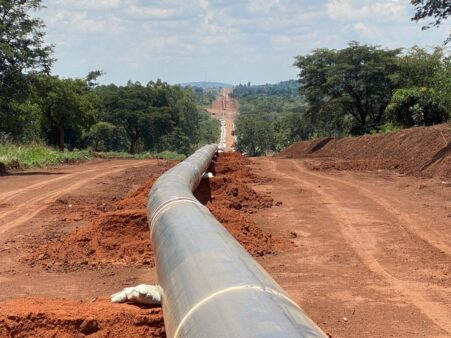
For exports to begin, the entire East African Crude Oil Pipeline (EACOP) must be completed. At least two pump stations, one in Uganda and one in Tanzania, must be operational.
In addition, the marine storage terminal, tanks, jetty, and load-out facilities at Tanga must be completed and certified.
Only after crude is transported and sold, either to export markets or a refinery, does revenue begin to accrue.
Payments are then deposited into Uganda’s Petroleum Fund, overseen by the Ministry of Finance in coordination with the Bank of Uganda and the Uganda Revenue Authority.
 #WomenFixingUganda: Q&A with Leadership Coach Eileen Walusimbi on Conscious Leadership That Builds Lasting Organisations
Market engagement underway
While PAU did not respond to inquiries on the current state of commercial readiness, including negotiations with potential buyers and the balance between long-term offtake agreements and spot sales, an inside source indicates that government has already begun engaging international buyers, primarily refineries.
Preparations are also underway for an international launch of Uganda’s crude oil blend, including the formal unveiling of its commercial name.
Engagement with international markets is currently being undertaken jointly, but this approach is expected to evolve as first oil approaches.
Given the commercial sensitivity of these discussions, details remain limited.
Uganda’s crude is classified as heavy, narrowing the pool of potential buyers to refineries equipped to process such grades.
Industry data from platforms such as digitalrefining.com show that refineries in the US, India, China, Canada, and Russia have the technical capacity to process heavy crude, positioning them as likely candidates in Uganda’s emerging marketing strategy.
Why oil matters for inflation
These operational realities explain why BoU’s modelling focuses less on ceremonial milestones and more on when oil production begins to influence macroeconomic fundamentals.
Over the past year, average headline inflation stood at 3.6%, while core inflation averaged 3.9%. In October 2025, inflation eased further, driven mainly by softer domestic price pressures.
Services inflation fell to 4.5% from 5.1%, reflecting lower education and accommodation costs. Other goods inflation declined to 2.6% from 3%, while food crop inflation eased to 6.1% from 7.4%.
Energy, Fuel and Utilities inflation edged up slightly to 0.1% from -0.1%, due to modest increases in liquid fuel prices, highlighting Uganda’s continued sensitivity to imported fuel costs.
Oil production matters for inflation because Uganda remains a net importer of petroleum products and key industrial inputs.
The exchange rate, therefore, plays a central role in domestic price formation.
According to BoU, oil production is expected to generate substantial foreign exchange inflows through exports, foreign direct investment, and improved investor confidence.
These inflows would support the shilling and dampen imported inflation over time.
Progress and risks ahead
Government projections estimate annual oil revenues of between $1.5 billion and $2 billion at peak production, over a production life of at least 20 years.
PAU reports that as of January 2026, the Tilenga Project was over 62% complete, below the 73.18% target, according to the Annual Report of the Auditor General 2025; the Kingfisher Project had reached 76%, above target; and EACOP stood at 79%, also above target.
All three projects remain aligned and are expected to deliver first oil in the second half of 2026.
Earlier data from October 2025 show that at Tilenga, more than 150 of the planned 450 wells had been drilled, the central processing facility was nearing completion, and the feeder pipeline was almost complete.
At Kingfisher, 17 of the planned 31 wells had been drilled, and the processing facility was in its final stages.
UNOC continues to coordinate production, transport, and trade while advancing the Kabaale Industrial Park, a 29-square-kilometre hub anchored by a planned $4 billion refinery.
Despite this progress, BoU’s alternative scenario assumes oil production is delayed until the 2027/28 financial year due to infrastructure or logistical constraints.
Under this scenario, export earnings, fiscal revenues, and foreign exchange inflows are pushed back, creating depreciation pressure on the shilling and raising import costs.
The central bank estimates that headline inflation would be 0.5 percentage points higher in 2026/27 and 0.9 percentage points higher in 2027/28 compared to the baseline.
Core inflation would also rise, signalling broader and more persistent price pressures. In response, BoU says it would need to maintain a tight monetary policy stance to keep inflation expectations anchored.
Uganda’s current low inflation reflects favourable conditions, but the central bank’s modelling sends a clear message: oil production is not just a growth story.
It is a key pillar of inflation stability—and the timing of revenue-generating production, more than the symbolism of first oil, will determine whether that stability can be sustained in the years ahead.