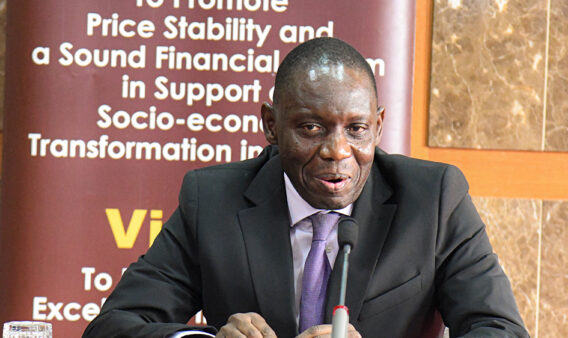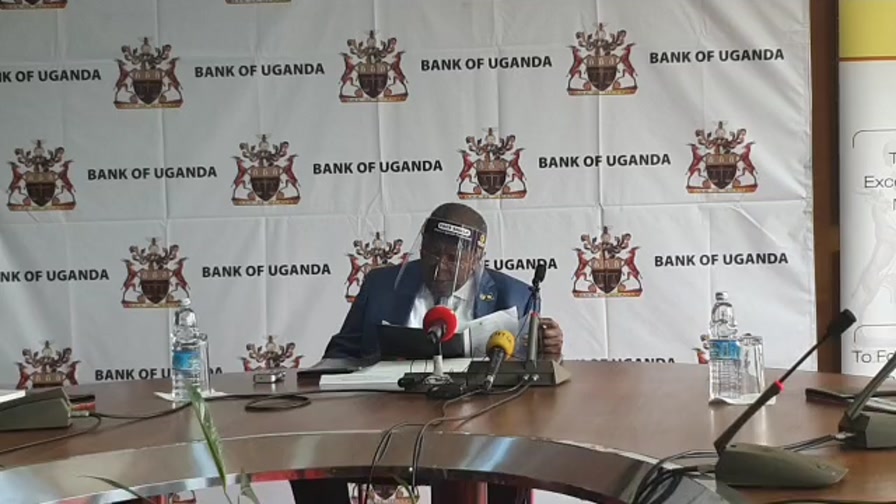
The Bank of Uganda (BoU) has Monday morning released the Monetary Policy statement for August maintaining the Central Banking Rate at 7 percent.
During the Monetary Policy Committee (MPC) meeting of August 2020, Governor Emmanuel Tumusiime-Mutebile confirmed that BoU has decided to maintain the CBR at 7%. The band on the CBR has also been maintained at +/-2% points while the margin on the rediscount rate and bank rate is unchanged at 3&4% points on the CBR, respectively. Furthermore, the rediscount rate and the bank rate have been maintained at 10 percent and 11 percent, respectively.
Stephen Kaboyo, the Managing Director Alpha Capital Partners, says the decision of keeping rates unchanged speaks to the fact that the BOU believes that it’s done its part for now in terms of mitigating the economic impact of Covid 19 inspite of the fact that the fiscal side still remains constrained.
“BOU seems to have taken a view that combination of monetary measures taken in Q2 of the calendar should start taking effect in anticipation that easing of the lockdown measures should lead to recovery of economic activity,” Kaboyo says.
He adds: “It is also my view that BOU did not see strong justification to cut rates considering the fact that local currency is relatively stable in an environment where the interbank market is excessively liquid.”
According to the Monetary Policy statement for August, economic activity is estimated to have reduced by 3.2 percent in the second quarter of 2020 which the Central Bank attributes to the COVID-19 containment measures and floods in some parts of the country.
On a good note, the Purchasing Managers’ Index (PMI) continued to register improvements since May 2020 and slightly crossed the 50 mark, indicating improvements in the business environment.
The statements further shows that economic growth in Financial Year (FY) 2020/21 is projected in the range of 3.0-4.0 percent, further increasing to 5.0-6.0 percent in FY 2021/22. Economic growth is consequently expected to remain below the potential growth rate until FY 2022/23.
Annual headline and core inflation rose to 4.7 percent and 5.8 percent, respectively, in July 2020, from corresponding levels of 4.1 percent and 4.9 percent in June 2020.
 Ruparelia Group Wins Key Entebbe Land Case, Clearing Path for the New Mega Speke Resort and Convention Centre, Entebbe
‘’The MPC is cognizant that its primary mandate is to achieve the medium-term target of CPI inflation of 5 percent. However, it noted that the extreme uncertainty characterises the outlook, which is heavily contingent upon the intensity, spread and duration of the COVID-19 pandemic, particularly the heightened risks associated with a second wave of infections. In these conditions, supporting the recovery of the economy is overriding in the conduct of monetary policy provided inflation remains in the range 5 percent +/-3 percentage points’’- BoU noted.
BoU predicts that the decline in food crop and energy prices and subdued demand could partly hold inflation down. Core inflation is expected to peak at 6.1 percent in the first quarter of 2021, while headline inflation could peak at 6.2 percent.
The statement also shows that the complementary fiscal and monetary policy actions have provided a foundation for the recovery of economic activity as the lockdown is relaxed. Thus, The Composite Index of Economic Activity (CIEA) grew by 5.7 percent month-on-month in June 2020, indicating a pickup in economic activity relative to the contraction registered in the three months to May 2020.
Whereas supply will initially recover in line with the easing of containment measures, the Central Bank projects that demand will benefit only gradually from improvements in foreign demand and confidence levels, as well as continued support from fiscal and monetary policies.
‘’Eventually aggregate demand is likely to increase faster than supply, thereby absorbing excess capacity.’’- BoU says.
BoU warns that domestic demand may take longer to recover despite the gradual easing of the lockdown. Moreover, food crop prices and external sources of inflation are likely to remain weak in the near-term amid the global economic downturn.
Key Highlights of the Monetary Policy Statement for August 2020
- CBR maintained at 7%
- Economic activity estimated to have contracted by 3.2 percent in the second quarter of 2020
- The Purchasing Managers’ Index (PMI) slightly crossed the 50 mark
- Economic growth in Financial Year (FY) 2020/21 projected in the range of 3.0-4.0 percent, further increasing to 5.0-6.0 percent in FY 2021/22
- Annual headline and core inflation rose to 4.7 percent and 5.8 percent, respectively, in July 2020, from corresponding levels of 4.1% and 4.9% in June 2020