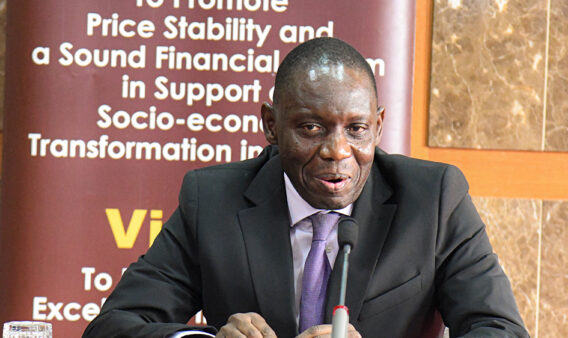
The Bank of Uganda (BoU) has opted to hold its Central Bank Rate (CBR) steady at 9.75% in its May 2025 Monetary Policy statement, citing a resilient domestic economy and broadly contained inflation, but warning of heightened global uncertainties and a shifting balance of risks that could push inflation upwards in the near term.
The Monetary Policy Committee (MPC), chaired by Governor Michael Atingi-Ego, emphasized that while inflation remains below target and growth remains firm, there is increasing concern over the potential for inflationary pressures to build up if economic activity accelerates beyond current supply capacities or if global disruptions intensify.
Inflation remains below target, but risks tilt upward
For much of the past year, inflation has remained below the BoU’s medium-term target of 5%. Annual headline inflation averaged 3.4% while core inflation — which excludes volatile items like food and energy — came in at 3.9%. This subdued inflation performance has been attributed to prudent monetary management, exchange rate stability, favorable food and fuel prices, and global disinflation trends.
However, the latest data for April 2025 shows a slight uptick, with headline inflation rising to 3.5% and core inflation edging up to 3.9%, from 3.4% and 3.6% in March respectively. These increases were driven mainly by higher prices for services and non-food goods.
The BoU projects core inflation to average between 4.5% and 5.0% in FY2025/26 and to converge toward the 5% target in the medium term.
However, the Bank cautioned that several upside risks could disrupt this path, including: rising domestic demand spurred by investments in Uganda’s extractive sector, a possible escalation in geopolitical tensions and trade restrictions.
The risks could extend to exchange rate depreciation due to heightened global market volatility and adverse weather affecting food production.
At the same time, downside risks such as continued global commodity price declines, stronger-than-expected agricultural output, and capital inflows supporting the exchange rate could help contain inflation.
Growth holds steady, but global headwinds loom
Uganda’s economy continues to show resilience. According to the Uganda Bureau of Statistics (UBOS), real GDP grew by an average of 6.0% in the first half of FY2024/25 — a strong recovery compared to the previous year and only slightly below the 6.6% recorded in the latter half of FY2023/24.
This growth has been underpinned by a rebound in household consumption, fueled by improving real incomes, and increased public and private sector investment, particularly in infrastructure and the oil and gas sectors.
 Ruparelia Foundation to Hold Free Eye Camp in Bukedea in Honour of Rajiv Ruparelia
The central bank maintains its projection for FY2024/25 at 6.0–6.5%, with expectations of reaching 7.0% in the outer years. Key enablers of this outlook include continued industrial and agricultural expansion, stronger capital investment, and effective execution of government programs such as the Parish Development Model (PDM).
However, the Bank signaled that the current pace of growth is nearing capacity limits, suggesting that further acceleration could spark inflation if demand begins to outpace supply.
Several external risks to the growth trajectory remain, such as disruption in global supply chains caused by trade tensions or changes in global shipping routes; slower global growth and weakened demand in major export markets, and reversal in global financial easing trends that could tighten credit conditions in Uganda.
Conversely, accelerated oil and gas sector investment, stronger tourism inflows, and pro-growth global policy shifts could offer upside surprises to Uganda’s growth momentum.
Policy Outlook: Vigilant but Accommodative
Despite global turbulence, the MPC believes its current monetary stance remains well-calibrated — tight enough to anchor inflation expectations, but supportive enough to allow the economy to sustain its current growth path. Accordingly, the CBR will remain at 9.75%, with the rediscount and bank rates held at 12.75% and 13.75% respectively. The CBR band remains at +/-2 percentage points.
Governor Atingi-Ego reiterated that any future changes to the policy rate will be guided by data, particularly shifts in inflation, economic activity, and external developments.
“The MPC considers the current policy stance appropriate to maintain inflation around target while supporting sustainable economic growth and socio-economic transformation,” he stated.
Conclusion
The BoU’s decision to maintain the CBR reflects a delicate balancing act. On one hand, Uganda is enjoying strong growth and contained inflation. On the other, uncertainties both at home and abroad — from potential overheating to global market instability — demand caution. With investment in extractives and public spending rising, the BoU will need to remain nimble to navigate what could become an increasingly volatile economic landscape.
As Uganda edges closer to first oil production and expands its industrial base, the central bank’s ability to adapt its monetary policy swiftly and effectively will be vital in preserving macroeconomic stability in the years ahead.