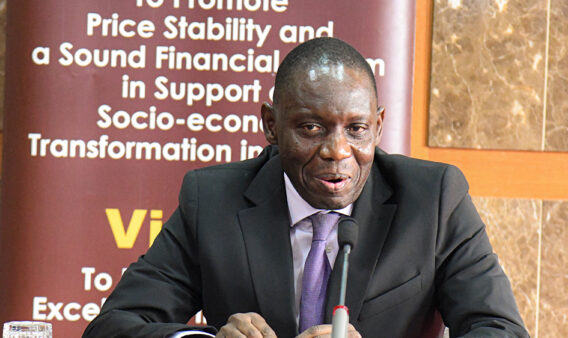
Bank of Uganda (BoU) has today, April 6th, 2020, in the April 2020 Monetary Policy Committee (MPC) meeting reduced the Central Bank Rate (CBR) by 1 percentage point to 8 percent.
The CBR has been at 9% since October 2019.
This is the lowest-ever rate since the CBR was introduced as a monetary policy tool, back in July 2011, then at 13%.
The highest it has ever risen is 23%, at the height of one of Uganda’s worst inflationary spells. At the time, inflation annual headline and core inflation was 30.5% and 30.8% respective
In a statement signed by the Bank of Uganda Governor, Prof. Tumusiime Emmanuel Mutebile, he said that “the Covid-19 pandemic has led to a severe contraction in economic activity due to a combination of global supply chain disruptions, travel restrictions, measures to limit contact between persons, and the sudden decline in demand.”
He also said that “consumer-facing sectors have been severely affected by social distancing measures and heightened uncertainty, while the manufacturing sector has declined on account of disruptions to the inflow of raw materials.”
“Economic activity in the trade sector has also been weighed down by the decline in external demand and supply chain disruptions, while service sectors such as finance, insurance, and information and communications are affected by the general stall in business activity and investment. Consequently, the Ugandan economy is projected to slow down drastically in the second half of Financial Year (FY) 2019/20, with GDP growth for the FY projected at 3 – 4 percent,” he said.
He added that downside risks to the economic growth outlook have increased, particularly in the near term and economic activity is projected to remain subdued until the pandemic is contained globally.
“Although GDP growth is projected to gradually recover in the second half of FY2020/21, the emerging output gap is projected to persist until 2022. However, there is significant uncertainty over the depth and duration of the current slowdown. The COVID-19 pandemic has been reflected in the deterioration of global financial conditions and an appreciation of the US dollar against other major currencies, resulting in volatility in the domestic foreign exchange market. The Uganda shilling depreciated against the US dollar by 2.2 percent between February and March 2020. In addition, the propagation of COVID-19 bears severe consequences on Uganda through theworsening of external position, due to capital outflows, adverse effects on the flow of international trade, tourism, workers’ remittances, foreign direct investment and loan disbursement, exacerbating exchange rate depreciation pressures,” he said.
“Given the deterioration in macroeconomic conditions and in order to ensure adequate access to credit and the normal functioning of financial markets, BoU has decided to ease monetary policy. Consequently, the CBR has been reduced by 1 percentage point to 8 percent. The band on the CBR will remain at +/-3 percentage points and the margin on the rediscount rate and bank rate will remain at 4 and 5 percentage points on the CBR, respectively. Consequently, the rediscount rate and the bank rate will be 12 percent and 13 percent, respectively,” he said.
 Building Financial Resilience: How CFO Arnold Ainebyona Is Positioning SanlamAllianz Life for Growth and Capital Strength
However inflationary fundamentals showed that headline inflation declined to 3.0 percent from 3.4 percent in February 2020, while core inflation declined to 2.5 percent from 3.1 percent. Energy Fuel and Utilities (EFU) inflation declined to 7.7 percent from 8.0 percent in February 2020, while food crops inflation increased to 2.5 percent from 1.3 percent.
BoU to provide liquidity to banks in distress; banks permitted to restructure loans
BoU has also directed all Supervised Financial Institutions (SFIs) to defer the payments of all discretionary distributions such as dividends and bonus payments for at least 90 days effective March 2020, depending on the evolution of the pandemic.
“This will ensure that SFIs have adequate capital buffers while supporting the real economy,” Mutebile said.
He also said that in addition, BoU would provide exceptional liquidity assistance to commercial banks that are in liquidity distress for a period of up to one year. He also said that BoU issue reverse REPOs of up to 60 days at the CBR, with an opportunity to roll over as a way of providing longer-term liquidity to commercial banks.
The central bank will also be purchasing Treasury Bonds held by Microfinance Deposit taking Institutions (MDIs) and Credit Institutions (CIs) in order to ease their liquidity distress whenever the need arises. MDIs and CIs that do not hold Treasury bills or bonds in their asset holdings will also be provided with liquidity that shall be secured by their holdings of unencumbered Fixed Deposits or Placements with other SFIs.
BoU, Mutebile also said, would grant “exceptional permission to SFIs to restructure loans of corporate and individual customers including a moratorium on loan repayment for borrowers that have been affected by the pandemic, on a case by case basis at the discretion of the SFIs for up to 12 months, effective April 1st, 2020.
He said; “BoU will continue to monitor the evolving financial market and macroeconomic conditions and calibrate its operations to meet the need for any additional liquidity support, as may be warranted.”