By Taddewo Senyonyi
Bank of Baroda (U) Ltd is one of the leading commercial banking institutions in Uganda. The bank will on 18th December this year clock 60 years of uninterrupted service to Uganda. One of the biggest milestones of the bank is giving a chance to Ugandans to own 20% of one of the most profitable banks in September 2002 the first bank to do so.

The bank’s contribution to the economic development of Uganda has been recognised in several ways, some of which includes: an International Award for Business Excellence 2013 by the Global Trade Leaders’ Club, Madrid, Spain and the Superbrand East Africa 2012-2014 by Superbrands, the world’s largest independent arbiter of branding.
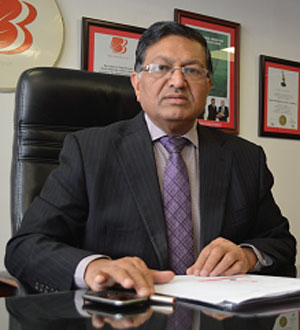
The bank has also won the FiRe Award 2012 for financial reporting. Majorly owned by Bank of Baroda, India, the country’s largest public sector bank, worth US$ 147 billion, Bank of Baroda Uganda is one of the oldest and strongest banks. The CEO Magazine’s Taddewo Senyonyi caught up with the bank’s Managing Director, Ashok Kumar Garg, about the bank’s experience in Uganda and the future prospects.
Bank of Baroda is one of the consistently profitable banks in Uganda; what factors explain the impressive performance the bank has enjoyed in the recent past?
Profitability of the Bank is the sum total of a number of variables , the major ones being:- Emphasis on low cost deposits through increasing clientele base, Deployment of funds efficiently, Micro management of treasury operations, Robust credit monitoring mechanism and thrust on Fee based income besides continuous focus on recovery of impaired assets.
The reasons for impressive performance can be attributed to the following factors:- Customer centricity has always been at the centre stage of Baroda’s operations, listening to the customer and proactively providing them solutions by improvising existing products and also introducing new products in line with the expectations of the customer. Flexibility in approach towards customer and charges has also contributed to business growth.
In a nutshell, we are a Super Financial House rendering the entire gamut of banking products and services under one roof be it wholesale or retail. Our wholly owned subsidiary Baroda Capital Markets (U) Ltd. is one of the pioneers in Securities market. The company has contributed significantly to the evolution of the securities market in the country. All activities related to equity trading including rendering demand services, take place in total compliance with the relevant statutes, rules and regulations required by the regulators.
Another form of investment opportunities provided to our customers is investments in Government Treasury bills/bonds which provide investors an opportunity to earn higher interest rates in comparison to other investment options having a risk free status. These services are rendered by our state of the art Treasury Department. We are amongst the six Primary Dealers licensed by the Central Bank. We are a bank for everyone and every business.
Bank of Baroda has had 60 uninterrupted years in Uganda’s banking industry, how has the bank survived over the years? And how has it contributed to the growth of Uganda’s economy?
The Bank has been a part and parcel of the growth and development of the Country by providing timely and need based financial assistance as also inculcating the habit of savings. Each one of our people is working overboard to improve the quality of our services not only for customer satisfaction but for customer’s delight. Safety, security and growth of stakeholders’ funds are our primary concern and the bank has adopted global best practices to minimize and mitigate various risk factors.
We are well capitalized to pass through stressful times comfortably. Good corporate governance, meticulous compliance of various regulatory and statutory requirements has been the hallmark of the bank. The bank has been a pioneer in financing the agriculture sector by lending financial support to major businesses in the sugar, dairy products, cotton , tea/coffee processing , food processing, finance to out growers and floriculture industry thus not only giving a boost to the agriculture sector but also ensuring valuable foreign exchange earnings to the country.
The Bank also provides Salary Loans, Consumer Loans to the salaried class of employees, and finances the highly demanding Infrastructure Sector, the economic growth engine Small and Medium Enterprise (SME) sector, the very essential Health and Education sector etc. The Bank has an exposure of 26 % of its total loan portfolio to Manufacturing sector and 19% to Agriculture sector among others thereby handsomely contributing to the growth and progress of the Nation in a very positive way. The biggest contribution Baroda is making to the community is probably employment generation and value creation.
 All Cash Withdrawals Now to be Taxed
What are the bank’s growth expansion plans?
We want to double our business in three years i.e. 2013-2015. The Bank is committed to bringing its products & services closer to the customers at the places & manner desired by them. To increase the outreach, we have recently opened a full service outlet in Kololo, Kampala. In fact, total number of our service outlets has doubled in a time span of three odd years. Moreover we are popularizing usage of Alternate Delivery Channels namely: ATM & Net Banking with facility of free SMS alerts.
In spite of Bank of Uganda reducing the Central Bank Rate to 11%, commercial banks’ lending rates are still high, thus making credit expensive. Why are you not reducing your rates?
The Prime Lending Rate of the Bank is based on inter alia various macro economic factors like cost of resources to the Bank, operational cost, minimum margin to cover regulatory requirements of provisioning & capital charge, profit margin, prevailing rates on government Treasury Bills and Bonds, the Central Bank Rate etc.However, as regards Bank of Baroda, the Prime Lending Rate has been consistently reduced downward in tune with the Central Bank Rates. The Prime Lending Rate of the Bank has been reduced from 27 % in Jan ’12 to 19 % in Aug’13.
A higher interest rate on Loans & Advances impedes the industrial growth in the economy. However, I also wish to comment about the issues of savings. Savings are crucial for the economic development of a nation. Countries with higher savings rate grow better than the countries with lower saving rates. A matter causing concern is low savings Rate in Uganda which is just 4 % against Kenya’s 14 %, Tanzania’s 20 %, India’s 31 %, and China’s 53 %.
Therefore this is important that regular saving habits are inculcated among the Ugandans right from the childhood. So my appeal to the countrymen is to inculcate the habit of savings and then experience the power of compounding. The more savings we put together as a country, the cheaper it will be for us to access loans for development, job creation and more growth.
After about 40 years, Bank of India returned to Uganda last year, a development that will see you compete for business especially from Ugandan-Indian business community. How are you prepared to handle this competition challenge?
The banking environment in Uganda has witnessed realignment in its competitive structure with the entry of many new Banks in the recent past. As such, the dynamics of the financial sector have changed drastically. With the entry of more players, the competition is on rise and is becoming moderate to fierce. We visualized the changing face of competition well in advance and accordingly designed more effective operational strategies for increasing the customer base.
We have fine tuned our basics by focusing on sustained Business Growth, High Asset Quality, Robust Systems and Procedures, Continuous Innovation, Focus on Customer Centricity and proper ALM systems to maintain Solvency and Liquidity. We believe that competition is always good for the development of the Banking Sector and we have thrived in competition as is evident by our presence in the country uninterruptedly since 1953. It provides us opportunity to introspect and improve upon ourselves by way of exploring ways & means to discover ever changing needs of the customers and proactively providing solutions.
We are entering into the final quarter of the year, what’s your bank’s financial outlook in 2013?
The financial year 2012 was very encouraging for the Bank. The Bank could beat the industry trend in major key parameters despite the macroeconomic challenges. In 2013, the economy seems to be on a recovery path especially the second half of the financial year will turn out to be good. Now the market is in the process of stabilizing on account of policies adopted by the Central Bank of the country and Government of Uganda to tame inflation and achieve sustainable growth. The Bank’s outlook for 2013 is therefore positive.