African asset financing startup, M-Kopa has raised a combined equity and debt round of at least $250m, the company announced on Monday. This is one of the biggest single funding rounds raised by an African startup. M-Kopa will use this funding to continue its Africa-wide expansion and increase its 3m users in Kenya, Uganda and Nigeria.
This funding round attracted Standard Bank, Africa’s largest bank by assets, who sunk $100m into the debt round. The rest of the debt round was supplied by development financial institutions the International Finance Centre (IFC), FMO which is a Dutch development Bank and British International Investment (BII) and funds managed by Lion’s Head Global Partners, Mirova SunFunder and Nithio.
On the other hand, the equity round (about $65m) was led by Japanese firm Sumitomo Corporation with $36.5m. The rest of the funding came from Blue Haven Initiative, Lightrock, Broadscale Group and Latitude, the sister fund to Local Globe. As per Digest Africa, M-Kopa had raised about $245 million, so this funding round will make it one of the most funded African startups with about $500 million raised since its inception.
M-Kopa was founded in 2011 in Nairobi, Kenya, by Jesse Moore, Chad Larson, and Nick Hughes. The founders recognized the immense energy poverty in Africa, where millions of people lacked access to reliable electricity. They saw an opportunity to address this problem by leveraging the widespread use of mobile phones and mobile money platforms in the region.
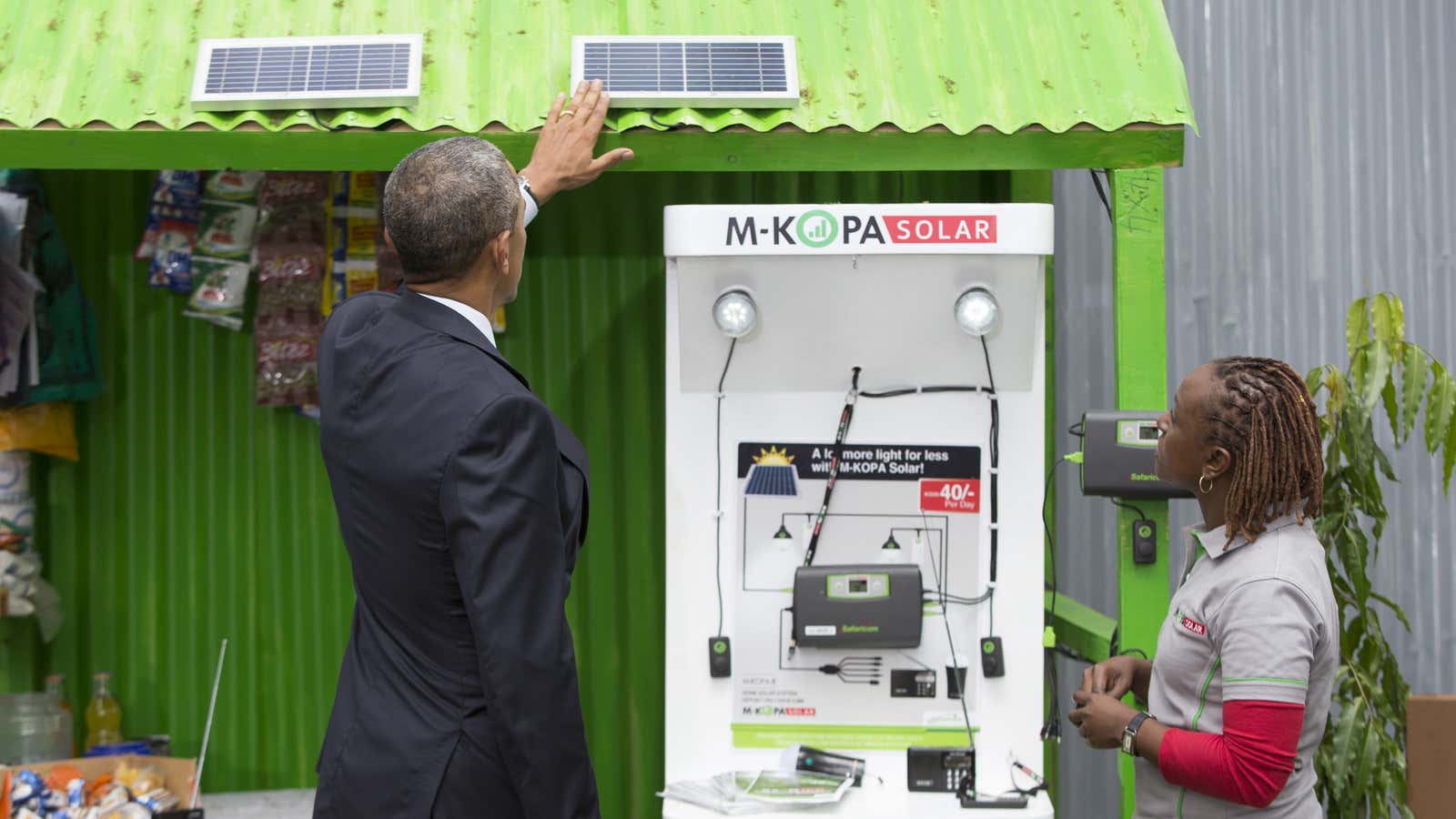
M-Kopa pioneered an innovative business model based on pay-as-you-go solar energy. The founders developed solar home systems that included solar panels, battery storage, LED lights, and phone-charging capabilities. Unlike traditional solar solutions that required a large upfront investment, M-Kopa offered affordable access to clean energy by allowing customers to make small daily payments using mobile money.
To use M-Kopa’s services, customers would first make a small initial deposit and receive the solar system installation. They could then activate the system by making regular payments through mobile money platforms such as M-Pesa or MTN Mobile Money. Once the payment was made, the system would unlock and provide electricity for the household.
Related
 Katikkiro Charles Peter Mayiga Urges Families to Prioritize Health at Ettendo Worship Concert
This pay-as-you-go approach enabled customers to enjoy the benefits of solar power without the financial burden of a significant upfront cost. It also allowed M-Kopa to mitigate the risk of non-payment by remotely disabling the system if a customer fell behind on payments.
M-Kopa’s business model gained traction quickly, and the company experienced rapid growth. In its early years, M-Kopa focused on expanding its operations within Kenya and eventually expanded to other African countries, including Uganda and Nigeria.
Over time, M-Kopa expanded its product offerings beyond solar home systems. The company introduced additional products such as solar-powered televisions, energy-efficient cookstoves, and solar-powered water pumps, further enhancing its impact on households in off-grid areas. M-Kopa also introduced smartphones which people pay for in daily instalments. They sell the phones to individual customers and also in partnership with ride-hailing companies whose drivers need smartphones to work.
M-Kopa currently has 3m customers according to TechCrunch, having witnessed a CAGR of 85% between 2020 and 2022. With this new funding, M-Kopa will focus on acquiring 100,000 new customers a month, and also expand its footprint into the e-mobility sector by providing electric motorcycles (commonly known as boda bodas) in their offerings starting with Kenya where it has already secured a partnership with Nairobi-based Swedish manufacturer Roam.