For more than a decade, Uganda’s energy sector—under the political stewardship of Ruth Nankabirwa Ssentamu since 2021—has ranked among the government’s top priority sectors, consistently absorbing trillions of shillings in taxpayer funding and, in several budget cycles, commanding well over 5% of the national budget.
Anchored on mega hydroelectric projects, oil and gas development, and ambitious transmission and distribution expansion, the sector has been positioned as a cornerstone of industrialisation and long-term economic transformation.
Yet the latest Auditor General’s Annual Report to Parliament for the year ended June 2025 reveals a sector struggling to convert scale into performance.
The report paints a sobering picture: underutilised power plants, crippled transmission infrastructure, financially exposed distribution operations, delayed oil and gas projects, and critical gaps in environmental preparedness—all unfolding against a backdrop of rising public debt and intensifying fiscal pressure.
Taken together, the findings suggest an energy sector that has expanded rapidly on paper and in budgetary allocation, but whose execution, coordination, and governance have failed to keep pace with the scale of public investment now at stake.
Read in aggregate, the Auditor General’s findings may well serve as a snapshot of the energy sector under Ruth Nankabirwa Ssentamu’s five-year stewardship at the Ministry of Energy and Mineral Development.
While the period has been defined by unprecedented capital deployment—spanning generation, transmission, distribution, and oil and gas—the report raises uncomfortable questions about outcomes, value-for-money, and institutional readiness.
It suggests that scale has outpaced systems, ambition has exceeded execution capacity, and fiscal exposure has grown faster than operational resilience.
As the country edges closer to first oil and carries an increasingly debt-financed power sector, the record now emerging invites a more rigorous public and parliamentary assessment of whether Uganda’s most capital-intensive ministry has delivered commensurate performance for the trillions entrusted to it.
Electricity Generation: Big Dams, Weak Demand, Mounting Financial Risk
Uganda has invested heavily in electricity generation as part of its Vision 2040 ambition to reach 52,481MW by 2040. Flagship projects—Karuma (600MW) and Isimba (183MW)—were financed through large on-lent loans from China’s EXIM Bank, totalling nearly USD 2 billion
Yet the Auditor General’s analysis reveals a stark utilisation gap across Uganda’s electricity generation fleet. Karuma Hydropower Plant produced only 808.27 GWh, equivalent to just 30% of its declared available capacity, while Isimba generated 1,046.41 GWh, or 72% of capacity.
In contrast, the ageing Nalubaale–Kiira complex was operated beyond its declared limits, achieving 112% capacity utilisation—a disparity that underscores deep structural imbalances in dispatch priorities, where older assets are run harder even as newly commissioned, debt-financed plants remain significantly underutilised.
More troubling is Karuma’s operational profile. In its first two years, the plant averaged 70MWh and 116MWh, far below the 300MWh minimum dispatch threshold required to expose latent defects during the defects liability period.
As a result, the plant realised only UGX 148.16 billion—less than half of its projected UGX 316.42 billion revenue, raising concerns about debt servicing and long-term asset integrity.
Management attributed the low dispatch to insufficient demand, preferential dispatch of low-cost private producers, and rigid capacity-charge structures—an admission that Uganda’s power market architecture is failing to absorb the very assets it financed.
These performance gaps inevitably place the spotlight on Uganda Electricity Generation Company Limited (UEGCL), the state utility charged with converting these multi-billion-dollar investments into reliable and bankable electricity output.
According to the Auditor General, UEGCL reported a profit of UGX 25.02 billion in FY2024/25, a sharp decline from UGX 54.28 billion posted the previous year—representing a 54% contraction in profitability.
The drop was directly attributed to the underutilisation of Karuma Hydropower Plant, which significantly reduced energy sales and revenue despite the scale of capital invested in the asset.
Beyond profitability, the report highlights mounting liquidity and working-capital pressures. UEGCL’s trade and other receivables increased by UGX 38.25 billion, rising from UGX 118.66 billion to UGX 156.91 billion, largely driven by unpaid power sales to UETCL, including UGX 108.94 billion outstanding, some of it dating back over a year.
At the same time, trade and other payables climbed to UGX 41.88 billion, while delayed contractor payments—some exceeding 200 days—left UGX 4.81 billion unpaid during the audit period.
Revenue performance remained weak: of the UGX 620.02 billion budgeted revenue, the company collected UGX 217.28 billion, while spending UGX 217.28 billion out of UGX 332.01 billion available, reflecting both revenue underperformance and constrained absorption.
Taken together, the Auditor General’s assessment suggests that UEGCL remains profitable in name but fragile in substance—a utility sitting atop some of Uganda’s most expensive infrastructure, yet struggling to translate installed capacity into sustainable cash flows.
In a sector financed largely through sovereign borrowing, this weak financial conversion heightens the risk that generation assets become fiscal liabilities rather than engines of industrial growth.
Transmission: Idle Transformers, Grid Failures, and Costly “Deemed Energy”
Even where power is available, Uganda’s transmission network is proving unable to evacuate it efficiently.
The Auditor General documents persistent grid interruptions caused by line faults, vandalism, equipment failures, transformer outages, and SCADA system limitations.
These weaknesses forced the Government to recognise UGX 26.94 billion in deemed energy payments—power paid for but not consumed—during the financial year.
More alarming is the extent of idle infrastructure. For example, major transformers at Namanve, Mutundwe, Lugazi, Owen Falls, Agago, and Namanve South have remained out of service for periods ranging from 8 to 41 months.
Some assets, rated as high as 63 MVA, have sat idle due to faults, delayed repairs, or lack of load planning.
The Auditor General concludes that this reflects non-utilisation of significant non-current assets, misalignment between investment and demand, and weak maintenance planning—effectively locking billions of shillings in stranded infrastructure.
It is therefore no wonder that the Uganda Electricity Transmission Company Limited (UETCL) the government entity in charge of transmission, recorded a sharp deterioration in financial performance during the audit year, sliding from a profit of UGX 82.25 billion in the previous year to a loss of UGX 293.1 billion in FY2024/25.
The Auditor General further notes that UETCL’s Return on Assets (ROA) stood at just 1.89%, underscoring weak asset productivity in a capital-intensive business.
Beyond the reported loss, the low ROA is largely explained by the fact that over 60% of the company’s total assets remain classified as work-in-progress, meaning they do not yet contribute to revenue generation.
Management indicated that efforts are ongoing to expedite project completion and commissioning in order to bring these assets into productive use.
Liquidity pressures remain acute. Outstanding receivables amounting to UGX 1.48 trillion continue to constrain UETCL’s cash flows, despite ongoing recovery efforts.
In addition, legacy inter-entity balances remain unreconciled, including UGX 132.1 billion payable to the Ministry of Energy and Mineral Development in respect of the rural electrification levy, complicating cash management and financial reporting.
The company’s strategic execution was also materially constrained by funding shortfalls. The Auditor General reports that UETCL’s Strategic Plan was underfunded by 41.8%, with only UGX 1.758 trillion made available out of a planned UGX 3.022 trillion. This included a 95% shortfall in capital development funding, equivalent to UGX 905.366 billion, which limited project implementation, feasibility studies, and network expansion.
 Diageo Says Kenyan Distributor Weaponising Case to Frustrate its Exit From EABL
Performance against planned outputs was mixed. Of 91 outputs assessed, only 46 outputs (51%) were fully achieved, 31 outputs (34%) were partially achieved, while 14 outputs (15%) were not achieved at all, pointing to execution gaps across UETCL’s mandate.
Operational efficiency also weakened. Transmission capacity utilisation declined to 43.4%, with over 60% of transformers operating below 50% load. The system reserve margin fell sharply from 32.2% to 12.83%, while technical losses rose to 4.46%, exceeding the target of 4.08%.
The Auditor General further cited ineffective utilisation and maintenance of transmission assets, including long-idle and faulty transformers, vandalism incidents, and recurring equipment failures.
Distribution After UMEME: A Rocky Transition for UEDCL
The expiry of UMEME’s 20-year concession on 31 March 2025 marked a historic shift in Uganda’s electricity distribution landscape.
Uganda Electricity Distribution Company Limited (UEDCL) inherited a dramatically expanded operation almost overnight.
By June 2025, the scale of operations had expanded dramatically. The asset base ballooned from UGX 113 billion to UGX 2 trillion, reflecting the wholesale transfer of network infrastructure.
Over the same period, the customer base surged from 165,937 to 2.2 million, while staff numbers rose sharply from 480 to 2,489 to support the vastly enlarged footprint.
Annual revenue also increased significantly, jumping from UGX 111 billion to UGX 661 billion, underscoring both the opportunities and operational pressures that accompanied the rapid expansion.
But scale has come at a cost.
The Auditor General reports service delivery weaknesses across network reliability, outage management, metering, customer responsiveness, and complaint resolution.
UEDCL attributes these challenges to years of underinvestment in the distribution network, vandalism, electricity theft, procurement bottlenecks, and staffing constraints inherited from the concession’s final years. .
While management has rolled out corrective measures—including the “Wetereze” loss-reduction campaign, meter replacement, and a five-year rehabilitation plan—the report makes clear that distribution remains a fragile link in Uganda’s power value chain.
Oil & Gas: First Oil Target Under Pressure
Uganda’s oil sector—once marketed as the country’s next fiscal game-changer—is also falling behind schedule.
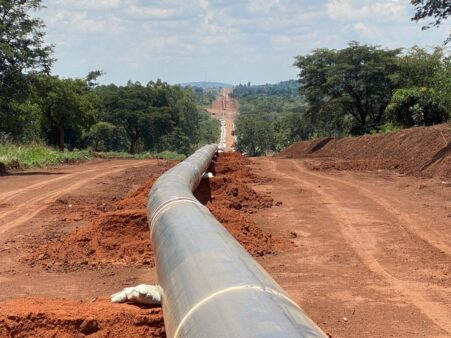
Government’s target of First Oil by mid-2026 hinges on progress across three critical projects: Tilenga, Kingfisher, and the East African Crude Oil Pipeline (EACOP).
However, Auditor General reviews show that all three projects are behind their planned milestones.
As of June 2025, progress across Uganda’s three flagship oil and gas projects was uniformly behind schedule. Tilenga had reached 57% completion, falling well short of its 73.18% target, while Kingfisher stood at 69.62%, also below the planned milestone.
The East African Crude Oil Pipeline (EACOP) trailed at 62.5% completion, compared with a planned 72%, underscoring the cumulative execution gap across the entire First Oil programme.
As of November 2025 the status of the progress has improved and by November 2025, overall completion rates for the projects were 60% for Tilenga, 74% for Kingfisher (all wells necessary for first oil have been drilled) and 75% for the East African Crude Oil Pipeline.
While drilling at Kingfisher has progressed sufficiently for first oil, schedule slippages across the broader ecosystem pose material risk to the 2026 timeline.
Perhaps the most alarming oil-sector finding relates to environmental and safety readiness.
Management indicated that measures such as pre-commissioning tests , increased work shift and establishment of an Inter-ministerial committee ,have been put in place to fast track the project implementation.
The National Oil Spill Response and Monitoring Infrastructure Project, designed to prepare Uganda for oil spill emergencies, has effectively stalled.
Out of an estimated UGX 59.9 billion required, Government released just UGX 1.2 billion over three years—barely 2% of the project cost.
The Auditor General warns that entering first oil without a functional spill response system exposes Uganda to unmitigated environmental, reputational, and financial risks, especially given the scale and cross-border nature of EACOP.
The Bigger Picture: An Energy Sector Outpacing Its Institutions
Viewed collectively, the Auditor General’s findings point to a deeper structural failure: Uganda’s energy ambitions have significantly outpaced the readiness and responsiveness of the institutions meant to steward them.
Generation capacity has expanded rapidly, but demand stimulation has lagged. Transmission assets have been built, yet many remain idle, underutilised, or poorly maintained.
Electricity distribution has been nationalised following the exit of UMEME, but without adequate transition buffers to protect service quality. In the oil and gas subsector, project construction has advanced, yet critical environmental and emergency safeguards remain chronically underfunded.
These gaps are no longer isolated technical shortcomings. They increasingly reflect systemic coordination and oversight weaknesses, including signs of regulatory inertia in a sector that demands constant, assertive supervision.
The persistence of stranded assets, distorted dispatch priorities, rising deemed-energy costs, weak service delivery, and delayed readiness systems raises uncomfortable questions about whether the regulatory architecture—particularly the Electricity Regulatory Authority—has been sufficiently proactive in enforcing efficiency, discipline, and value-for-money across the power value chain.
The fiscal stakes are already visible. Public debt has climbed to UGX 114.6 trillion, while energy projects account for some of the longest-running and most capital-intensive infrastructure delays in Government portfolios.
At this scale, misalignment between investment, regulation, and execution is no longer theoretical—it carries real fiscal costs, operational consequences, and reputational risk for the state.
Unless Government urgently tightens coordination between the Ministry of Energy and Mineral Development, the Electricity Regulatory Authority, the Uganda Electricity Generation Company Limited, the Uganda Electricity Transmission Company Limited, the Uganda Electricity Distribution Company Limited, the Petroleum Authority of Uganda, and the Ministry of Finance, Planning and Economic Development, Uganda risks entering its oil and power future burdened by stranded assets, rising contingent liabilities, and eroding public confidence.
The promise of energy as a catalyst for industrialisation remains intact. But the Auditor General’s verdict is unmistakable: without sharper regulation, stronger institutional accountability, and disciplined execution, Uganda’s energy transition risks becoming its most expensive missed opportunity.