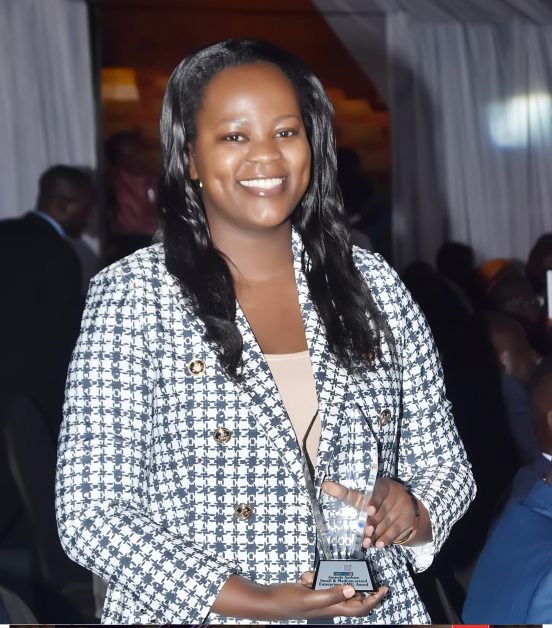
AutoXpress Uganda CFO, Amanda Ayebare won the SME CFO Award at the 9th edition of the Chief Financial Officer Awards 2025– an initiative of ACCA Uganda and Deloitte Uganda.
In an exclusive interview with CEO East Africa Magazine’ Paul Murungi, she opens up about leading finance in the demanding SME landscape, the necessity of thinking “outside the box,” adopting quickly, and steering the business through tough choices concerning survival and growth.
Ayebare champions the need for tenacity and firm rooting to turn challenges into long-term success.
Amanda, congratulations on this incredible milestone. Leading finance in an SME is both exhilarating and demanding. How does it feel to see your hard work and persistence recognised at this level?
Thank you, I appreciate it.
It’s very fulfilling and humbling to be awarded on one of the biggest platforms of the profession. True, SMEs can be quite adventurous, so it really is a full circle moment for me.
What first drew you to finance, and how did you discover that the discipline could be not just analytical but also creative and transformative?
I come from a family of mathematicians, so I’ve always been a friend to numbers. It seemed natural that my career would follow along that path, but I wasn’t sure in which direction exactly.
I would point my introduction to the profession to my A Levels, where I studied Entrepreneurship, and remember taking Accounting under one of the papers. Our teacher was great, and I absolutely enjoyed it and passed it very well.
Over the years, it’s become incredibly clear that number crunching and analysis are only half of the profession. Seeing the need to contribute to business strategy and how finance feeds into all spheres of any organisation is a testament to the wide range of possibilities and creative directions one’s career could take. It truly allows you to think outside the box and mould your experience to adapt to any industry.
Every CFO’s journey has turning points — moments when theory meets reality. What have been those defining moments for you at AutoXpress?
Wow, there have been several over the years, but most notably for me would be the transition from Accountant to Finance Leader. There are innovative accounting systems available these days that transform theory into well-presented reports; however, having to then apply that information in the real world, with real-life company challenges, on a daily basis, is no easy fit.
Currently, the most defining moment for me at AutoXpress is the expansion drive. Moreover, being a part of the core management team has widened my horizon on business sustainability, which has not only made me move out of my comfort zone but also honed my skills as a business professional – a unique blend of finance and business.
SMEs often face the toughest trade-offs between survival and growth. How have you balanced risk-taking with financial prudence in steering AutoXpress forward?
True. And, I believe you will always have to do a happy dance between the two (survival or growth) because that is the very nature of SMEs.
I’m glad that AutoXpress chose to firm its roots first before expanding. Growth in itself is risky, but we bite the bullet with preparedness, planning, forecasting and financial discipline. Key questions are always answered when it comes to the financial needs in the growth plans and during decision-making.
Leadership is often about people more than policies. What have you learned about building trust and resilience within a small, close-knit organisation?
Trust is vital. Especially because each decision (more so in finance) has far-reaching consequences and not only affects oneself but also the organisation. Resilience is also a requirement if you are going to see an SME through the current business climate. So, it’s been important for me to show up on both fronts in order to be a reliable and trusted member of the team.
I am also a big advocate for everyone learning something about finance, including non-finance professionals. Many times, finance is a support function, and in some companies, the department works in silos. Bringing in those charged with governance, sales team members and operations officials makes them not only appreciate the numbers but also take ownership of their contribution to the bottom line and trust the finance team a little more.
How do you define your legacy at AutoXpress — what systems, values, or culture do you want to outlive your tenure?
Sometime last year, I overheard someone describing me to someone else who didn’t know me. And they said, ‘She’s very particular.’ Haha, that always stuck with me. I espouse values such as honesty, diligence, hard work and love of what I do.
Be that as it may, I would hope that the finance function remains meticulous, supportive to the core of the business, and I would like my legacy to be associated with the tenacity that was needed at the Turning Point of the organisation.
 Ruparelia Group Wins Key Entebbe Land Case, Clearing Path for the New Mega Speke Resort and Convention Centre, Entebbe
Looking back, what key innovations or financial strategies do you believe helped turn challenges into opportunities for success?
On the issue of growth, SMEs grapple with a funding gap/need for access to finance and must bank on several key relationships to thrive.
AutoXpress maintains good relationships with all key stakeholders who support the company’s needs and growth plans. Innovation is also at the heart of the company culture, with recent dual onboarding of an accounting system and a business system that are industry-specific and promise efficiency and innovation.
All this while keeping track of the financial planning, budgeting and projections such that any growth and every new branch opened henceforth is supported within a well-oiled machine.
Outside the office, what experiences or relationships have most shaped the way you show up as a leader — perhaps things that taught you patience, empathy, or grit?
My family, by far, has been the most influential. I have early memories of being given responsibilities by my parents from a young age. Resilience taught by my Dad, and the blessing of being a caregiver and taking care of others, studied from my Mom, have stirred up a good cocktail of leadership ability in me.
I am also considered among those who took on the Accounting profession through the non-conventional route. Having opted into ACCA and obtained the Oxford Brookes University degree along the journey, rather than going the direct university route, made me have to learn to stand out against all odds and beat the status quo to get a shot at the top.
Finally, it’s all the people I’ve encountered along my career journey whom I endeavour to learn from, both in and out of the office – colleagues, Peers, Mentors and the ACCA Uganda team, who have always been of great support careerwise.
What keeps you motivated on difficult days? What makes you wake up excited to do what you do?
Knowing that the difficult days are part of everyday life. I like what I do. I like the profession, and that’s been motivation enough for me so far. Enjoying what I do makes it feel less of a burden and more of a blessing to have the opportunity.
Starting out my profession in one of the Big 4 Audit firms, PricewaterhouseCoopers, definitely laid a great foundation for resilience and gave a master class in looking for a way out of demanding situations, no matter what.
I’ve also got an entrepreneurial streak, so I look forward to learning and cross-referencing winning ideas between my career and in business ventures.
What advice would you share with emerging SME CFOs who want to build strong, resilient companies while remaining true to their values?
Oddly enough, I think it starts with the individual.
Ask yourself ‘Why me? What is my goal here? What do I want to achieve? What is my role within the bigger picture of the organisation? What is the company’s goal?’
Then, you must master the company and its needs. This takes time, but as Finance professionals, you are best suited to have a bird’s eye view of all corners of influence, blind spots and in order to be a valuable member, think of how you can make an impact that will be useful and lasting, unique to the company’s needs.
You should not compromise on your values; they are what make you, you. We ultimately need to take accountability for our decisions, so think before you act.
If someone asked you what success truly means, what would you say — and how has that definition changed over time?
Success for me is living in my God given purpose. Many search for that fulfilment for long, but the change over time for me has been in the continued pursuit of its understanding, listening, adjusting and ultimately yielding to HIS plan for my life.
Success to me then means that having found your purpose, you are of impact to some or many for the very reason you were created. I find greater peace in this alignment.