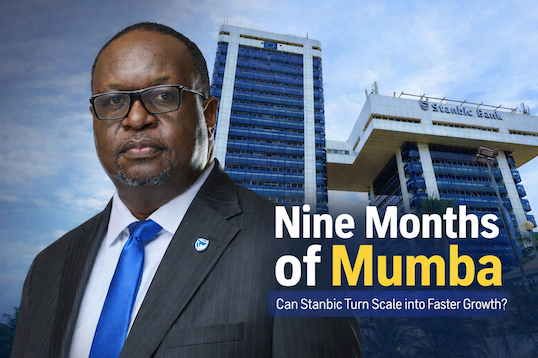
In a few weeks, Stanbic Bank Uganda — the country’s largest commercial bank — will release its full-year 2025 results. If its first-half performance is any indication, the bank is likely to report positive growth across most of its core fundamentals.
Stanbic Uganda Holdings Limited (SUHL), where Stanbic Bank remains the anchor subsidiary and principal value driver, recorded a sharp acceleration across its balance-sheet metrics in H1 2025. Customer deposits grew to UGX 8.44 trillion, a 28.9% year-on-year increase from UGX 6.55 trillion in June 2024. That liquidity expansion translated into measured loan growth, with loans and advances rising to UGX 4.94 trillion, up 12.9% from UGX 4.38 trillion — reflecting a deliberate lending posture that balanced growth with credit discipline.
Growth was broad-based. Corporate and Investment Banking led the surge, posting a 52% increase in deposits and a 17% rise in lending. Business, Commercial, Private and Personal Banking all recorded solid gains across both deposits and loans. Strategic portfolios also expanded, with the SME loan book edging up to UGX 969 billion from UGX 950 billion, while agriculture lending reached UGX 398 billion — reinforcing Stanbic’s positioning at the centre of Uganda’s productive economy.
Income performance mirrored this balance-sheet momentum. Net interest income climbed to UGX 371.5 billion, while non-interest income reached UGX 313.7 billion, lifting total operating income before impairment to UGX 685.2 billion. Core banking activities accounted for the bulk of this performance, including UGX 112.0 billion in fees and commissions and UGX 188.2 billion in trading income.
Profitability followed suit, though less dramatically. SUHL reported profit after tax of UGX 278.4 billion, an 18.2% year-on-year increase, translating into a robust return on equity of 26.9%. Total assets expanded to UGX 11.80 trillion, up 20.9% from UGX 9.77 trillion in June 2024, consolidating the Group’s position as Uganda’s largest financial services franchise.
Strong Numbers — But Not the Full Story
Viewed in isolation, the H1 2025 numbers are solid but not necessarily conclusive. Their significance becomes clearer when set against H1 2024. In the six months to June 2024, deposits grew by just 4.9%; by contrast, they expanded 28.9% in the same period of 2025. Asset growth accelerated from 3.8% to 20.9%, while lending growth picked up from 9.5% to 12.9%. Income lines followed a similar trajectory, lifting operating income to a markedly higher base than a year earlier.
Notably, this balance-sheet acceleration has not yet translated into a commensurate surge in profitability. Profit after tax grew by 17.6% in H1 2024 and 18.2% in H1 2025 — steady, but modest relative to the pace of asset and deposit expansion.
This lag partly reflects the bank’s emergence from a prolonged period of slowed momentum. Between 2020 and 2024, Stanbic continued to grow in absolute terms, but at a materially slower pace than in the preceding five years. Customer deposits, which had expanded at an average 18% CAGR between 2015 and 2019, slowed to about 6.6% CAGR from 2020 to 2024, rising from UGX 5.49 trillion to UGX 7.11 trillion. Lending growth moderated even more sharply, with the loan book increasing from UGX 3.62 trillion to UGX 4.37 trillion — a sub-5% CAGR — while asset growth similarly slowed to below 5% annually, despite total assets reaching UGX 10.34 trillion by end-2024.

This period was shaped not only by the economic disruption of COVID-19, but also by an increasingly competitive landscape in which both tier-one peers and fast-rising mid-tier banks expanded at significantly higher rates, often leveraging digital channels, niche strategies and lower base effects.
Against that backdrop, the resilience of profitability is notable. Stanbic’s net profit grew from UGX 241.7 billion in 2020 to UGX 486.8 billion in 2024 — a strong outcome, but one that increasingly reflected profit growth outpacing underlying balance-sheet expansion.
To better understand how the bank is assessing this moment, we sought an interview with Mumba Kalifungwa. We shared a broad set of questions covering growth momentum, sector headwinds, internal bottlenecks, governance and accountability, and the strategic priorities shaping Stanbic’s next phase. While he did not respond to every question, his feedback offered insight into how the bank is attempting to pivot from a period of measured growth toward renewed momentum under new leadership.
Kalifungwa acknowledged the complexity of the operating environment. “Uganda’s banking sector has faced macroeconomic pressures, foreign exchange volatility, and regulatory shifts, all compounded by the impact of COVID-19,” he said. “Customers’ capacity to borrow and repay has been tested, and banks must adapt responsibly.”
It is, however, important to note that while Mumba’s explanations are valid, Stanbic’s competitors — both in the tier-one bracket and among mid-tier banks — grew at materially faster rates. Between 2020 and 2024, Stanbic’s net profit expanded at a 19.1% compound annual growth rate, strong in absolute terms but increasingly outpaced by rivals. Centenary Bank delivered a 20.7% CAGR, while Absa Bank Uganda recorded a far sharper rebound, growing profit at 44.6% CAGR, and dfcu Bank expanded earnings at 32.9% CAGR, underscoring how quickly momentum shifted toward banks that moved decisively in the post-pandemic period.
The divergence was even more pronounced among mid-tier institutions, many of which expanded at two to three times Stanbic’s pace. Housing Finance Bank grew profit at 36.1% CAGR, PostBank Uganda at 36.8%, and NCBA Ugandaat 44.1%, reflecting the rise of digitally driven, niche-focused and government-backed models. Backed by regional capital, targeted strategies and leaner operating structures, these banks grew faster even as Stanbic remained the most profitable in absolute terms — a dynamic that steadily narrowed its growth advantage across the sector.
Under his leadership, Kalifungwa made it clear that he would continue to solidify Stanbic’s position as more than a financial institution — as a catalyst for inclusive growth, a partner for women, youth, and farmers, and a driver of social and economic transformation.
He believes the bank’s H1 2025 results are an indicator of the good things to come.
“Our first-half results were a powerful indicator that our seemingly overambitious growth goals are possible to achieve,” Kalifungwa says. “While there is room for improvement, these figures show we are on track to maintain our market leadership and, more importantly, to deepen our relevance to customers.”
Strategic Priorities: Purpose at the Core
At the heart of Stanbic’s strategic pivot is a deliberate emphasis on positive impact initiatives, designed to extend the bank’s role beyond traditional financial services.
“We are refocusing our energy on initiatives that create meaningful economic opportunity for women, youth, and farmers,” he explained. These groups form the backbone of Uganda’s socio-economic development, and Stanbic sees its role as a partner in accelerating national transformation.

The bank is building on existing initiatives such as Stanbic4Her, the SACCO Programme, and the Stanbic Business Incubator, which already support enterprise growth, financial inclusion, and access to affordable finance. “Our ambition is to scale these programs, harnessing partnerships to maximise reach and impact,” Kalifungwa notes. “This is about more than banking. It is about enabling people to succeed in ways that drive the economy forward.”
Driving Innovation Through Technology
 Ruparelia Group Wins Key Entebbe Land Case, Clearing Path for the New Mega Speke Resort and Convention Centre, Entebbe
Digital channels are central to Stanbic’s strategy. By expanding online account opening, digital lending, and agent networks, the bank aims to reach underserved segments quickly and efficiently.
Integration of advanced tools such as Salesforce with core banking systems is improving decision-making, customer insights, and cross-selling capabilities. “Technology is an enabler,” says Kalifungwa. “It allows us to deliver faster, more personalised services while maintaining the integrity and security our customers expect.”
At the same time, digital expansion comes with increased exposure to fraud and operational risk. The bank has invested heavily in AI-driven fraud detection, enhanced whistleblower channels, and robust internal controls- very critical for a bank that has in the past faced a couple of big-ticket frauds.
Kalifungwa is clear: “Zero tolerance for fraud is non-negotiable. Accountability begins with leadership, and transparency is essential. Stakeholders must trust that any breach of integrity is addressed swiftly and decisively.”
The External Landscape: Industry Headwinds
Uganda’s banking sector faces challenges that extend beyond any single institution. Regulatory uncertainty, rising operational costs, digital disruption, and intensifying competition from fintechs and mobile money platforms demand a collective, strategic response.
Kalifungwa advocates for closer collaboration between banks and regulators to foster innovation while maintaining financial stability. Shared infrastructure, anti-fraud networks, and skills development are among the measures he believes are critical for sector-wide resilience.
“Banks cannot operate in isolation,” he emphasises. “We must invest in technology and talent, maintain transparency, and uphold the highest ethical standards. Our industry has an opportunity to set a new benchmark for integrity and service excellence.”
Balancing Growth and Prudence
Internally, Stanbic has addressed legacy bottlenecks that previously slowed growth. Operational inefficiencies have been trimmed, cultural inertia is being replaced with a performance-driven ethos, and leadership has been reorganised to align with strategic priorities. Digital onboarding and self-service improvements are already enhancing customer experience, particularly for children’s accounts, diaspora clients, and smallholder farmers.
Credit risk management remains a priority. “Sustainable growth is better than rapid growth without prudence,” Kalifungwa notes. “We are deliberate in lending, ensuring that our expansion is resilient, and that our customers succeed.”
Despite challenges, Kalifungwa sees immense potential. The bank is scaling support for SMEs, aligning with ESG principles, and backing green and sustainable investments. Financial inclusion is being deepened through FlexiPay, and specialised products for youth and women entrepreneurs are gaining traction.
“Our legacy as a management team that I lead will be defined not by profits alone but by the tangible impact we create,” he says. “This is about driving Uganda’s growth — empowering businesses and communities — while maintaining trust through transparency and ethical leadership.”
All eyes on Kalifungwa: Can He Deliver Stanbic’s Next Growth Phase?
Under Mumba Kalifungwa, Stanbic is increasingly positioning itself not merely as Uganda’s largest commercial bank, but as a regional growth enabler anchored in East Africa’s integration agenda. The strategy rests on two reinforcing pillars: leveraging Standard Bank Group’s balance sheet, regional network and capital appetite, and using that scale to keep lending and structuring large transactions even as others pull back. The shift marks a move from passive market leadership to more deliberate growth orchestration across strategic sectors.
Speaking at the October 2025 Standard Bank East Africa Summit, Kalifungwa framed Uganda’s role as both central and underappreciated. “We sit at the geographic centre of East Africa — a location that is not just symbolic, but strategic,” he told delegates, pointing to investments in modernised border posts, regional highways, energy interconnections and trade-facilitation systems that have repositioned Uganda from a terminal market into a gateway for cross-border opportunity. For him, this infrastructure is laying the groundwork for deeper participation in regional value chains.

Crucially, Kalifungwa argues that integration is not just about logistics. “This connectivity is not about moving products,” he said. “It’s about moving potential — enabling entrepreneurs, women and youth-led enterprises to reach new markets.” He described Uganda as a natural bridge between markets and Stanbic — as the country’s largest bank and part of Africa’s biggest financial services group — as uniquely positioned to translate that potential into growth. “When you bank with us at Stanbic Uganda, you are banking in East Africa, and you are banking on the continent,” he said.
Recent transactions illustrate this pivot in concrete terms. Through its Corporate and Investment Banking platform and regional coordination, Stanbic structured USD 45 million in cross-border financing for the Pepsi bottling expansion across Uganda and Kenya, reversing traditional capital flows and supporting one of East Africa’s most ambitious industrial integrations. Similarly, the USD 36 million financing for Quality Chemical Industries Limited — to build a second WHO-compliant pharmaceutical plant — places the bank at the centre of Africa’s health security and industrialisation agenda, expanding tablet production capacity from 1.4 billion to 2.4 billion units annually. These are not incremental loans; they are ecosystem-shaping transactions.
The strategy is anchored domestically through the Keep Growing campaign — an 18-month commitment launched at a time when much of the sector is tightening credit. Targeting women, youth, farmers, SMEs and households, the initiative has already delivered UGX 245 billion in loans to more than 88,000 entities, often at rates below market prime. Through platforms such as Stanbic4Her, SACCO partnerships and the Stanbic Business Incubator, the bank is reinforcing a development-led approach to commercial banking.
Taken together, the outlook suggests a bank seeking to reclaim momentum not by chasing short-term profit acceleration, but by scaling fundamentals through regional connectivity, disciplined risk appetite and inclusion-driven growth. “We are stepping beyond traditional banking,” Kalifungwa says. “Our mission is to support Uganda’s growth journey — which has always been our purpose.”
For now, however, all eyes remain on Kalifungwa as Stanbic prepares to release its full-year 2025 results. These numbers will offer an important signal, but they will not yet amount to a definitive verdict — coming less than a year into his tenure. Expectations are inevitably shaped by his record at Absa Uganda, where between 2020 and 2024 he oversaw a sharp rebound, lifting deposits to UGX 3.19 trillion, loans to UGX 1.99 trillion, assets to UGX 5.43 trillion, and net profit from UGX 40.7 billion to UGX 177.9 billion.
The more demanding test lies ahead. The years 2026 and 2027 will be decisive — not just in determining whether Stanbic can grow faster again, but whether that growth proves sustainable, disciplined and repeatable in an increasingly competitive and fast-evolving banking landscape.