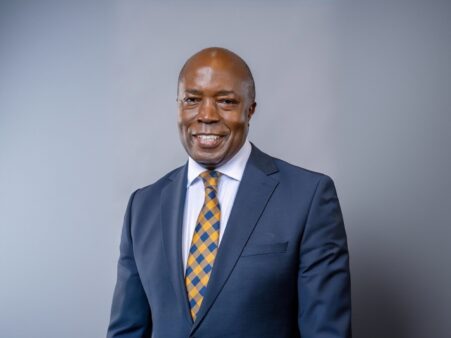
In this conversation with CEO East Africa Magazine’s Muhereza Kyamutetera, Muwanguzi reflects on 17 years of building Pegasus, the grit it took to win boardroom trust without relying on political connections, and the hard-learned lessons in the business, regulation, and the disruptive future of AI.
At the core of Muwanguzi’s philosophy is what he calls safeguarding Ugandanness in technology — a form of techno-nationalism, where nations deliberately prioritise domestic innovation and control of critical technologies to protect jobs, create local value, and secure their economic future. Large investors and foreign capital alone, he argues, will not solve Uganda’s unemployment crisis. The real backbone of opportunity lies in organised segmentation and protecting the middle layer: the stockists, SMEs, and everyday hustlers who turn big ideas into accessible services.
For him, techno-nationalism is not an abstract ideology — it is a survival strategy to ensure Uganda’s fintech and creative industries are not swallowed by multinationals but instead nurture talent, keep value at home, and build long-term resilience.
Let’s start with the name — why Pegasus? What was the inspiration behind it?
Ah, Pegasus — that’s an interesting one. In Greek mythology, Pegasus is the winged horse, a creature that seemed impossible yet existed in the legends. It was also known for carrying messages between Zeus and humanity. I found that analogy powerful because it symbolised something extraordinary, almost impossible, but still real. That’s the spirit I connected with — creating something that many might think is unlikely, yet making it possible. I’ve always been a big fan of classical Greek literature and history, so the name resonated with me on a personal level. There isn’t a dramatic backstory to it, but I simply thought it captured the vision perfectly.
I find it fascinating that you chose a name rooted in Greek mythology, especially as someone building technology. What drew you to that connection?
I’m a big history and politics enthusiast, beyond technology. I love reading a lot — Greek history, Roman history, and Christian history as well. Lately, I’ve been more into Far Eastern history, because it’s not really explored much — Indian, Korean, and Japanese history. But overall, I’m just a big history fan, and that’s how the Pegasus thing came in, from Greek history.
I’m also a big politics fan, not from a practising perspective, but I love debating geopolitics — it’s like a hobby I’ve always had. Growing up, I actually thought I was going to be a lawyer, and you can probably see a bit of that in me. But, you know how the Ugandan education system is — they always say if you’re not a scientist, if you don’t do math or physics, you won’t do much.
Even so, while I was in school, I always felt I was equally good at math and at history, though history came more naturally to me. But life took me in this direction, and somehow I ended up a software engineer — and that’s where Pegasus comes in.
Since you’ve brought it up, let’s go back to those very first days — the early days of Pegasus. Can you take us back to the founding — what inspired you and your co-founders to start it?
Yes, Ronald — Ronald Muwanguzi. I actually just turned 44 a few days ago, on September 19. I’m the son of Augustine Johns Muwanguzi. I was born in Masaka District, although it is now Bukomansimbi due to the district splits. My late mother was Kenyan, and my late father Ugandan — that’s where I come from. We’re a family of seven. I’m the fourth born, with three sisters above me and two siblings below. My youngest brother, who’s now 38, is also a director in Pegasus. He’s an architect by profession, a minority shareholder, and more on the board side. He was actually there from the beginning, but he never wanted to get into technology. Initially, he tried, but he loved drawing and stuck to architecture. Still, he participated, and that’s how we built it up.

Firstly, I went to St. Kizito Primary School in Bugolobi. We were among the pioneers in the 1980s, right after the war. It was a Catholic missionary school attached to Our Lady of Africa Catholic Church. Growing up in Bugolobi, it was the natural choice — just a walkable distance. For secondary school, I went to Kako Senior Secondary School in Masaka, my father’s choice. He went there himself and, being his firstborn son, he insisted I should follow in his footsteps, even though my preference was King’s College Budo. For A-level, I attended Busoga College Mwiri, and then proceeded to Makerere University, where I was admitted on government sponsorship to study Quantitative Economics.
At Makerere, I stayed in University Hall, and my first degree ended up being in QE. During my vacation in Essex, like most people, I was encouraged to seek employment. I got a job at Infocom as an accounts clerk in the early 2000s. Back then, there were only about two or three ISPs in Uganda — Infocom, Bushnet, and Africa Online. Having internet was a novelty — mostly for diplomats, government officials, or big companies, and it was dial-up.
At Infocom, they used to even charge UGX80,000 for an email address. Bills were printed and sent physically, like water or Umeme bills. My role as accounts clerk was to print and prepare these bills. But at 5 pm, when the accountants went home, the techies would stay behind with their gadgets. And I, being a boy who always loved gadgets, stayed behind with them. That’s how I got exposed to the internet and computing. I eventually asked to be transferred from accounts to the technical department, and they trusted me with my own work.
So, while studying QE at Makerere, I was also working at Infocom, and I had some ka-money at campus — not much, but enough to take a girlfriend out here and there. But my love for QE started fading. This was the time of the dotcom boom in the late ’90s and early 2000s, and I fell in love with computing. Remember, at A-level I did PEM and Technical Drawing — my dream was to be an electrical engineer, but I missed the cutoff by just 0.2 points. QE was my second choice. So computers became my way back into engineering.
QE was a tough course — one of the hardest at Makerere, alongside Statistics. But once I found computers, I never looked back. By my third year, I was already researching universities abroad that offered computing. At the time, Makerere didn’t even have a computing faculty; it was just a unit under Mathematics. So after my final QE paper, I already had a ticket to the UK. I joined a university there to study software engineering, and I graduated with a first-class. They retained me to teach as a junior lecturer for six months.
I also got several offers from the industry — Intel, Microsoft, Yahoo, and others. But I didn’t take them, because in my mind, I was always a builder. In those advanced economies, you’d just be working on one small component of a huge system. I wanted to build things from scratch. So after six months of teaching, I packed up, resigned, and came back to Uganda in July 2007 — with no job offer, nothing. My wife, who was working at Face Technologies at the time, basically supported us for six months. Everyone thought I was mad, giving up opportunities abroad. But I had a dream — to build my own stuff.
When I came back, Makerere had just established a computing faculty. I enrolled for a Master’s in Data Communication and Software Engineering, and also got a short gig as a lecturer. Prof. Baryamureeba saw my CV and said, ‘I have to have you.’ But my bigger vision was Pegasus. I noticed that in Uganda at the time, everything was cash-based. Cards were not common. The only electronic value people had was airtime. So I asked myself — can airtime be used to buy bread, to pay for things? That was my first idea.
In September 2007, I registered Pegasus with that vision — to create a platform for exchanging electronic value. Around the same time, I joined MTN, thanks to a friend who pushed me there. That was a turning point, because while working at MTN, I could also explore ideas for Pegasus. One of the first things I worked on was the ‘Friends and Family’ concept — sharing airtime. That was the seed of mobile money — the idea of exchanging value electronically, person to person.
Of course, I later learned there were pricing and tax dynamics that made it complicated. But the bigger idea had already formed. Kenya’s M-PESA was already taking off, and we knew this was the future. From MTN, I eventually moved to the National Water and Sewerage Corporation, but by then, Pegasus was already on its path.

The reason I left MTN for National Water and Sewerage Corporation (NWSC) — which, to many, looked like a downgrade — was that MTN, to me, was like the UK. They had everything. There was no room to innovate because everything was already in place. What do you give to someone who already has everything?
When we first piloted e-water, many people thought the National Water and Sewerage Corporation (NWSC) was too archaic, too paper-based, too bureaucratic, like most government institutions at the time, to embrace digital payments. But what impressed us was that the entire leadership of NWSC — from the Managing Director at the time and his senior management team, to the regional managers and subsequent leaders who came after — chose to embrace the vision. They didn’t just tolerate the idea; they leaned into it, asked the right questions, and gave us room to prove it could work.
That collective buy-in is what allowed us to demonstrate results. Within just a month of going digital, NWSC’s collections went up by 25%. And importantly, it wasn’t a one-off project — successive leadership teams at NWSC continued to build on that foundation, scaling and refining the system instead of abandoning it. That continuity gave Pegasus credibility across the industry, because it showed that this was not about one individual championing a project, but an institution that understood the long-term value of digitisation.
It was also at NWSC that I met Ronald Azairwe, our current Managing Director, in 2008. That’s about 17 or 18 years ago now. I shared with him my idea for Pegasus: if we could build and digitise systems for big organisations, why not build our own company to do this at scale?
This is how many startups begin — people work at places like Google or Intel, sharpen their skills, then step out to build their own. I felt the same. I had left the UK, where opportunities were abundant, to come home and create. But even here, I realised I was still ‘serving’ at Makerere, MTN, and NWSC. I wanted to create. That’s how we developed our first big product — the TouchPay platform for Umeme.
Umeme had huge problems at the time. All electricity payments were manual — offices closed at 5 p.m. and on weekends, and banks struggled with reconciliations. They had nearly UGX 50 billion sitting in a suspense account — payments that customers had made but which couldn’t be traced. This created loopholes for fraud. National Water had similar issues. Domestic water bills averaged UGX 25,000, but people were forced to waste half a day in queues just to pay. The cost and inconvenience of paying exceeded the value of the bill, so arrears piled up.
When we digitised water payments through e-Water, collections jumped by 25% in just one month. Why? Because we reduced the cost and inconvenience of paying. Suddenly, people could pay anytime, even at 3 a.m., without leaving their homes. Once we saw that impact, we realised we were onto something big. We asked ourselves: any business that suffers from inefficiencies in cash collections — how can we digitise it?
From there, we expanded to Umeme, DSTV, URA, and many others. Naturally, the biggest handlers of cash were the banks, since every business payment eventually ended up in the banking system. So we went to the banks to digitise their processes too. That’s how Pegasus’s biggest clients became banks and financial institutions.
At the time, MTN was just starting to think about mobile money, but its focus was on peer-to-peer transfers. Convincing big companies like utilities to accept mobile money was another matter entirely. Utility companies were used to traditional cash collection models and were sceptical of e-money. Even legal questions arose: Is e-money legal tender? Lawyers argued it wasn’t. Our solution was to route payments through banks as escrow accounts, so every shilling of e-value was backed by real cash.
National Water became the first utility to collect payments via mobile money, breaking the mental barrier. Once that breakthrough happened, others followed: Umeme, DSTV, URA, and eventually even supermarkets and small traders like the mama selling charcoal. Everyone came on board.
I still remember Richard Mwami, the head of MTN Mobile Money then, telling me, ‘If I could just get one client to collect on mobile money…’ I convinced National Water, and that opened the floodgates. From there, the rest is history.
Back then, if you recall some of those first meetings — like with NWSC’s Managing Director William Muhairwe or the Umeme MD, Selestino Babungi — what did you have to go through to convince them? How easy was it, and how has that shifted over time?
Oh, it was brutal. I remember those meetings. At National Water, I have to commend William Muhairwe, the MD at the time — he was very visionary. He was the first person who said, ‘I want to close cash points.’ The company was spending close to UGX 2 billion a month just on cash-in-transit. Think about it: National Water is everywhere in the country, with about 140 branches then, and Kampala alone had around 60 sub-branches, each with cash points.
At the end of the day, bullion vans had to collect cash from all these branches. No single bank could handle it, so five different banks had to provide vans, security, and insurance — not only for cash in transit, but also for cash left on premises until the next pickup. Then add in printing costs, electricity, toners, staff, and supervisors. The math showed that about 10% of all money collected went into just collecting it.
The MD, being an economist, looked at the numbers and said, ‘This doesn’t make sense.’ His first idea was for banks to open branches inside National Water offices. It looked neat on paper, but then you ran into regulatory and political issues. Every bank branch needed Bank of Uganda approval. And then there was the human cost — what do you do with 1,000 tellers and supervisors once cash points are shut down? What about all the suppliers of paper, printers, and security? Innovation sounds nice as a headline, but implementation is where you hit walls.
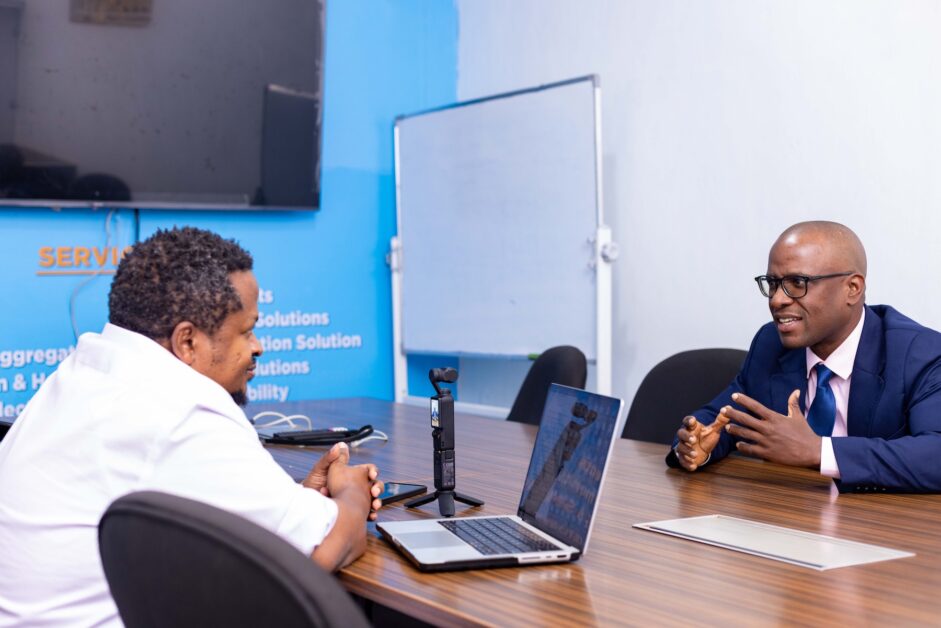
I told him, maybe there’s another way. Instead of banks setting up inside National Water, why not let customers pay directly at existing bank branches? The banks already had over 2,000 branches nationwide compared to National Water’s 300. That way, the footprint was much larger. But then another challenge came up: if a customer paid at a bank, how would National Water’s accounts update instantly? That’s when I proposed integrating bank systems directly with National Water’s system.
The MD loved the idea, but banks resisted. Their first answer is always ‘No.’ Risk departments would not allow their systems to connect to external ones. These conversations were brutal — every day was pushback. People told me, ‘Why keep fighting? It can’t work.’ But I believed it could.
Eventually, I said, let’s just start with one bank. At the time, only four big banks were collecting for National Water: Stanbic, Stanchart, DFCU, and Centenary. But their monopoly made them rigid. I noticed Bank of Africa had a branch right next to National Water’s headquarters on Jinja Road. I approached their MD, pitched the idea, and to his credit, he agreed. He called his IT team and said, ‘Make this happen in two weeks.’
That was the breakthrough. Once Bank of Africa was integrated and customers could pay there, 85% of the traffic went to them. Suddenly, all the other banks came rushing, asking to connect. The floodgates opened. National Water closed cash points, redeployed staff into customer service and reconciliation roles, and transformed branches into service centres. It wasn’t painless, but it worked.
We faced similar battles at Umeme with TouchPay, and here too, visionary leadership made all the difference. Selestino Babungi, Umeme’s CEO, was always keen to give Ugandan innovators a chance. He understood that the challenges around electricity distribution mirrored those at NWSC: long queues, manual reconciliations, huge arrears, and massive suspense accounts. By embracing TouchPay, Umeme not only solved these problems on a much bigger customer base, but also helped put Pegasus firmly on the map. TouchPay became our flagship product — proof that with forward-looking leaders willing to bet on local solutions, Ugandan innovation could deliver world-class results.
Today, digital payments are the norm. Kids grow up digital. But back then, it took a fight. We also had to face regulatory uncertainty — in those days, it was the wild west. No regulator. You came up with an idea, implemented it, and went live. That freedom was exciting, but it also allowed bad players and fraud. Regulators only came in because of the chaos caused by the bad side of innovation.
Now, regulation has matured the industry. It slows things down — we now need compliance teams, legal teams, and oversight we didn’t have before — but it also brings sanity and builds trust. And in fintech, trust is everything. Money is emotional. People will fight to protect two things: their children and their money. That’s why experience, reputation, and longevity matter. Pegasus today has that trust — and that’s one of our biggest advantages.
How do you think regulation could be strengthened to help the industry accelerate, and also make it easier for innovators and SMEs? Since some things require big investments, how do you see regulation shaping growth so the industry can benefit more people?
Two things stand out for me. One is around the law and fraud. Regulations are really just a function of the law, and in many ways, the law hasn’t kept up. In the old days, if you wanted to rob a bank, you picked up a gun, got a getaway car, and risked a shootout with the police. The law was very clear — you were a bank robber, you went to jail. Today, the gun has been replaced by the computer. Fraud is digital, but our laws haven’t fully caught up. Even in open-and-shut cases, lawyers struggle: which law applies? We do have the Computer Misuse Act, but that was designed more for online abuse than financial fraud. So there are gaps. Until we strengthen laws around cyber fraud, the industry will remain exposed.
The second is competition. Yes, we operate in a capitalist world, but without some guardrails, small players can be suffocated before they even start. If you only end up with one or two dominant players, then where’s the choice, where’s the quality? Regulators also risk capture if the big players are stronger than the regulator itself. We’ve seen this globally with antitrust cases against companies like Google and Microsoft. It’s the same here. Pegasus is in the same space as giants like Mastercard and Visa, but how do we compete with their capital? Even if our product is superior, they can undercut prices until we die off, then raise them later.

In more mature markets, regulators step in to protect smaller players, ensuring innovation isn’t killed by sheer financial muscle. Here, regulators have been helpful in arbitrating informally — calling players into a room and saying, ‘Let’s play fair.’ But without the backing of strong legal frameworks, many small innovators still die off quickly. You see it all the time: someone comes up with a great idea, and a big player just throws money at it and wipes them out.
Of course, regulation itself has costs. It creates compliance departments, adds bureaucracy, and raises the cost of doing business. That gets passed on to clients. But for me, if I had to pick two priorities, they would be fraud and anti-competition. Fraud affects everyone — big, small, or mid-sized. And competition ensures that good ideas survive, that the industry stays dynamic and diverse, and that clients have real choice.
Out there, there’s another young person, excited about the possibilities, coming out with a degree in software engineering and thinking, ‘Now that I’ve graduated, maybe it’s time to start my own Pegasus, or Alpha Kappa, or another Greek name.’ If you were addressing a room of such graduates — and building on the lessons you’ve learned over 17–18 years in the game — what are some of the things they should be prepared for?
 Ruparelia Group Wins Key Entebbe Land Case, Clearing Path for the New Mega Speke Resort and Convention Centre, Entebbe
On this side of the world, the challenges I faced 17 years ago are still the same — just in different phases. You’re going to get ‘No’s.’ Doors will be shut. People will dismiss you because you don’t have a name. Someone might even take your idea and say, ‘Let’s give it to a South African or Ghanaian company.’
Let me give you a story. We never really benefited financially from what we did with National Water. At the time, it wasn’t about money — it was about building a name, proving ourselves, doing something. Most people think that once they register a company, money will start flowing the next day. It doesn’t work that way. You’ll have to do things that feel unnatural. Sometimes you’ll have to offer services for little or nothing, just to get through the door, because you’re competing with giants — MTN, Airtel, Visa, Safaricom, M-PESA — and with Pegasus, which now has 17 years of history.
So my advice is: don’t make it about money at the beginning, and don’t take ‘No’ as the final answer. When you’re unknown, the default answer is always ‘No.’ Who are you? What gives you the right to enter this boardroom? You’ve got to learn to be okay with rejection.
Michael Jordan once said he played 23 seasons and won 8 championships. If winning is the measure of success, that means 15 seasons were failures. But no one remembers the failures — only the wins. That’s how business is. For every ‘Yes’ you get, there are 50 ‘No’s behind it. If you give up at the 30th, you’ll never reach the ‘Yes.’
The key is to learn from every rejection. Don’t just say, ‘They don’t like me’ or ‘It’s because we’re small.’ Ask: Why did they say no? When banks told us, ‘We don’t connect to third parties,’ we looked for a workaround. When National Water said, ‘E-value isn’t legal tender because only the Bank of Uganda can issue that,’ they were technically right. But instead of giving up, we asked: How do we work around this? That’s how we found ways to convert e-value into legal tender and move forward.
It’s about persistence. You keep chopping down each problem until you get to the point where the person says, ‘Okay, let’s try.’ In our case, it was getting that one bank to say yes. Once that happened, others followed.
So here’s what I tell young innovators: your biggest competitor is not MTN, Airtel, or Visa. Your biggest competitor is you yesterday. As long as today you are better than yesterday, you’re moving in the right direction. Even if you don’t get the ‘Yes’ today, measure yourself by how much closer you are to it than you were before. That’s what will keep you going.
Because in the end, for every one ‘Yes,’ there are thousands of ‘No’s.’ If you judge yourself by the ‘No’s, you’ll always feel like a failure. But if you see them as steps toward your ‘Yes,’ then you’ll keep moving until you break through.
You’ve talked about the ‘No’s’ and the ‘Yeses,’ and the cost of just getting one foot in the door. But how do you actually get the door to open in the first place? What does it really take to get that first chance?
We didn’t have any gamba n’ogu (connections). That’s the one thing. I’m very private, and we had no powerful uncles or retired generals writing recommendation notes for us. In Uganda, there’s this mentality that you need a gamba n’ogu to get anywhere. Sure, it might get you through the door sometimes, but it doesn’t last. Like Martin Luther King said — in the end, you’re judged by the content of your character. Competence is what sustains you.
So if you don’t have connections, you have to pull a move that neutralises the guy who does. Someone else may walk in with a chit from a colonel or a minister, but beyond that paper, he has nothing. I knew I had the product they wanted, but how do I get in without that backing? Our move was simple — we gave it away free of charge. That shocked the room. Even the guy with the gamba n’obu couldn’t compete with free. That’s the kind of wild, irresistible move you sometimes have to pull to not just open the door — but unscrew the door and throw it away. From then on, you can walk in and out freely, because your value speaks louder than anyone’s connection.
It’s about long-term thinking. If you’re short-termist, the first ‘No’ will kill you. You want quick wins, quick money, quick recognition. But this game requires delayed gratification. For five years, you might have to be a slave to your vision. But in those five years, you’ll own your client. You’ll show them so much value they can’t breathe without calling you. You’ll be their butler and their CEO at the same time.
For us, giving it free was the move. The first client became our loudest advocate, and the second client paid for both himself and the first. Word spread in the financial sector — an industry built on trust. Other companies said, ‘Our gamba n’obus took the contracts, ate the money, but left the problem unsolved. These Pegasus guys solved it. Who are they? Give me their number.’ And that’s how we rolled — not on connections, but on reputation and results.
So, every now and then, things go wrong — especially with fraud. I know you guys have had your moments, some of them well-documented. And in this industry, it’s me today, tomorrow it’s someone else. It just keeps coming. But what has it taught you about rising up after a major incident — regaining the trust of clients, and keeping the work going? Because honestly, I’d love to sit in your war room the day after such an incident, just to see how you handle it.
You know, someone once told me, You should write a book about this, because every time I share the story, it sounds mad. But I’ve always had this instinct of going against the current. When I went to the UK, everyone else was there to make their fortune. Even my own family members stayed, became permanent residents or citizens. I had the same path — clean, open. But I backed out, came home with no job offer. My own mother didn’t talk to me for a year. She said, I sent you there for what? There’s nothing here for you. Even my wife thought I was crazy. But I had a vision.
It’s the same instinct that guides me when things go wrong. Like in 2024, when we got hit — and big clients like MTN, Stanbic, Airtel, Bank of Africa were all affected. The press releases were out. Most companies ‘ first reaction is: Bring the lawyers, bring the contracts, let’s limit liability. And yes, legally we could have capped exposure — indemnified at 2 billion when the hit was 3.6 billion. But I said no. The integrity with which we run this business when things are going right is the same integrity we must show when things go wrong.
Our clients trusted us. Unfortunately, someone exploited the platform. The only right thing was to own up. And that’s what saved us — honesty and openness. We opened up our systems, not just so clients could see what happened, but so they could also check if they had the same gaps on their side. We hired an independent security firm and shared their full report with all our partners. Most companies would hide that. But we said: Here it is. Yes, the cards are bad, but they’re on the table. That openness built trust.
One client even told us: This is the most professional incident response we’ve ever seen. Even in our own bank, when we face fraud, we don’t get this level of openness internally. That was powerful. Because while ours made the news, many others have gone through the same — they just hide it.
We also negotiated with clients honestly: Yes, we owe this money. But let us keep our business running, because that’s how we’ll pay you back. And they agreed, because they’d rather stay with the devil they know than risk a new partner who might not survive such a hit.
Out of that fire, Pegasus actually came out stronger. Today, when clients face fraud, they call us: Ronald, you’ve been here before. Help us clean up. We even monetised that expertise. The central bank later set up a consortium on cyber and fraud response, bringing together regulators, banks, law enforcement, and industry players. Pegasus chairs it.
So really, there’s no magic secret. The only secret is honesty and integrity. Reputation is nothing without character. And that’s what kept us alive.
Today, everybody talks about working smart — especially young people coming into the industry. But sometimes it feels like the value of working hard is being forgotten. From your experience, what’s the real value of hard work? And looking back, how does that compare with your experience working with employees then — say, 15 years ago — versus now?
You know, I grew up in a world with no internet. A big part of my adult life was lived without it. When I try to explain this to my kids or even the boys and girls we hire today, they struggle to imagine it. At your age, if you wanted to see someone, you walked there. If you wanted to write home, you used speed delivery through the Posta Office. You wrote a letter, and sometimes you waited three weeks or a month for a reply. That taught us patience.
Now, everything is instant. Someone sends a WhatsApp and expects a reply in five minutes. Food is ordered and delivered in ten. And you see it in today’s impatience. Young people want to get rich in six months. They resign quickly, sometimes not because the job is bad, but because they’re bored. So their CV in two years looks like ours did after ten.
For me, I’ve worked in only a handful of places — Infocom (now Liquid Telecom), MTN, National Water, and then Pegasus. That’s it. In fact, some of the people I worked with as a student at Infocom are still there today, almost 30 years later. That loyalty and patience shaped us. But keeping and retaining talent now is a real challenge. Companies like Google create gyms, playful offices, and spaces that change daily just to break monotony. For smaller companies like us, it’s harder.

So I try to mentor. Ronald, our MD, is the front manager — he’s the one clients see. I’m the chef in the kitchen, with the team, creating, fixing, innovating. That’s where I love to be. But in that role, I’ve also become a mentor, because I deal directly with the impatience of the younger engineers. When someone’s agitated after three months, I take them for lunch, tell them our story, and try to show them the long game.
I tell them: Pegasus is 17 years old, but behind that is almost 25 years of work. Don’t expect to have that in two years. Be patient. The trenches are what make you. The person you’ll be five years from now is being shaped today. Don’t rush the process. Don’t try to give birth to yourself prematurely.
Even CEOs call me now for advice, because many of them have to navigate technology in ways they weren’t trained for. They value candour and honesty. And with young professionals, I always say: even if you’re entrepreneurial, spend time in employment. Learn how companies work. Build connections. Know how to take orders before you learn to give them. Some are built to be workers, some to be entrepreneurs — you can usually tell. But whichever path, the trenches are unavoidable.
Those who listen, slow down, and build patiently often succeed. They call me back years later and say, You were right. Those who rush through 20 companies in five years often burn out, and by 30, they’re stuck. So the lesson is simple: patience, resilience, and hard work still matter.
From the kitchen — while you’re sitting there chopping onions and cooking up solutions — what trends are you seeing today that will really shape the next five years? What should people who want to be winners in that future be focusing on now? And in light of that, what gives you hope or excites you about where the industry and your business are headed — and on the flip side, what still keeps you up at night?
AI is inevitable. It’s scary, but it’s also where the internet was in the late ’90s — on the edge of transforming everything. Back then, if you wanted a bill, it was written in a big counter book. When computers came, people who had spent 30 years doing accounts by hand must have thought, How can they get rid of this system we’ve built everything around? But computers came anyway, and entire roles disappeared.
AI is at that same point today. Anything repetitive, anything with a clear protocol, AI will take over. Software engineering is very much at risk, because once you define the protocol, AI can do it better, faster, and without human issues — no sickness, no lateness, no HR drama. As a business owner, I see the attraction: machines are efficient, people are not. And in finance, where most of our processes are repetitive, AI will come hard and fast.
I’ve lived through this shift before. I remember the first website I built in HTML back in 2004 — it felt like magic. Now, AI can generate a complete website or app in minutes. That tells me: students today are like accountants who mastered the counter book just as Excel was arriving. The curriculum is still teaching skills that will soon be obsolete. That’s the scary part. But there’s also an opportunity. Those who adapt early, who jump straight into AI, will ride the wave — just like I jumped from quantitative economics into digital at the right time.
Look at Standard Chartered Bank. They’ve closed branches but still serve customers fully. You can open a shilling, dollar, or euro account online at 3 a.m. in five minutes. No forms, no queues. That’s AI already at work. Banks that don’t catch up will simply be swept aside. In five years, tellers will be gone. Call centres will be run by AI. The entire experience will be digital.
So yes, AI is a disruption, but it’s also an opportunity — if regulators and policymakers play their part. We have talent. Our universities are producing good engineers and coders. The cost of entry in IT is low — you just need a laptop, an idea, and a supportive environment. Unlike factories, which need huge capital, creative industries like software, journalism, and design can thrive if ring-fenced for local players.
That’s why regulation matters. We need progressive, forward-looking laws that protect Ugandan innovators, the way some visionary leaders did when they gave Pegasus a chance. I remember when Umeme digitised all its payments through our platform — for 13 years, every bill payment in Uganda went through a 100% local system. That only happened because a bold CEO gave us a chance against bigger foreign competitors.
Today, Pegasus even exports services — we have clients abroad paying us in dollars. That proves Ugandan solutions can compete globally. But to grow this further, we need more than luck or generosity. We need laws that deliberately prioritise local content in creative and digital industries. Let foreign investors bring capital for heavy industries like car manufacturing, but let Ugandans own the creative space. Because creativity is in the head, even if you steal my laptop, you can’t steal my mind. Give me another one, I’ll build again.
That’s the opportunity AI brings — but only if we prepare ourselves and protect our space.
We’re heading into an election season. If I brought all the presidential candidates into one room and asked you to speak to them directly, what would you want them to include in their manifestos about supporting young people, creativity, and industries like fintech, where the barriers to entry are low but the potential impact is massive? What’s the one message you would want them to take away?
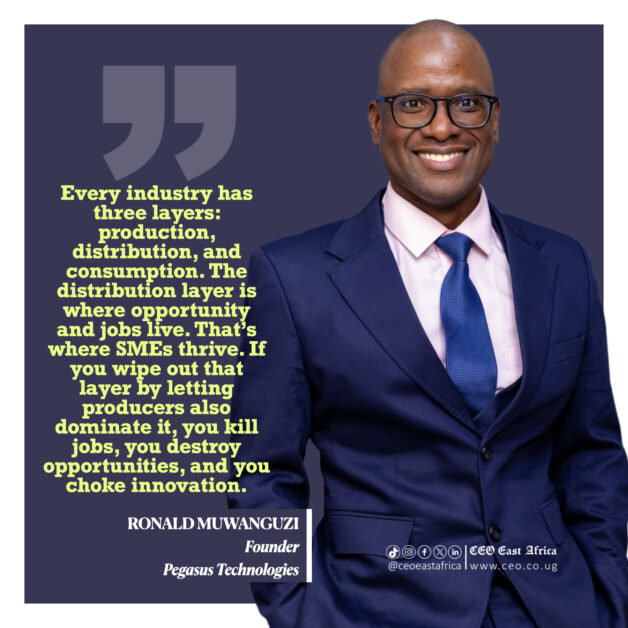
You know, for me, it’s simple — every industry has three basic layers: production, distribution, and consumption. The producer creates the product, the distributor moves it to market, and the consumer uses it. This is Economics 101, and it applies everywhere — whether you’re talking about Coca-Cola, Nile Breweries, or even payments.
Now, on the production side, you’ll always have the big players — the telcos, the banks, the multinationals. They own the factories, they own the heavy industry. That’s fine, because not many Ugandans can raise the kind of capital needed to play at that level. But the distribution layer is where the opportunity and jobs live. That’s where SMEs thrive — the depots, the stockists, the guy on Kampala Road selling airtime, the lady with a small kiosk. When you wipe out that layer by letting producers also dominate it, you kill jobs, you suffocate SMEs, and you choke innovation.
We saw this clearly with airtime. In the old days, there was a whole ecosystem — from major distributors to the street vendors. Everyone earned something from that 5–10% commission. But when telecoms decided to bypass them and sell directly, they took the value for themselves and wiped out an entire industry of local entrepreneurs. The same thing is now happening in the digital payments space.
Look at how growth really happens: most of today’s big Ugandan entrepreneurs started in distribution. The Mulwanas were battery distributors before moving into manufacturing. Amos Nzeyi and the Kayobokes began in transport before bottling Pepsi. Even Steel & Tube started as a hardware shop before becoming a full-scale steel producer. I know a gentleman on Mityana Road who now runs a gin factory. He didn’t begin in production — he was a distributor for Uganda Breweries. Over time, he grew strong enough to set up his own plant. And today, he has his own distributors. That’s the entrepreneurial ladder. Protect the distribution layer, let it flourish, and over time, it feeds into production and creates new jobs.
The danger is that big players often want to eat from both sides. They’re already taking value from production, but then they also want to wipe out distribution and take that value too. That’s anti-competitive, and it’s the single biggest threat to fintech in Uganda. It’s like someone sitting on ten apples, taking nine, and still saying: ‘I also want the last one.’ The result is that local SMEs — 100% Ugandan-owned, paying taxes here, hiring locally — get suffocated. At Pegasus, for example, we partner with Makerere’s software engineering department. Every year, we take our best 10 students, and most are already on full-time contracts with us by graduation. Multinationals can’t absorb all that talent. If they push us out of the distribution layer, those opportunities simply vanish.
And it’s not just the multinationals — sometimes even the government crowds out private players. Look at NITA-U, which regulates the industry but also manages all government SMS services. How do you regulate and compete at the same time? Before, firms like us delivered Umeme’s token SMSs competitively. When UDCL absorbed Umeme, NITA pushed us out. We lost revenue, tax contributions dropped, engineers lost their jobs, and the government didn’t absorb them.
This isn’t unique to our sector. It’s happening across industries. Every time it happens, unemployment rises, tax revenues shrink, and innovation stalls. The solution is actually very simple economics: production, distribution, and consumption. Protect the distribution layer for locals. Even if the factories hire foreigners, let Ugandans own the distribution. That’s where the majority of employment, entrepreneurship, and tax revenue is generated.
If Uganda consistently applied that principle — the same way Tanzania ring-fenced tour guiding for its citizens — we would see more young Ugandans climbing the entrepreneurial ladder, moving from distribution into production, and building the next generation of industry giants. Honestly, if we got this right, I believe we could solve half the unemployment problem in this country.