
It has been almost 15 years since Uganda adopted the access to Information (ATI) Act (2005). The ATI act empowers citizens to scrutinize government decisions and hold public officials accountable, while also protecting whistleblowers.
Twaweza East Africa, a Non-Governmental Organization (NGO) with a regional presence in Kenya, Uganda and Tanzania recently conducted a survey titled “Between paper and practice” where Twaweza sought civil servants’ views on access to information and citizen participation which was officially launched at Hotel Africana on Tuesday, 12th November in Kampala.
The findings presented in the brief were generated from a qualitative research study that was conducted by Twaweza between December 2018 and March 2019.
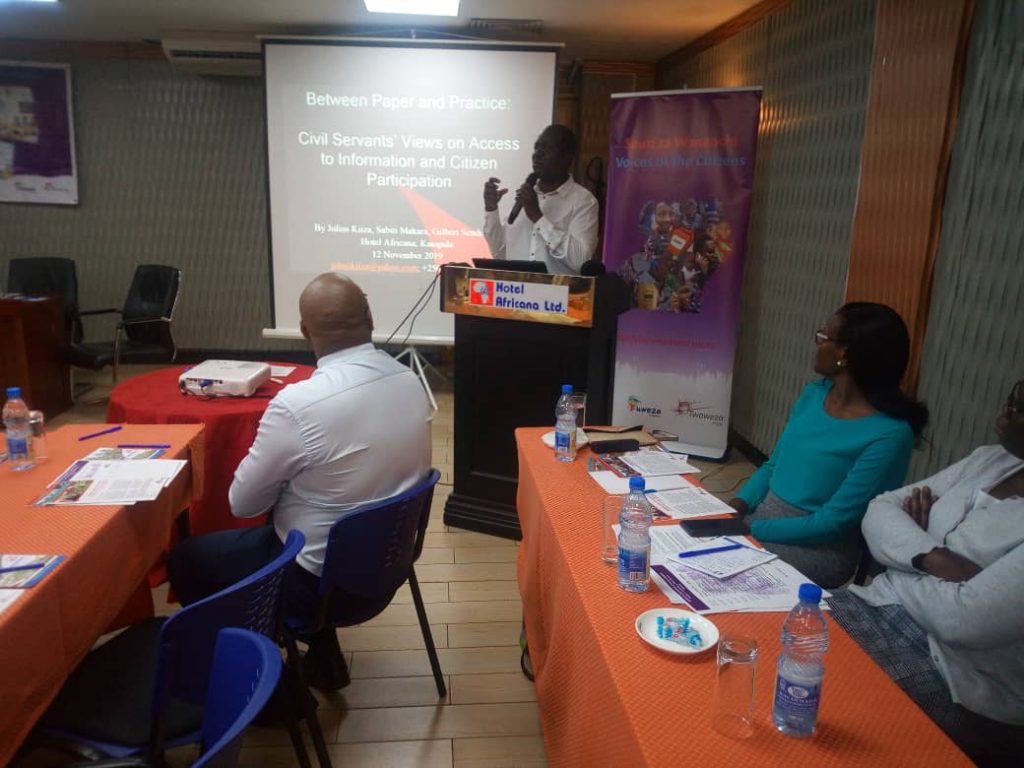
The study targeted senior civil servants at national level in government ministries, MDA, Parliament of Uganda, selected higher local governments (district local governments) and officers at lower local governments (sub counties).
Among the key findings from the study it emerged that most public servants do not know that they are legally obliged to release information.
“They think they have discretion over what information to release to who” states the report.
The brief also reveals that most communication /information offices do not have budgets to run their programs especially when compared to other departments – including security, works, health – which receive substantial funding from their parent ministries.

The study explores the extent to which Uganda’s civil servants uphold Article 1 of the Constitution which asserts that “All Power belongs to the people…”
Some of the questions asked to the respondents included; Do public officials perceive citizen participation to be a key part of their job? Is citizen involvement in public affairs inconvenient to public officials? Does it necessarily slow down government business? Is government too complicated for the ordinary citizen to understand?
The study also posed questions such as do public servants feel duty-bound to simplify information and communicate it to the citizenry in accessible formats?
“Mindful of the spirit of the decentralization policy implemented through local government administration units, we explore whether Barazas, budget conferences, radio talk shows and other spaces of citizen participation serves as (a) instruments of citizen participation, or (b) as mechanisms for entrenching elite preferences” reads an excerpt from the Twaweza brief.

Insight 1 from the study reveals that there is little data or statistics on information requests.
On appositive note, the Ministry of ICT with support from Office of the Prime Minister launched the Ask Your Government (AYG) online platform (www.askyourgov.ug) in August 2014.
This online portal permits citizens to directly send information requests to government ministries, departments and agencies. Responses come directly via email and are published on the portal, generating statistics on the demand for, and supply of, government-held information.
However, the majority of requests on the platform appear to be about job opportunities.
With the exception of the Ministry of ICT (thanks to the above stated online platform) no MDA reported having statistics on information requests.
Related
 Beyond the Low-Hanging Fruit: The Grit, Capital, and Vision Required to Industrialise Rural Uganda
The absence of official records in Uganda’s ministries, departments and agencies is inconsistent with the modern age. In addition, Section 12 of ATI Act creates a duty on officers to render such “reasonable assistance…as is necessary to enable citizens to access information.”
Recommendations by civil servants and politicians
Civil servants and politicians that participated in the study proposed several suggestions to improve citizens’ access to information and participation in public decision-making:
Many suggested that information sharing should be mainstreamed,
This will involve a new governance dispensation under which duty bearers have access to information as part of their official duties.

To enhance it’s effectiveness, the access to Information Act should be popularized through sensitization seminars and Barazas. Popular versions should be published and given to civil servants, political leaders and citizens.
According to the report findings, there is a need to amend other public service laws, to harmonize them with the ATI legislation, It was also recommended by interviewees that the Public Service Standing Orders, the Official Secrets Oath of Allegiance be amended or revised.
Some civil servants recommended the return of the return of the graduated tax system which supplemented the revenue of local authorities and allowed them to implement more local initiatives.
“We should consider re-opening the discussion on this because it can help provide much-needed revenue for local authorities and spark citizen interest in local government accountability for spending,” said the respondents.
2 out of 3 (68%) say TV and radio stations should be free to broadcast their own programmes and should not be required to broadcast news programmes produced by government.
Three out of four Ugandans see village representatives as the best way to influence government.
Professor Julius Kiiza, Makerere University says that the spirit of Access To Information Act is watered down by a long list of exemptions.
“There happens to be a disconnect between paper and practice in Access to Information,” says Professor Kizza.
Twaweza means ‘we can make it happen’ in Swahili. It’s a citizen-centered initiative, focusing on large-scale change in East Africa.
Sauti za Wananchi is a nationally-representative, high frequency mobile phone panel survey.