Uganda stands today at a pivotal economic crossroads today.
On the one hand, the country has set itself an ambitious development trajectory. Through its Tenfold Growth Strategy and the upcoming National Development Plan IV, policymakers aim to dramatically expand Uganda’s economy, transform livelihoods, and lift millions of citizens out of poverty.
Central to this vision is a strong emphasis on youth, women, and small and medium enterprises (SMEs), the very groups expected to drive the country’s next phase of economic growth.
Technology sits at the heart of this ambition. Across Uganda’s development frameworks, from the Digital Uganda Vision 2040 to the Digital Transformation Roadmap and the National Financial Inclusion Strategy (2023–2028), digital connectivity is increasingly viewed as a powerful tool for unlocking economic participation, improving productivity, and expanding financial access.
But here lies the paradox. At the same time Uganda is seeking to deepen digital inclusion, it must also mobilise more domestic revenue to finance infrastructure, public services, and economic transformation.
In practice, one of the most visible and accessible tax bases has been the very ecosystem powering the digital economy: mobile phones, smartphones, and mobile money services.
The challenge now is to strike the right balance—ensuring taxation does not slow the very tools needed to drive economic inclusion.
Uganda’s expanding digital economy
Few technologies have reshaped Uganda’s economy as rapidly as mobile connectivity.
According to the Uganda Communications Commission (UCC) Market Performance Report for Q4 2025, the country had 47.1 million active mobile subscriptions by December 2025, reflecting one of the highest connectivity levels in the region.
Mobile money has become equally central to everyday economic life. By the end of 2025, Uganda had 36.3 million active mobile money accounts, facilitating payments, remittances, and business transactions across the country.
In the final quarter of 2025 alone, 2.48 billion mobile money transactions were processed, underscoring just how deeply digital payments are embedded in the economy.
For millions of Ugandans, particularly those working in informal markets, mobile money has effectively become the country’s most accessible banking system.
Traders receive payments digitally, farmers receive remittances, and small businesses manage working capital through mobile wallets. In many cases, the mobile phone is the first gateway into the formal financial system.
The device gap
Yet despite this rapid growth in digital transactions and connectivity, a major barrier remains: access to smartphones.
Uganda’s mobile ecosystem remains heavily skewed toward basic and feature phones, limiting the extent to which many citizens can fully participate in the digital economy.
According to UCC data, of the 47.1 million active mobile subscriptions, about 20 million devices are smartphones, while 32.2 million are feature phones and 6.1 million are basic phones.
At first glance, these figures may suggest that smartphone adoption is approaching half the market. But the reality is more complex.
Uganda operates in a multi-SIM environment, where individuals commonly own multiple SIM cards to take advantage of different tariffs, promotions, or network coverage.
As a result, subscription numbers do not translate directly into unique users or evenly distributed device ownership.
In practice, smartphones tend to be concentrated among urban and higher-income households, while many Ugandans, especially in rural communities, continue to rely on feature phones or shared devices.
This means the true level of smartphone penetration among individuals is likely significantly lower than subscription figures suggest.
Yet the device gap is only part of the story.
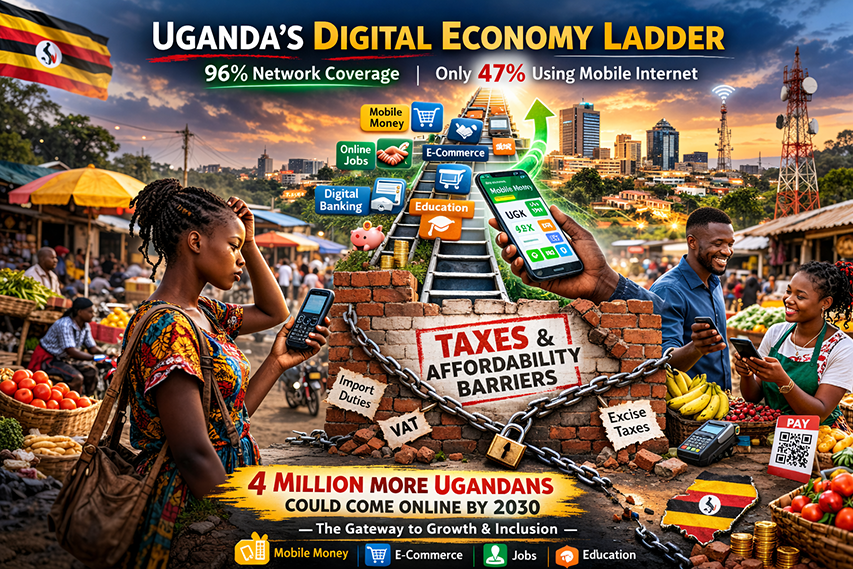
Industry analysis by the GSMA shows that while around 96% of Uganda’s population lives within mobile broadband coverage, only about 47% actually use mobile internet, revealing a significant “usage gap.”
Millions of Ugandans already live within reach of digital infrastructure but remain unable to participate fully in the digital economy.
This gap matters. Feature phones support voice calls, SMS, and basic mobile money services, but they cannot unlock the full opportunities of the digital economy.
Services such as e-commerce platforms, digital lending apps, online education, e-government services, digital marketplaces for small businesses, and gig-economy platforms require smartphones.
In effect, Uganda has already built much of the infrastructure needed for a digital economy, from widespread mobile networks to a thriving mobile money ecosystem. Yet millions of citizens still lack the devices required to access its full potential.
Closing this device gap may, therefore, be one of the most important steps toward expanding financial inclusion, entrepreneurship, and digital productivity across the country.
The affordability barrier
The primary reason is cost.
Entry-level smartphones remain prohibitively expensive for many Ugandans. Research by GSMA shows that the cheapest smartphones in Uganda cost around $38.91 (approximately UGX 150,000–160,000); equivalent to 39% of the average monthly GDP per capita.
For the poorest 40% of households, the cost rises to nearly 96% of monthly income.
Even more striking is the role of taxation. Industry analysis suggests that taxes and duties account for roughly 35% of the final retail price of entry-level smartphones.
For a boda boda rider, market trader, or small farmer earning irregular income, this additional cost can delay smartphone adoption for years.
 Ruparelia Group Wins Key Entebbe Land Case, Clearing Path for the New Mega Speke Resort and Convention Centre, Entebbe
Mobile money and the tax debate
The tension between digital growth and taxation is not new in Uganda.
In 2018, government introduced a mobile money tax initially set at 1% on all transactions, including deposits, withdrawals, and transfers. Following widespread public backlash, the levy was later revised to 0.5% on withdrawals only.
Research has since shown that even these smaller transaction taxes can influence user behaviour. Studies analysing transaction-level data found that the tax reduced mobile money activity and pushed some users back toward cash-based transactions, particularly in areas where banking alternatives were limited.
In effect, transaction taxes can introduce friction into systems designed to expand financial inclusion.
A huge untapped opportunity
Despite these challenges, Uganda’s digital economy remains one of the fastest-growing sectors in the country.
UCC data shows that by December 2025, 18.5 million Ugandans were actively using mobile internet, while 332.4 million gigabytes of data were consumed in a single quarter.
Over the same period, telecommunications sector revenues reached UGX 1.66 trillion in Q4 2025 alone. These figures highlight both the rapid growth already underway and the vast untapped potential that still exists within Uganda’s digital ecosystem.
With the right policy environment, analysts believe digitalisation could become one of the most powerful drivers of economic transformation.
Industry studies suggest that targeted reforms, including improving device affordability and rationalising sector-specific taxation, could add as much as UGX 14.6 trillion to Uganda’s economy over the coming years.
The youth and SME effect
The implications go far beyond connectivity.
Smartphones are increasingly the primary tools through which young Ugandans build businesses and access new income opportunities.
Entrepreneurs use them to sell products through social media platforms such as WhatsApp and TikTok, access mobile banking and digital credit, operate ride-hailing or delivery services, and trade through e-commerce platforms.
Others use smartphones to connect to global freelance marketplaces offering services such as graphic design, software development, and digital marketing.
Digital platforms have also created thousands of jobs in sectors such as ride-hailing, online retail, logistics, and digital marketing. In almost every case, the smartphone is the entry point to participation.
Expanding smartphone ownership therefore has direct implications for employment, entrepreneurship, and economic mobility.
A policy crossroads
Uganda’s policymakers are therefore facing a classic development trade-off. On one side lies the need to raise revenue to finance public services and national development programmes.
On the other lies the need to ensure taxation policies do not slow digital adoption.
Taxes on smartphones, data services, and mobile money transactions may generate short-term fiscal gains, but they may also slow the speed at which millions of Ugandans enter the digital economy.
The untapped millions
And the scale of the opportunity is enormous.
According to GSMA analysis, improving device affordability and reducing sector-specific tax barriers could dramatically accelerate digital adoption across Uganda.
The research estimates that with the right package of policy reforms, particularly those aimed at reducing taxes on entry-level smartphones and improving affordability, Uganda could connect up to four million additional people to the internet by 2030.
For a country seeking to expand financial inclusion, accelerate productivity, and unlock new opportunities for youth and small businesses, bringing millions of additional citizens online would represent a major economic leap.
Greater smartphone adoption would not only expand access to digital services such as mobile banking, e-commerce, online education, and government platforms, but would also stimulate broader economic activity across sectors including agriculture, retail, transport, and digital entrepreneurship.
The golden goose
Uganda’s digital ecosystem is still in its early stages, yet the numbers already demonstrate its transformative potential.
With 47.1 million mobile subscriptions, 36.3 million mobile money users, and billions of digital transactions processed each quarter, the mobile sector has become one of the most powerful engines of economic inclusion in the country.
The question facing policymakers is therefore not whether the digital sector should contribute to national revenue. Rather, it is how to structure taxation in a way that accelerates digital adoption rather than constrains it.
Because if the very technologies designed to lift millions out of poverty become too expensive to access, Uganda risks slowing the engine of its own economic transformation.
Put differently, policymakers must ensure that in their pursuit of revenue they do not tax the ladder that millions of Ugandans are trying to climb.
And for many citizens entering the digital economy, that ladder begins with one simple device: an affordable smartphone.