
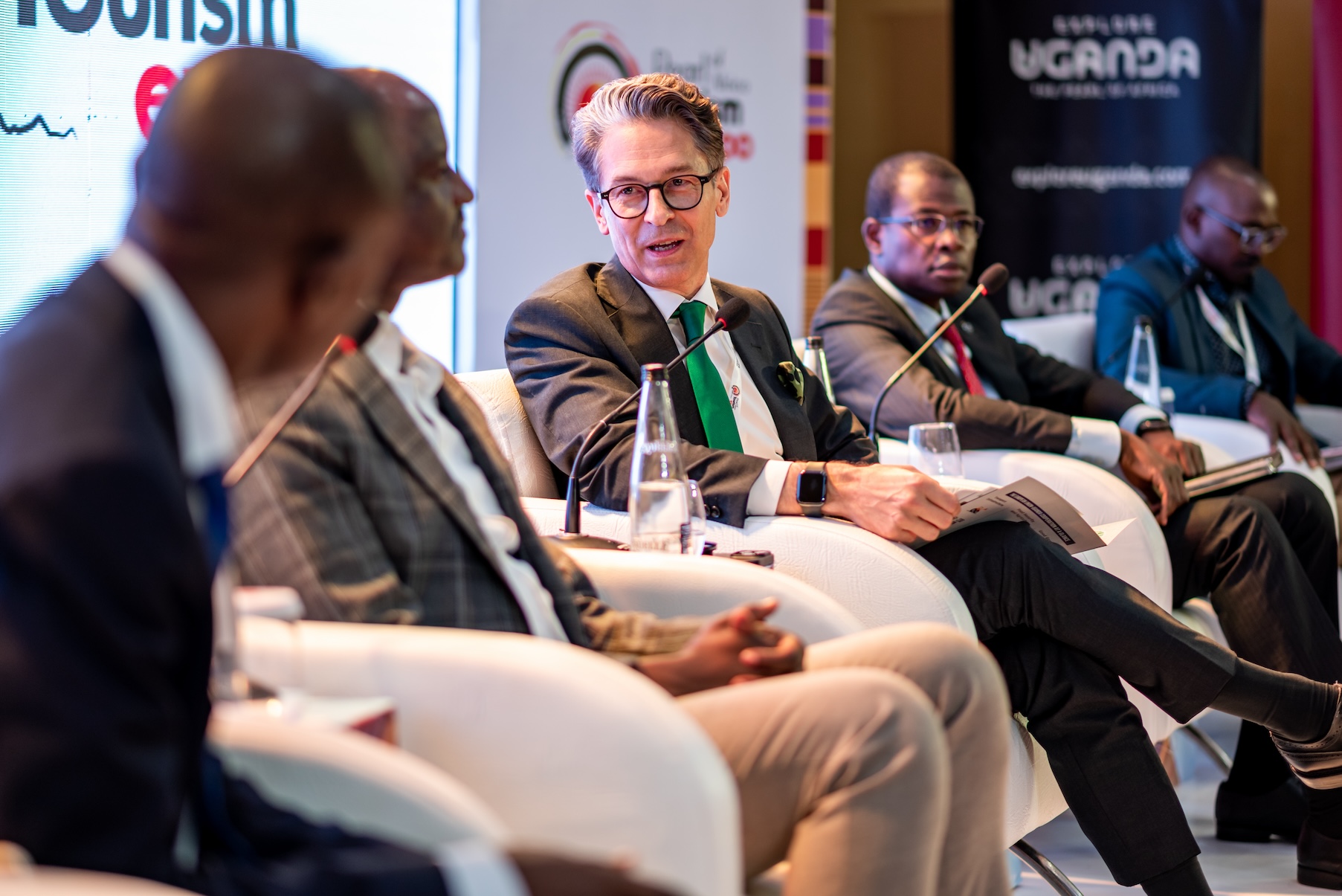
I am delighted to be here today at this seminar with the objective to discuss Sustainable financing for tourism and hospitality. I will try to present to you what the European Union is doing and what are our plans for the future in this regard, but first let me congratulate the Uganda Tourism Board and the Ministry of Tourism, Wildlife and Antiquities for this fantastic 2024 edition of the Pearl of Africa Tourism Expo that has successfully brought together tourism and travel trade partners from Uganda and all over the world to meet new clients, network, and discuss tourism business deals.
I am glad I have seen many European companies and representatives all along the Expo. Tourism was one of the 4 priority sectors we presented and discussed at the recent Uganda-EU Business Forum held in this very same place about 2 months ago in March. I hope the groundwork we did at the Forum is having its bearings on the Expo.
Over the years, the European Union has worked closely with the Ugandan Government and the private sector to advance the tourism industry, which plays a vital role in the country’s economy, development and cultural preservation.
With some of its Member States present in Uganda, the European Union has been a steadfast partner in promoting tourism’s role in economic development, creating jobs, facilitating access to finances and fostering environmental stewardship in Uganda. We have witnessed substantial progress over the years, with increased investment and infrastructure development in tourism hotspots, the enhancement of community-based tourism initiatives, and the preservation of critical ecosystems.
However, there is plenty of work to do yet to unleash the full potential of the Uganda tourism value chain at all levels, national, regional and international. To that aim the EU and its Member States will continue to invest in sustainable tourism projects and initiatives. We will also support efforts to strengthen institutional capacity for tourism management and promote community involvement in tourism development. In addition, we will work closely on initiatives to improve the standards and sustainability of the industry.
Let me now jump into what specifically the EU is doing concerning access to finance, which is the main theme of this panel discussion and what we plan to do in the near future.
If we had to identify the big five in the support of tourism, apart from training and skilling, infrastructure, transport or marketing, I would say that access to finance is definitively one of the main ones. Unless you are already a big company without reserves problems, access to finance is always one of the big headaches and challenges for most entrepreneurs and business persons I come across while discussing the prospects of tourism and hospitality in Uganda. If they have to borrow from commercial banks in Uganda, the interest rate is between 21% to 25%. For me as a Swedish citizen, that’s an incredible challenge. In my country interest rate for a personal or business loan would be always below 4%.
 Fraud Alert: Fake Sudhir Ruparelia Accounts Increase on X, Raising Cybersecurity Concerns
In 2020 during the brunt of COVID that so greatly affected all sectors in Uganda, but especially tourism, we at the EU joined hands with the Uganda Development Bank to put in place a very innovative initiative, rarely seen anywhere else in the region, where loans and grants were provided jointly at very competitive conditions, down to 7-8% interest rate with a 2 years grace period, to pay for the salaries of the staff at hotels and tour operators and keep them as breadwinners of their families during those difficult times.
In 2022 we expanded the purpose of the facility to include expenditures meant to go green by investing in improved practices of waste management, energy efficiency with solar panels and the like. So far we are supporting 100 hotels and tour operators, and if anyone present here would like to apply for the “UDB-EU Tourism Recovery Facility”, let me inform you that the call for proposals is still open until the UGX64 billion that was made available are exhausted.
In a recent report launched at the Uganda-EU Business Forum titled: “Towards a sustainable tourism economy in Uganda” you will find the EU and Member States’ list of projects supporting tourism in Uganda and a whole section on ongoing proposals and ideas on access to finance in the tourism value chain. Let me give you in bullet point mode some of those ideas:
- There is a pressing need to improve access to finance for Micro, Small and Medium-sized Enterprises (MSMEs) and communities engaged in the tourism value chain through an improved business-enabling environment and the provision of tailored financial products delivered through innovative digital channels.
- Access to finance is a major barrier for businesses, especially SMEs, in the tourism sector. Providing tailored financial products and technical assistance can unlock investment opportunities and support the growth of sustainable tourism enterprises. Given that businesses operating in the tourism value chain are usually collateral-poor, further developing the ecosystem for movable collateral should be urgently addressed.
- Complex regulations and lack of coordination among stakeholders hamper tourism business growth. Streamlining regulations, improving quality assurance mechanisms, and enhancing collaboration can create a conducive environment for tourism development.
- We need to conduct a detailed diagnostic of the regulatory environment, strengthen the legal and regulatory environment by identifying and addressing the constraints within the credit information market and larger Movable Assets-Based Lending (MABL) ecosystem, build the capacity and train regulatory bodies on best regulatory practices and encourage their active participation in MABL market development in a supervisory role, improve the secondary markets for movable assets in terms of asset recovery, valuation, and disposition in Uganda, strengthen the MABL ecosystem with skills development for key stakeholders (enforcement, valuation, auctioneer and other appropriate intermediaries) and awareness creation and sensitization about the MABL industry.
- We need to create a shared ICT platform for credit information submitted to Credit Bureaus, create a Data Hub/Credit registry at the Bank of Uganda to improve the quality of credit information, support financial institutions (including Fintechs) to increase their knowledge about the needs of and the opportunities for financing of MSMEs in the tourism value chain, a.o., support selected lending institutions in the development and implementation of algorithmic (data-driven lending), psychometric scoring systems as alternative risk assessment methodologies, technical assistance and business development services (BDS) to address tourism businesses’ capacity gaps and to promote a green transition towards responsible production and enabling them to develop bankable investment proposals based on green and circular economy principles (special attention to women-led businesses), set up innovative de-risking mechanisms and finance mechanisms to provide access to finance to the private sector for innovative business initiatives in the sustainable tourism value chain.
To conclude, let me confirm that the EU is at present in the approval process of an initiative to support sustainable tourism in Uganda for EUR 15.5 million and that will include as one of the main 3 objectives, precisely access to finance. The other 2 components are:
- Increase Uganda’s visibility and attractiveness as a sustainable travel destination.
- Increase local communities’ participation in and benefits from tourism in natural landscapes and their conservation.
Thank you for your dedication and support for Uganda’s tourism sector.
