Every time a country discovers oil, it comes under scrutiny and so its not surprising that the spotlight is now on Ugandan activities in the oil-rich Albertine region.
Last year, the European Union Parliament called for the delay of the East African Crude Oil Pipeline (EACOP), expressing concern over human rights abuse and environmental degradation.
It’s against this background that the Government of Uganda, through the Ministry of Gender Labour and Social Development (has embarked on a campaign to engage the contractors involved in oil and gas activities as far as upholding human rights in concerned.
Benard Mujuni, Commissioner for Equity and Rights MoGLSD, tasked the companies involved in oil and gas to take the moral decision uphold human rights because that is the only way they will be able to do business.
“Human rights is also business. Do not just look at profits at the expense of human rights because you can lose those profits if you are found to be violated rights.”
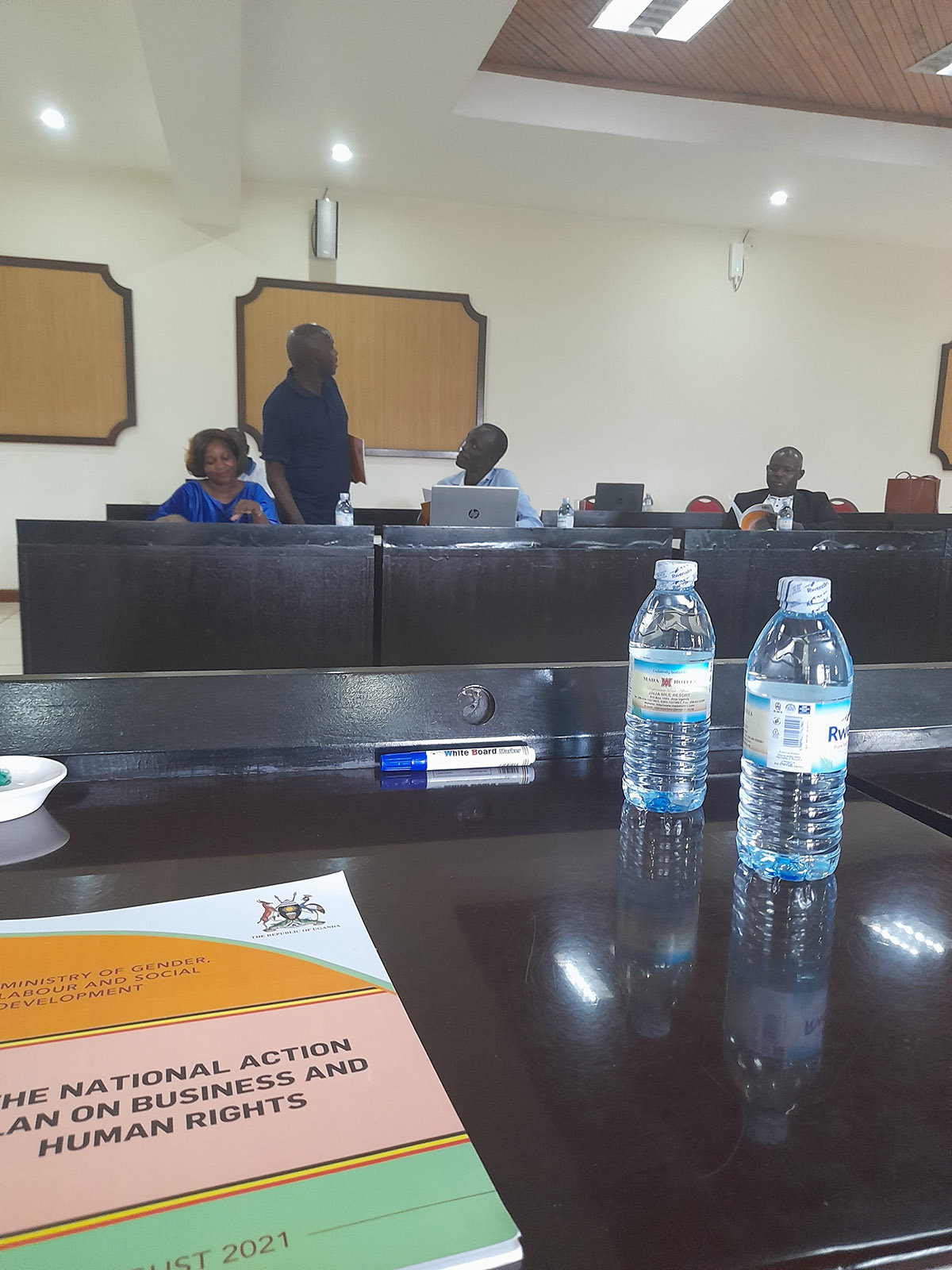
In line with the National Action Plan on Business and Human rights, and to avoid a situation where oil sector developments are moving faster than strict adherence to the rights of the communities and workers, International Alert is supporting the MGLSD to pilot its business and human rights interventions in Oil and Gas sector
Among other activities, a series of trainings aimed at compelling the contractors to uphold and respect human rights as they carry out their activities, are being carried out.
International Alert is a global peace building charity that offers dialogue, training, research, policy analysis, advocacy and outreach activities focusing on solving the root causes of conflict with people from across divides
Richard Businge, a consultant with International Alert, while speaking at a recent training in Jinja, called on companies to avoid conflict whiling carrying out their activities, in this case, oil and gas production.
“Companies are conflict-sensitive when they understand and act upon how they impact communities and the context.”
As a way of implementing the National Action Plan, the companies have been tasked to, among other practices:
 I&M Bank Katogo Golf Series returns with Shs 796m boost and an exciting new format
- Promote human rights education for their employees
- Ensure free prior and informed consent in acquisition of land and other properties for business operations
- Comply to laws both national and international standards
- Ensure inclusion of the vulnerable groups in the business operations
- Ensure environmental protection in their operations
- Apply corporate social responsibility
- Pay taxes to the government
- Ensure consumer protection
What Uganda stands to earn
Uganda confirmed the discovery of commercial quantities of oil in the Lake Albert basin in 2006. This important milestone led to years of exploration by several international oil companies, including Total Energies, China National Offshore Oil Cooperation (CNOOC), and Tullow PLC. Exploration was done concurrently with the formulation of appropriate legal and policy framework beginning with The National Oil and Gas Policy 2008 that was followed with The Petroleum Exploration, Development and Production (PEDP) Act 2013; and the Petroleum (Refining, Conversion, Transmission and Midstream Storage) Act 2013 became effective in April 2013 and July 2013 respectively. The National Oil and Gas Policy highlights the roles of the different Government institutions led by the Ministry of Energy and Mineral Development. The Ministry of Gender labour and social development is responsible for ensuring that this development is all people centred.
The Final Investment Decision (FID) by the joint venture partners in February 2022, signified the commitment of the oil companies to implement the close to US$10 billion in the Tilenga Project in Buliisa and Nwoya districts, the Kingfisher Project in Hoima and Kikuube Districts and the East African Crude Oil Pipeline (EACOP) that will cross the ten (10) districts of Hoima, Kikuube, Kakumiro, Kyankwanzi, Gomba, Mubende, Lwengo, Sembabule, Kyotera and Rakai in Uganda.
While the size of Uganda’s economy as reported by the Ministry of Finance Planning and Economic Development is US $ 45.7 billion, with expected domestic revenue of US $ 6 Billion (13% of GDP) in 2022/23; the oil and gas industry is a multi-billion dollar industry with great prospects. its assets are currently valued at US$ 116 billion (gross). The magnitude of the expected investments, is estimated at $15 – 20 billion, in a space of 3 – 5 years which will triple the country’s Foreign Direct Investments during this period. With the prevailing assumptions, Government is entitled to a net take of 75% from the upstream projects which translates to US$ 66 billion (US$ 2.6 billion per year) with the 25% going to paying the investors’ return. From the EACOP, through dividends and applicable taxes government is expected to earn US$ 400 million. From the refinery, through dividends and applicable taxes, government is expected to earn US$ 3.3 billion. Thus, the three projects (Tilenga, Kingfisher and the Pipeline) government earns a total of US$ 69.7 billion over the projects’ life and an average of US$ 2.8 billion per year.
The above could not be possible if H.E President Yoweri Museveni, did not insist on adding value to this exhaustible resource. Carefully he had studied the industry globally including avoiding the “ Oil curse” as manifested in countries where the resource is shipped out these countries in its raw form.
In terms of non-fiscal benefits; out of the US$ 15 billion investment in the sector, PAU is working with partners to ensure that at least 40% is retained in the country through national content.; Employment opportunities valued at US$ 1 billion are expected from the sector with about 10,111 Ugandans estimated to be directly employed in the sector, and this number is expected to grow to 13,000 at peak, the investments in the sector will also stimulate indirect and induced employment to a tune of 35,000 and 100,000 respectively.
In relation to capacity building of Ugandan companies through Supplier Development programs, promotion of Joint Ventures and the Industry Enhancement Centre. US$ 7.7 million has been committed to these programs under the Tilenga Project, while US$ 5 million will be spent on capacity building of suppliers and their contractors throughout the development phase in the Kingfisher Development and the East African Crude Oil Pipeline (EACOP) projects.
In terms of supply of goods and services; during the exploration phase out of US$ 3.5 billion spent in the country, US$ 980 million (28%) was retained in the economy through Ugandans providing goods and services. In the development phase, over 145 contracts worth US$ 6.8 billion in the upstream and midstream have been concluded. The value of contracts confirmed to be executed by Ugandan companies at Tier 1 and Tier 2 is currently worth US$ 1.73 billion (25%). In transfer of Knowledge and Technology; Total Energies EP Uganda under the Tilenga National Content program has already committed 30,536 manhours worth US$ 3.86 million towards technology transfer initiatives.
EACOP and KFDA are projected to contribute at least US$ 2.0 million towards technology transfer initiatives and in terms of non-fiscal benefits through sector linkages an estimated US$ 8.4 billion is expected with US$ 6 billion expected to be through local content and US $100 in health-related initiatives.