Experts participating in the just-concluded Nile Breweries Economic Forum, have urged the government to maintain a delicate balance between increasing the tax burden on existing compliant taxpayers and the need to build and sustain a robust and thriving value chain of locally owned businesses.
Doing so, the experts have advised will build an even bigger multiplier effect driven by synergies along the value chain that in turn increase job creation, amplified aggregate demand, skills transfer, and empowerment to SMEs, all of which combined will result in even greater tax revenue.
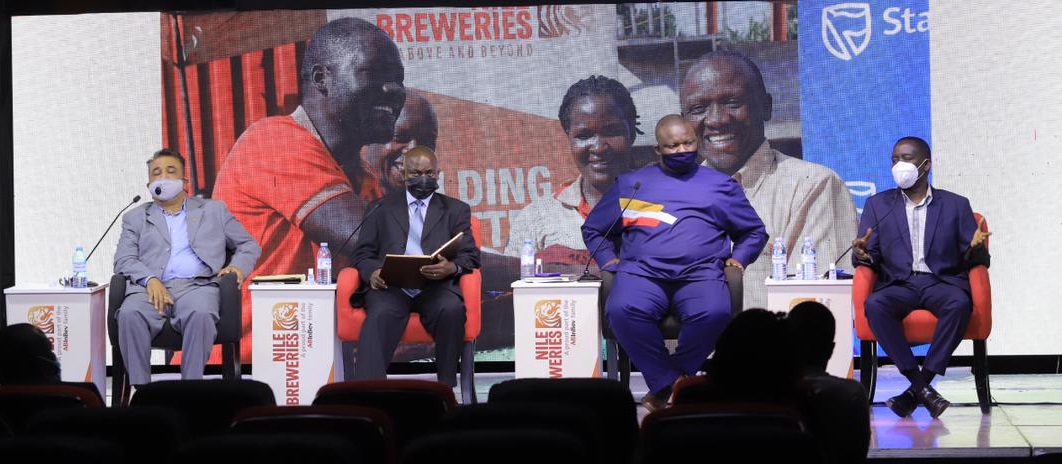
The Nile Breweries Economic Forum was hosted on NBS Television on August 18th, 2021, under the theme: The Contribution of the private sector in Uganda’s economy and its revival, post-Covid-19: A case study of Nile Breweries Limited and its value chain.
Experts at the forum, included, Dr Fred Muhumuza, a renowned Development Economist; Mr John Tinka Katungwensi, Assistant Commissioner Large Taxpayer’s Office, URA; Dr John Ilukor, a Survey Specialist at the World Bank and Mr Moses Kabanda, the Assistant Commissioner, in the Department of Macroeconomic Policy at the Ministry of Finance, Planning and Economic Development. Others are Hon. Sanjay Tanna, the CEO of Tanna Distributors and Mr Herbert Kyeyamwa, the Managing Director of AgroWays Limited, an agribusiness company and supplier of Nile Breweries.
At the forum, Cobus de Hart, the Head of Macroeconomic Consulting at NKC African Economics, an independent economic and political research firm, presented the findings of a study into the economic impact of Nile Breweries in Uganda. According to the report, which is based on the company’s activities in 2019, activities by Nile Breweries generated a gross value added (GVA) to Uganda’s GDP, equivalent to UGX595 billion.
Nile Breweries Ltd also supported 15,842 formal jobs and 24,264 informal jobs through its informal products retail chain. The company also paid UGX401 billion in taxes, equivalent to 2.4% of total Uganda tax revenue in 2019.
The study revealed that for example, NBL in 2019 spent UGX250 billion in procuring goods and services from suppliers across Uganda and this included UGX52 billion in agriculture inputs from Ugandan farmers. However, Cobus said that the company has since increased its share of local raw materials in the production process from 74.3% in 2019 to 93.8% in 2020, and therefore increased its payments to local businesses and farmers.
Speaking at the Forum, David Valencia the Nile Breweries’ Country Director said that an estimated 20,000 farmers are today positively impacted by the company’s supply chain.
“Nile Breweries depends on high-quality crops harvested by Ugandan farmers to brew its beers,” he said adding: “Annually, NBL purchases around US$23 million (close to UGX80 billion) worth of produce from local farmers. Aside from our spend on agricultural inputs, we invest up to UGX795M annually to upskill, connect and financially empower our farmers.”
He also said that other than direct purchases, the company actively supported farmers to be skilled, connected and financially empowered.
“We expect to have 6,500 farmers skilled in crop management protocols. Today we have close to 3,000 farmers empowered with mobile phones and 4,400 financially empowered through input loans and crop insurance in collaboration with Stanbic bank.”
Killing the goose that lays the egg and pricing formal beer out of reach of the low-income earners
The impact study recommended that to maintain and widen the gross value-addition by Nile Breweries and by extension the alcohol industry, it was important that sustainable fiscal policies, be maintained by the government to incentivise increased investment by the private sector which would, in turn, stimulate aggregate demand both for local raw materials and the end products. This would subsequently yield a greater impact that among other benefits, would significantly increase tax revenue, enhance market and price certainty for farmers, as well as empower SMEs along the value chain.
The study particularly warned against increasing taxes on beer produced using over 75% local raw materials, saying that doing so, would disrupt demand in this price-sensitive category and in due course hurt revenue collections, kill jobs in the value chain and erode farmer incomes.

Excise on duty on beer whose ingredients, other than water is 75% or more made of local raw materials was introduced in 2005 at 20% of the price. In 2005, it was moved to 30% and that of beer produced from barley grown and malted in Uganda was put at 40%. But after industry outcry, and poor performance, it was dropped back to 20% in 2008. It was moved back to 30% in 2015. In 2017 this was adjusted to 30% or UGX650 per litre; whichever is higher. Beer made of barley grown and malted in Uganda was dropped to 30% or 950 per litre whichever is higher.
In 2020, the government tried to increase this tax, to raise an extra UGX52 billion but parliament twice rejected the move. In their report, the Committee on Finance, Planning and Economic Development noted that an increase in excise duty will generally result in higher prices of beer for consumers, triggering a reduction in the volume of beer consumed which will, in turn, result in a reduction of taxes collected by the government.
“The major objective of introducing affordable local raw material beers was to provide a product to the low-income consumers that are hygienic and affordable as an alternative to illicit and informal local alcoholic beverages that do not contribute to tax revenue but are also a health hazard to the people. If government prices formal beer or alcohol out of reach, the sector will revert to a worse situation with people opting to drink the harmful illicit brews that can result in death,” the Budget Committee wrote in their report to Committee on Finance, Planning and Economic Development on the Reconsideration of the Excise Duty Tax (Amendment) Bill 2020.
Although in the last budget, government-maintained excise duty for beer whose constitution, except water, is at least 75% made up of local raw materials, at 30% or UGX650 per litre and beer produced from barley grown and malted in Uganda at 30% or UGX950, whichever is higher, there are fears that sooner or later, the government that is now under pandemic-related revenue pressure, may increase the taxes again.
“We are aware that intensifying fiscal pressures stemming from the Covid-19 pandemic have prompted many governments to pursue avenues to boost fiscal revenue. The results of this report present clear recommendations in this regard. The report presents the need for careful balancing of short-term windfalls with the potential for significant long-term value, fiscal and employment creation,” cautioned David Valencia.
Cobus de Hart of NKC African Economics said that conservative findings of the study showed that based on the estimated changes in the average price, volumes and sales that could result from the waivers on excise duty exemptions on beers produced using local raw materials, gross value-addition by Nile Breweries alone, could range between UGX54.7 billion and UGX122.7 billion.
“The related loss in AB InBev’s (Nile Breweries) contribution to jobs is estimated at between 2,336 and 5,239 jobs. Furthermore, if the exemptions were waived, tax revenues (from Nile Breweries) could decline by between UGX66 billion and UGX147 billion,” said Cobus de Hart of NKC African Economics.
 Stanbic Flags Off 2026 Schools Championship to Drive Innovation and Job Creation
The Nile Breweries’ chief executive said that if such an impact came to pass, it would hurt the business’ expansion plans.
“For Nile Breweries to execute capital investment plans a stable tax rate and lower Digital Tax Stamps costs are fundamental. We believe that better enforcement on the informal alcohol sector and fair pricing of the digital tax stamps are key in both government revenue target achievements and NBL’s continued growth,” he said.
It shall be remembered that in 2018, Nile Breweries closed down its UGX14 billion bottling plant for Chibuku an affordable opaque beer targeted at the lower-income segment, after cries to the government not to increase tax on the product were ignored. The plant was opened in 2017 and a 500 ml Chibuku pack was retailed at UGX1000. But the government, in the Excise Amendment Act 2018, introduced an excise rate on the opaque beer, of 30% or UGX650 per litre, whichever was higher, causing Nile Breweries to shut the plant. In the last 2021/22 budget, the government revised tax on the product to 20% or UGX230 per litre, whichever is higher, apparently in a bid to restart production.
Sanjay Tanna, the Chief Executive Officer of Tanna Distributors, a logistics company that distributes several Fast-Moving Consumer Goods in the Eastern region, concurred with Valencia and said that the Government, amongst other initiatives, ought to refocus on fighting illicit and tax uncompliant players in the alcohol and other industries.
“While formal alcohol players have been hit by the pandemic, illicit alcohol trade is thriving. It always seems easy to tax the likes of Nile Breweries, MTN and the other ‘big boys’. However, it’s important that we widen the tax base, rather than increasing the tax load on those few good taxpayers that are already paying.
According to a report by Euromonitor International, a market research firm, in the year 2020, due to the Covid-19 pandemic that led to restrictions on gatherings, as well as the closure of pubs and bars, consumption of illicit alcohol grew sharply, to account for 64.7% of all volume terms sold and 50% of all alcohol by market value, up from 31% in 2017.
Herbert Kyeyamwa, the Managing Director of AgroWays (U) Ltd an agribusiness company that among others sells agriculture raw materials to Nile Breweries, lauded the company for transforming farmers lives.
“Local sourcing by companies such as Nile Breweries has far much greater benefits that go beyond the tangible financial benefits mentioned in the impact report. There are intangible but transformational benefits like enabling farmers in hard-to-reach areas to open bank accounts, save, borrow and build a credit history in a financial institution. Local sourcing is doing a lot more than we are seeing and more can be done if a suitable environment is created,” he said.
Kyeyamwa also called upon the government to invest in enhancing the value created by the private sector in the crops used in the beer industry.
“Beer that is made from over 95% agricultural raw materials is an agricultural product. It has become a cash cow for our farmers and produce traders as well as the government in terms of taxes. If you have a cash cow, you need to feed it. The government needs to come out strongly to support the industry in terms of research and policy incentives and this will spur the gross value-added across the board and grow the economy,” he said.
Mr Kyeyamwa also said it was too early to tax optimally beer made of local raw materials before it reaches its full potential, where the government can yield better tax revenue from the economies of scale and the wider value chain.

“It is obvious that our agricultural system is still inefficient and largely reliant on the hand-held hoe. Our cost of production is high; that is a fact. If the tax policy was not favourable and companies like Nile Breweries decided to import, we do not stand a chance to compete at all, because it is cheaper to import maize or sorghum from South America than to grow it here,” he warned.
Government acknowledges the need to protect the local raw materials value-chain
Speaking at the Forum, Hon. Matia Kasaija, the Minister of Finance, Planning and Economic Development acknowledged that there was a need for innovative ways to sustainably tax the private sector while protecting the greater good created by the private sector especially in improving farmer livelihoods.
“I thank and salute Nile Breweries for involving our farmers, for supporting our farmers to become commercial farmers and enhancing their incomes,” he said, adding: “I wish to also take this opportunity to thank you for being one of our top taxpayers, paying over UGX400 billion.”
Hon. Kasaija said that government would be willing to engage with the private sector, to consider their concerns.
“If there are resolutions that you will make and you want the ministry and government to follow up, I’ll be too happy to receive your report to that effect,” he said.
John Tinka Katungwensi, the Assistant Commissioner. Large Taxpayer’s Office, at Uganda Revenue Authority (URA) also acknowledge the contribution of such players like Nile Breweries and said that there was a need to continuously innovate around the tax regime on local raw materials beer as an incentive to the private sector, especially considering the larger impact that the subsector has on the economy.
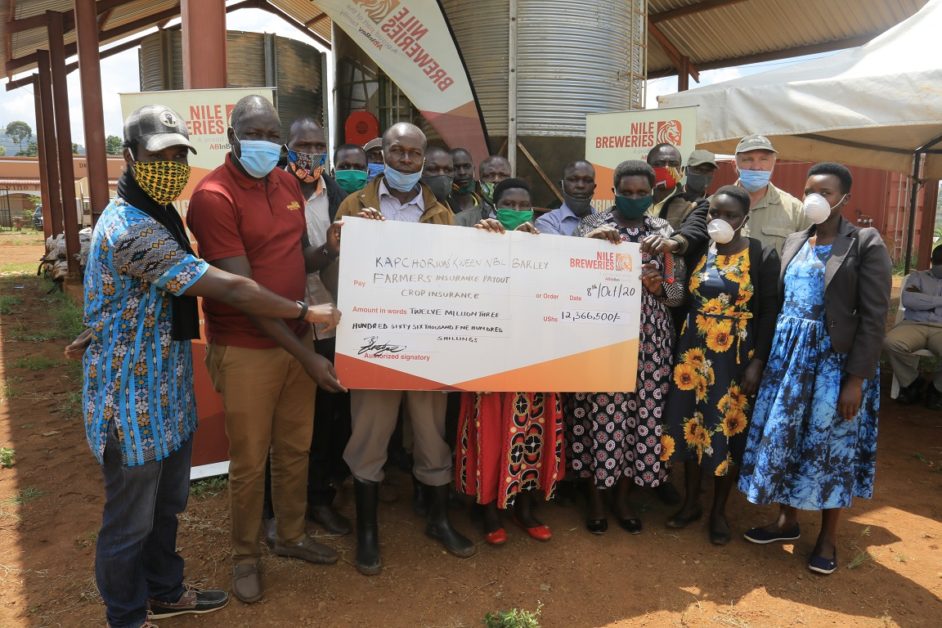
It also reported that the income of sorghum farming households supplying the company, was more than twice that of other farmers and that 89% of NBL supplying farmers reported that their quality of life had improved since joining the company’s support initiatives. The company now aims to have 100% of its direct farmers skilled, connected and financially empowered by 2025. PHOTO/Courtesy
“Given this pandemic period, there is a need for looking at our tax policy regime because when you look at the contribution of the private sector, including NBL, you find that NBL, has an enormous contribution- in 2019, they paid UGX401 billion in taxes and in 2020, they gave us UGX386 billion… NBL has actually contributed a lot in terms of employment, they have 650 employees, and they are paying a wage bill on average of UGX 5 billion per month. All this, the government needs to look into the tax incentive, so they take advantage of this,” he said.
“The issue of the waiver of local excise duty on locally manufactured goods needs to be looked into because as a country at the moment, we’ve really taxed everywhere,” he added.