
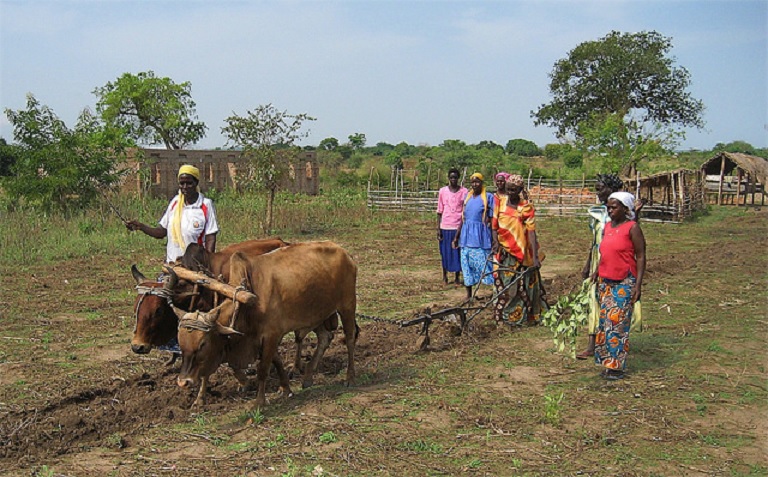
Despite the fact that women are the primary users of agricultural land in most African communities, the system of patriarchy which dominates social organization has tended to discriminate against women when it comes to ownership and control of land resources.
It’s on this background that several government officials, Civil Society Members, Academicians, from the Intergovernmental Agency on Development (IGAD) led by the IGAD Land Governance Unit early this week held a conference to discuss land ownership for woman, among other issues under the title: Beyond Policy.
The 3-day virtual conference from June 28th to June 30th, 2021, was one of the platforms through which IGAD aims to continuously promote and enhance women’s leadership in land governance. The conference aimed to respond to some of the identified challenges and to create a safe space for targeted audiences to dialogue with state and non-state actors to find solutions in addressing women’s land rights in the region.
Background
All the IGAD member countries have progressive polices, as well as progressive laws (constitutions) that promote women’s ownership of property (Land) and men’s ownership property as citizens. However, there exists a gap between the policy and practice. In nearly all IGAD member states the ownership and control of land is predominately in the hands of men. While women and men have equal rights to land ownership in policy, the common practice is that women have secondary rights to land through men. A woman will access land as a daughter using her father’s land, as a sister using her brother’s land, and as a wife using her husband’s land. This stems from a patriarchal culture which is the dominant culture in the IGAD region.
Patriarchy and women land ownership
Patriarchy is the culture where women are subservient to men. In this culture men are the heads – the decision makers and leaders. They are the heads of the home, and the decision makers in households; they are the heads of government, and the decision makers in government.
 Stanbic Bank and Rotary Transform Maternal Healthcare in Ntungamo District
In patriarchal societies, land must be kept in clan and along bloodlines through inheritance. Since women get married off into different clans, they cannot inherit land as that land would then go to another clan. Women as such access land not with ownership rights but with user rights. They cannot sell the land as it does not belong to them. They cannot pass on this land to their children as their children belong to another clan or blood line.
Secondary rights limit women’s benefits from the land use. For instance, they may cultivate the land but do not have control over the produce from the land.
Raised under patriarchy women believe in it and subsequently find themselves on many occasions acting against their interests. For instance, it is common practice for rural women who purchase land jointly with their husbands, with their hard-earned money, and not appearing on title deeds as owners because they only appear as witnesses on sale agreements for the purchase of land.
Statistics
Available data shows land ownership among women with title deeds is low, at 7% for Uganda, 6% for Djibouti, and 5% in Kenya (as joint ownership with men) and 1% owned by women along. While there is little available data the picture is much the same for the other IGAD countries except for Ethiopia.
IGAD is seven countries in the Eastern Africa and Horn of Africa region. These are Djibouti, Ethiopia, Somalia, Sudan, South Sudan, Kenya, and Uganda.