There were too many rats crawling about the contract the government signed with private firm, Societe Generale de Surveillance (SGS). For starters, the contractors demanded nondisclosure of not only contents of the contract but also that the existence of the contract itself was to remain a top secret. But, as Faith Athnus writes, the aforementioned are nothing compared to the fishy smell that emanates from clause 7.8.5 of the contract that states that, in the event that the contract is terminated by either Government or Ministry of Works, before the expiry of the five-year term or any extension or renewal of such term, the Ministry of Works will have to pay SGS 75% of the value of their total investment.

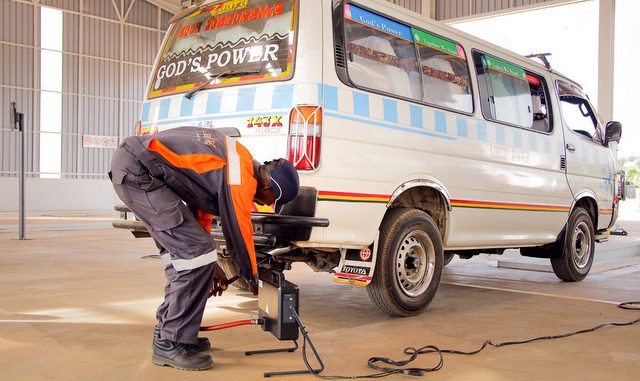
Societe Generale de Surveillance (SGS) had been contracted to oversee mandatory vehicle inspection in Uganda, but with the June 30, 2017, deadline fast approaching, the private contractor only had one station operational in Kawanda. Three other stations in Nabbingo, Namanve and Namulanda were just under construction.
So how would a deadline approach when the same facility that were supposedly meant to enforce the same were only still under construction? Mukono South MP Johnson Muyanja felt this was fishy. And he would not be wrong when, on June 20, 2017, he expressed concerns over the matter.
Speaker Rebecca Kadaga directed Works and Transport minister Monicah Azuba Ntege to explain to the House the background, status, operations and charges levied for vehicle inspection by SGS. The minister presented a statement to Parliament on June 29, 2017, but it fell short of convincing the House, prompting the Speaker to refer the matter to the Parliamentary Committee on Physical Infrastructure for further investigation.
Kadaga also directed to have the June 30, 2017 deadline for the mandatory inspection of motor vehicles halted pending investigations into the matter.
Parliament’s directive set the pace for the investigations whose findings were made public on February 8, 2018, with the report tabled by Lillian Nakate, the chairperson on Committee on Physical Infrastructure.
However, top of the recommendations in the report was a dour warning against cancellation of the SGS contract as “taxpayers would pay a hefty price if the deal was terminated.”
 Govt Abandons Plan to Tax all Cash Withdrawals
The committee cited clause 7.8.5 of the contract that states that in the event that the contract is terminated by either Government or Ministry of Works, for any cause, before the expiry of the five-year term or any extension or renewal of such term, the Ministry of Works shall have to pay SGS 75% of the value of total investment.
The same clause also puts a tougher condition for termination of contract, where the ministry is to pay 100% of the expected income of the provider from the services, whichever is greater, basing on the cost of demoblisation.
The unscrupulous target the weak spot
MP Nakate told Parliament that while it may be considered prudent business to insulate private owners of capital from possible loss in doing business with government using such contractual clauses, there has emerged unscrupulous habit among public officials of saddling the country with the risk of exorbitant costs even when some of the clauses of such contracts are potentially bogus.
During an interface with the committee, SGS claimed to have invested Shs51.2 billion within the seven months of its operations, a figure the committee says would be difficult to verify considering inherent lapses in contract supervision by the Ministry of Works.
“The end result is that, in the event of termination of contract, the already over-burdened taxpayer will have to meet the cost, which may be potentially inflated,