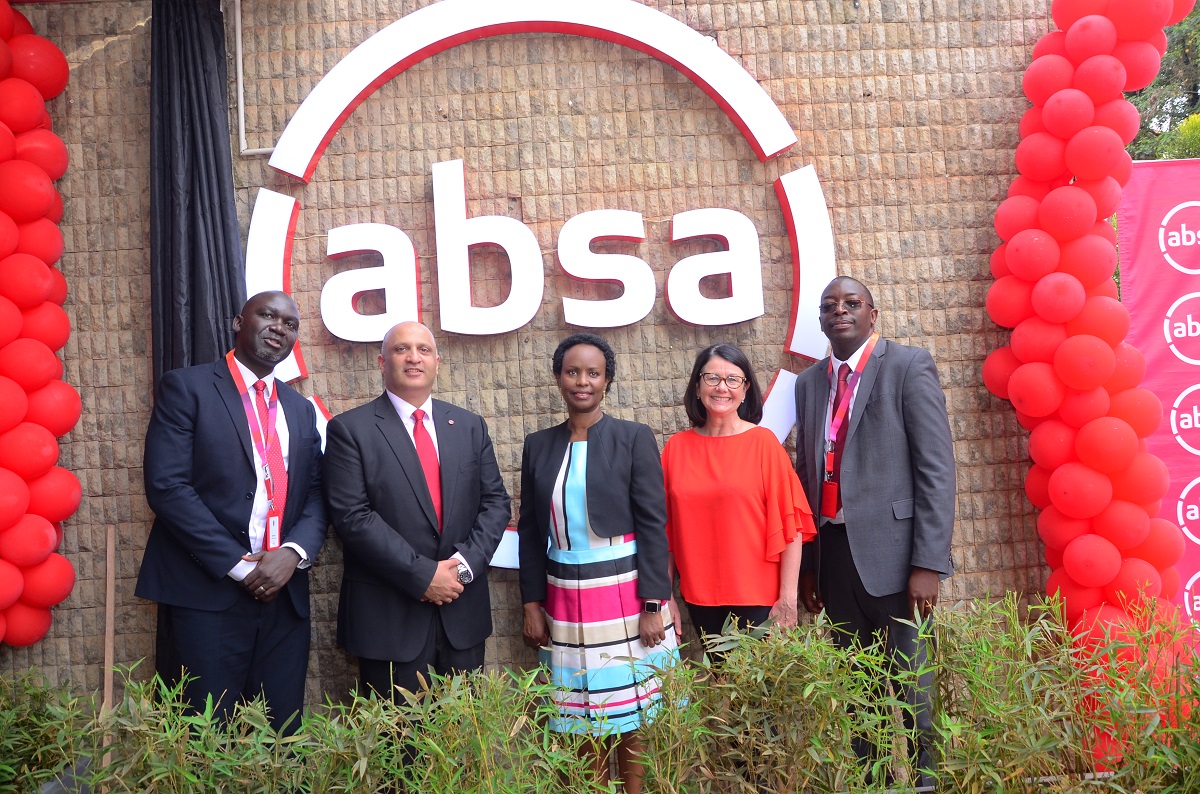
Absa Bank Uganda’s total assets in 2019 grew by 22.5% from UGX2.8 trillion to a record UGX3.4 trillion. This effectively makes Absa, Uganda’s third largest bank by assets, two places up from the fifth position in 2018- overtaking Standard Chartered Bank and dfcu Bank.
Absa is now, one of four, out of Uganda’s 26 licensed banks to cross the rubicon. The only other three banks in with over UGX 3 trillion in assets, include: Stanbic Bank (UGX6.7 trillion), Centenary Bank (UGX3.6 trillion) and Standard Chartered Bank (UGX3.2 trillion).
Dfcu Bank, which in 2017 reached UGX3 trillion, dropped to UGX2.88 trillion in 2018 and in 2019 reached UGX2.95 trillion.
In a media statement released by Absa, Mumba Kalifungwa, Managing Director of Absa Bank Uganda said that 2019 saw a steady growth in the bank’s balance sheet and income in 2019.
“We continue to drive cost efficiencies and manage our portfolio quality as a base for strong earnings. The bank earned more revenue by strategically diversifying income streams and developing a good asset mix which delivered a strong competitive advantage,” said Mumba Kalifungwa, Managing Director of Absa Bank Uganda.
The growth in assets was partly driven by a 13% growth in customer lending to UGX1.334 trillion in 2019 from UGX 1.178 trillion in 2018. The bank also held a vast cash trove (UGX711.5 billion) with Bank of Uganda and UGX769.2 billion in investment securities.

“We were able to advance more credit to our customers by implementing a customer-focused strategy that gave us flexibility to develop tailored financial solutions to help our customers meet their growth ambitions. Growth in customer lending was driven by increased customer engagement, relationship management and a strong focus on lending to the SME and trade sectors, which are significant drivers of the economy,” Mr. Kalifungwa stated.
As a result, Absa also registered a 13% growth in profit after tax, from UGX 69 billion in 2018 to UGX 78 billion in 2019. This resulted in a return on equity of 16.9%, indicating how well the shareholders’ capital is being deployed.
Increased customer confidence; growing customer deposits
Customer deposits grew by 22% to UGX2.2 trillion in 2019 which Mr. Kalifungwa attributed to increased customer confidence, positive reception of the Absa brand and increased investment in innovative and revamped banking channels.
“Our ambition is to become a digitally-led bank that is centred around the ever-changing needs of customers. Today’s customer demands even greater convenience as they look to reduce the amount of time spent banking and therefore our customers should expect more digital innovation from us that will enhance their banking experience. Our investment in digital channels has already started yielding positive results,” Mr. Kalifungwa said.
Last year, the bank increased investment in digital channels such as an enhanced internet banking App, agency banking and first fully digital branch in the market.

“Our growth in costs was attributed to the significant investment in the bank’s highly successful rebranding and separation from Barclays PLC. This was essential to ensure that the bank maintained its customer base by ensuring a smooth and stable transition. This investment paid off and is reflected by the positive reception of the Absa brand in the market,” Mr. Kalifungwa said.
Total costs grew by 27.3% from UGX241.2 billion to UGX307.1 billion, largely driven by a UGX25 billion rise in operating expenses- from UGX140 billion to UGX165.3 billion.
The bank’s total regulatory capital ratio grew to 22%, remaining well above the regulatory requirements.
“We are very well capitalized for the future and continue to have the ability to support our customer’s growth ambitions. We remain a significant player in the banking and financial services sector and a key contributor to Uganda’s economy,” Mr. Kalifungwa concluded.
Key Figures:
- 19.4% growth in revenue to UGX 405 billion, up from UGX 339 billion in 2018.
- 13% growth in customer loans and advances, standing at UGX1.334 trillion, up from UGX 1.178 trillion in 2018.
- 22% growth in customer deposits to UGX2.2 trillion in 2019.
- UGX 78 billion in profit after tax, up from UGX 69 billion in 2018.
- 1.3% rise in return on equity.
- Increase in total regulatory capital ratio to 22% in 2019, well above regulatory requirements.
- Total assets grew by 22.5% from UGX2.8 trillion to UGX3.4 trillion