There has been a lull in the so-called ‘Kisanja Hakuna Mchezo’, a slogan that President Museveni and his government adopted to claim a tougher stance against corruption as well as a statement of decisive commitment to service delivery to the people. Whether the slogan is still active or just in some hibernation awaiting recharge of its batteries is not known.
But if the vigour with which Museveni pushed it around the country has cleaned so much that the slogan has no more ‘victims’ to haunt into political destitution, then the time is now to stir it all up. There are two big fish that need to feel the wrath of the slogan, if results of PAC probe is anything to go by.
And, today, Finance and Economic Planning minister Matia Kasaija could need his gods awake to avoid a possible censure in Parliament.
An investigation conducted by the parliamentary Public Accounts Committee (PAC) on the acquisition and utilisation of the $200 million (about Shs727 billion) loan unearthed new evidence that could see top officials at the Ministry of Finance, Planning and Economic Development losing their jobs.
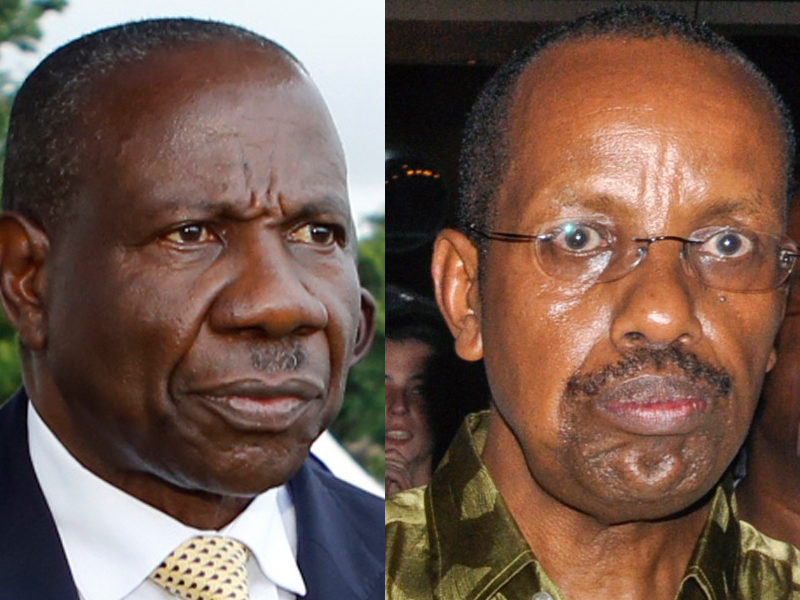
The officials in the picture are Finance minister Matia Kasaija and Secretary to the Treasury Keith Muhakanizi. The two are accused of misappropriating $200 million that was obtained from the Eastern and Southern African trade and Development Bank (PTA).
The debacle begun when the Minister of Finance on March 3, 2016, tabled the request by government to borrow $200 million from PTA Bank to finance development expenditure imports and replace part of the high interest domestic borrowing.
But Parliament had already rejected the loan proposal on January 7, 2016, arguing that Uganda is a member of the IMF and required to borrow to boost government reserves to finance shortfalls in the Balance of Payments if there is an urgent deficit needed.

Parliament found no urgency with the loan request since, at December 2015, Uganda’s reserves were worth 3.9 months of imports, which Parliament said did not demonstrate any urgency to Uganda as its import cover is above 3months of the import cover benchmark of the IMF.
After the central bank got wound of information of the Finance minister re-tabling the loan request, the Governor of Bank of Uganda wrote to the minister on February 2, 2016, objecting to the to re-submit the loan proposal.
In his letter, the Governor stated that the primary motivation for contracting the PTA loan was to stabilize the exchange rate in the face of temporary shocks yet Balance of Payment problems which were supposedly the reason for borrowing were not purely temporary.
The Governor also recommended to the Ministry of Finance that the borrowing should not proceed given the fact that Bank of Uganda had more than sufficient foreign exchange reserves to support these interventions; he stated that the current reserves in the Bank coffers amounted to USD2.8Million and did not require additional resources moblised from the PTA Bank, and especially a loan for this purpose.
However, the Ministry of Finance ignored the recommendations of the central bank and went ahead and presented the same loan proposal for the second time on April 6, 2016, and, this time round, the ministry simply changed the title and identified provision of medical supplies as a priority together with the other funds going out to the Ministry of Works and Transport as well as Rural Electrification Agency.
Following the second tabling, the loan proposal was referred to the Parliament Committee on National Economy and subsequently approved by Parliament on the April 26, 2016.
The plan was finalised with signing of the loan agreement between Government and PTA Bank on June 26, 2016.
However, the cracks into the utilisation of the loan started becoming public when National Medical Stores requested for $68 billion following numerous budget cuts and severe depreciation of the Shilling against the Dollar.
 Crisis Beneath the Pumps: Kenya’s Unfolding Fuel Scandal and the Fall of Top Energy Chiefs - Why it Matters to Uganda
Indeed, on November 30, 2015, the Permanent Secretary at the Ministry of Finance had acknowledged the funding constraints and advised that a funding facility before Parliament for approval would be used to address the ministry’s funding gap and his response was in reference to the PTA loan.
The situation continued to get out of hand and on May 10, 2016, NMS reminded the Secretary to Treasury of the funding deficit of $68 million and a request for supplementary budget.
In response, the Secretary to Treasury informed NMS that the money would be availed in FY2016/2017 and on August 17, 2016, as a follow-up of his earlier letter dated June 26 ,2016, the Secretary to Treasury requested NMS to submit procurement contracts for items with foreign currency requirements for FY2016/2017 and NMS provided the contracts by a letter dated August 17, 2016. However, to-date, the said funds have not been provided.
In an April 27, 2017 letter to the Minister of Health, copied to NMS, Minister Kasaija said Shs7 billion had been provided as a supplementary in 2016/2017 and that Shs20 billion had been provided to NMS as arrears in 2017/2018.
He further advised that NMS should get medicines on credit worth Shs41 billion for quarter four FY2016/2017, which then would have a fist call on the budget Funds for FY2017/2018 as arrears.
The Minister wrote that Shs41 billion would be availed in the next FY2016/2017, a letter the committee argued was a confirmation that the money had not been given to NMS.
MPs call for Kasaija, Muhakanizi sacking
The report that had been ready but remained shelved since August 2017 and was only tabled in January 2018 was read by Angelline Osegge (Soroti Woman MP), the PAC chairperson. The report highlighted a number of recommendations among which called for censure of the Minister and the Permanent Secretary.
Osegge accused the Minister Kasaija of lying to Parliament in the justification for the loan approval stating that the critical area for funding was medical supplies by NMS which was not, thus receiving the money fraudulently.
PAC also accused the minister of lying to the Speaker in his March 15, 2017 letter in which Kasaijae said that the necessary contracts had been provided by NMS to enable the necessary funds to be disbursed, yet NMS didn’t receive the said funding.
The Permanent Secretary Keith Muhakanizi allegedly lied to the committee that the loan was received to stabilise the exchange rate with the consent of Bank of Uganda, yet communications from the central bank said otherwise.
As if that wasn’t bad enough, the Accountant General is said to have objected to the loan proposal through a letter to the Secretary to the Treasury, indicating that the loan was not favourable because of its high interest rate, but Muhakanizi, who is a former Chairman of the Board of Directors of the PTA Bank, insisted on acquiring the loan despite the emphatic objections from central bank governor, the Accountant General and Director of Economic Affairs.
Thus, the Committee called for the censure of Kasaija noting: “For misleading the House to believe that the most critical funding objective was medical supplies, lying to Parliament in writing that NMS had never provided the needed supply contracts to enable disbursement of funds and further duping Parliament by re-packaging the same loan thus obtaining money by false pretense, the Minister of Finance Matia Kasaija must be censured.