
Raxio Data Centre Ltd is building Uganda’s first privately owned datacentre that is going to be Tier 3 certified. Why would anyone out there who runs a business or government or non-government organisation be excited about this development? What does such a data centre mean for them and their businesses?
I guess it comes down to the principles of doing business; if you are a business owner what do you want for your business?
First and foremost, you want a profitable business. Over and above it being profitable, you want your business to grow. The moment you have a profitable growing business, you then want it to move to the third stage – which is transcending generations; sustainability. The process of transcending generations is all about creating stability – there should be at no point where your business is disrupted or at least you want to minimize any disruptions.
What Raxio is building, our Raxio Data Centre is an enabler for businesses to be more stable.
Uganda is moving fast and embracing the digital revolution – at private sector, non-profit and government levels. But to get the most value out of ICT investments, your infrastructure needs to be stable and reliable all the time. But if your system is not setup in a way that allows it to be stable, then you cannot expect stability.
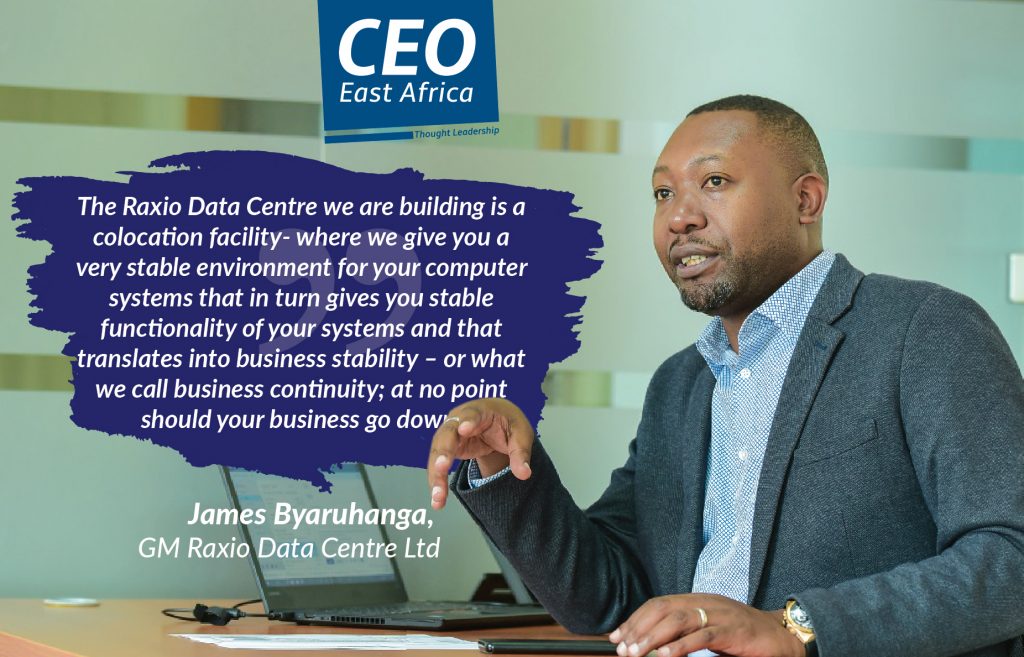
The Raxio Data Centre we are building is a colocation facility- where we give you a very stable environment for your computer systems that in turn gives you stable functionality of your systems and that translates into business stability – or what we call business continuity; at no point should your business go down.
We also use another term – disaster recovery; first of all we want to avoid any outages with business continuity, but in the event that there is an outage, there should be a fall-back position.
So those are the two ways that Raxio Data Centre will help businesses and organisations – by providing an environment that affordably enables business continuity and disaster recovery possible.
Going back to the basics, what are the key specs for the data centre you are putting up? How are each of these specs key to the stability and reliability you just mentioned?
The ideal environment for any computer systems revolves around a couple of issues. First of all, computer systems depend on power, they must be powered up. But reliable power is even more important; but even then, your stable power sources must be backed up to increase reliability.
So, yes, we have the main power system from the utility company, we then have a backup generator, but in between the backup generator and the mains in case of an outage there is an intermediary solution which is the UPS system (Uninterrupted Power Supply system).
But the kind of Tier 3 environment we are creating, does not stop at that; it is fully redundant meaning that each of these 3 power sources is duplicated; we have a second mains source, a second UPS system and a second generator system – just in case of anything.
Secondly, for your computer systems and servers to deliver value, you have to think about the operating temperatures; hard disks are always running, so they generate heat, the motherboards also generate heat. The computer fans are not strong enough to cool down these systems especially when the computers become many.

This is why it is important to cool down the environment so that the computers are able to work optimally. This is why the air conditioning becomes an important thing but at the same time it is not just any air conditioning that we are talking about but air conditioning that is green. We are developing a state-of-the art air conditioning system that is green – and even that too is fully redundant.
When you have such an environment that has so many electronic systems, fire is a possible risk, so we are adding to the centre an intelligent fire control system that is able to detect the possible causes of a fire before it breaks out and or be able to suppress it, in case it breaks out without spoiling the equipment of the customer.
The kind of system we are deploying will use an intelligent gas system; in case of a fire, the intelligent gas system will quickly suck out the oxygen from the room, to levels that can suppress the fire but at the same time not affect the people who might be in the room. This is over and above using things like fireproof doors, tiles and paints.
Another vital area we are looking at is security – both physical security and logical security. Organisations are going to be trusting us with their servers that are holding their data so the kind of security we provide must match that kind of trust.
So our multilevel security system has a combination of perimeter walls with gates that are manned 24/7 and once you are into the fence, we have biometric systems that help us identify who you are and what access levels you have so as to make sure that we have the right people in the right environment. We will also monitor the whole facility via a live CCTV system.
And of course, a datacentre by its very nature has to have connectivity. For business continuity and to have access to their servers 24/7 and as well as disaster recovery to make sense we must have high-speed always-on internet connectivity; which is why we have provided for up to eleven fibre carriers so that in case of an outage, there is seamless connection to another.
Those are the 5 major pillars, I would say.
I understand that construction of the data centre is in earnest. How far have you gone and when do you plan to go live?
We estimate that we have about 80% progress on the civil works and about 60% on the mechanical and electrical (M&E) works. For M&E we are in the ordering phase of equipment and when it arrives in the country, it will just be fitting and testing – but this is dependent on the civil works being complete.
We are slightly late, because we should have gone live by the end of 2019, but now our target is to go live by the end of Q1, 2o2o.
You have been running early bird offers with special benefits for those that sign up early. What are the key benefits for early birders?
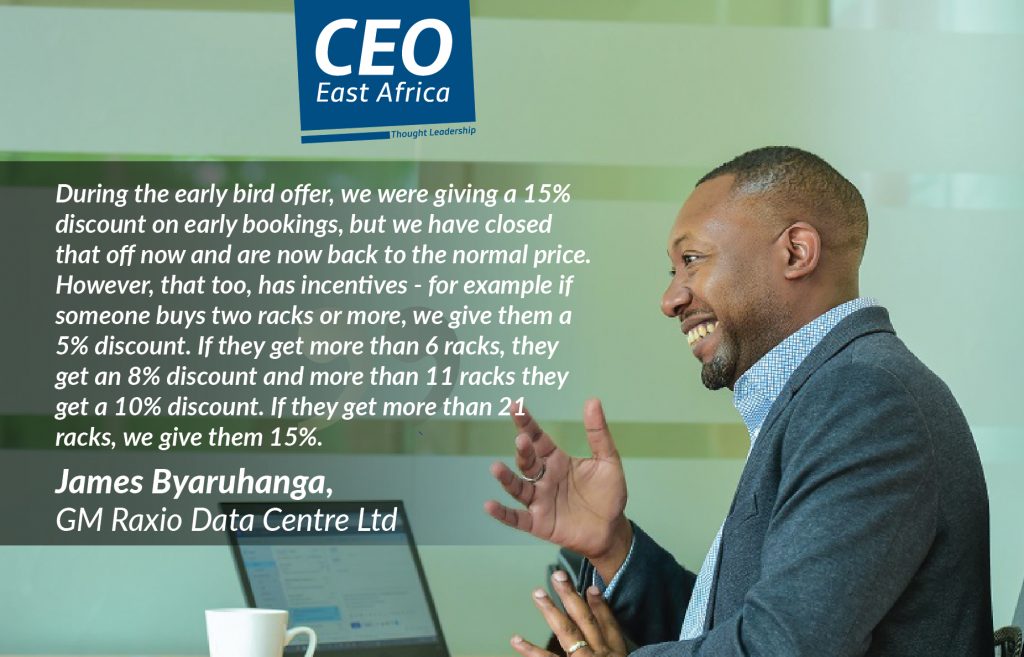
Well, first and foremost, the early bird offer is over; it is now normal service. During the early bird offer, we were giving a 15% discount on early bookings, but we have closed that off now and are now back to the normal price.
However, that too, has incentives – for example if someone buys two racks or more, we give them a 5% discount. If they get more than 6 racks, they get an 8% discount and more than 11 racks they get a 10% discount. If they get more than 21 racks, we give them 15%.
We also have incentives around early payments – for those customers, we extend discounts based on how long they want to prepay.
Those are some of the incentives and either way, there is still a very good reason to pre-book and prepay.
I understand there is a significant investment being put into the project – up to $15 million over its life-cycle. How much of this going into local content? How much impact are you having on the economy locally?
Interestingly the definition of local content in economics and in IT are 2 different things.
Local content in IT is basically what we call traffic- IT traffic that is destined and sourced locally; say if I send you an email for example from MTN to Airtel that’s local content in IT terms.
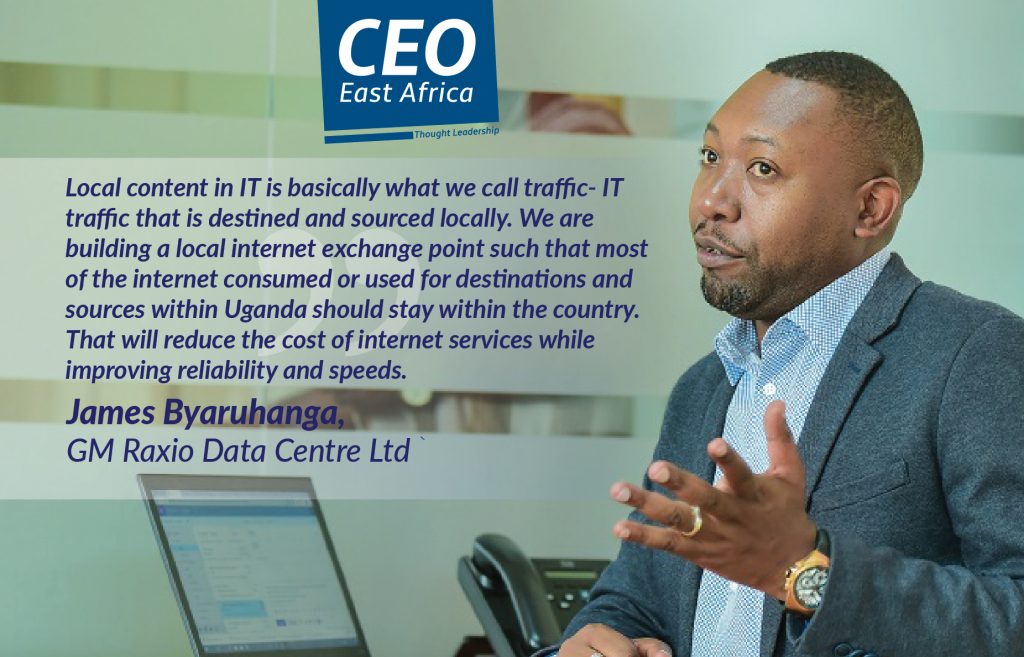
So, if we’re talking about the IT side of things we’re building a local internet exchange point such that most of the internet consumed or used for destinations and sources within Uganda should stay within the country. That will reduce the cost of internet services while improving reliability and speeds.
From the economics side, local content basically means sourcing materials locally and the opportunities created within the local economy and communities.
In that sense, our main contractor; Roko has had averagely 300 people on site daily from March 2019 and it is going to be a whole year’s construction. Our Mechanical and Electrical contractor, is going to have about 50 people working on the site for a period of about a year. The entire management team of Raxio Data Centre is also local. That is almost 400 jobs created directly.
In terms of materials, all construction materials from the civil works have been bought here including steel and cement. Of course, there are some items that are not available locally like fireproof tiles or fireproof doors – there is no one who is manufacturing them locally and that is why we have to import them.
Who is Raxio Datacentre? Who is behind the business and do you have any other similar interests in the region?
The investment firm that’s behind Raxio Data Centre is called Roha Incorporated. It is an American firm which in turn has got a special purpose vehicle called First Brick Holdings (FBH) that is investing specifically in data centres – but Roha invests in multiple businesses; mostly green fields investments.
The Kampala datacentre is FBH’s first one and there will be Kampala 2 in the near future. But before Kampala 2, there should be a data centre in Dar-es-salaam and Kigali. The idea is to have two have regional data centres and at least 2 in each country.