By Philip Karugaba and Shaidu Mafabi
As Ugandan Advocates, we have watched with a mixture of admiration and envy as our Kenyan neighbours conduct their judicial appointment processes in the full glare of public scrutiny. In the Kenyan capital, Nairobi, candidates for the bench appear before the Judicial Service Commission (JSC) to answer probing questions from commissioners and, crucially, from members of the public who have filed memoranda concerning the candidates’ suitability. These interviews are broadcast live, recorded, and archived, even on YouTube. Every Kenyan citizen can observe how their future judges respond to allegations of misconduct, questions about their judicial philosophy, and challenges to their integrity. The process is far from perfect, but it is undeniably transparent.
Two decisions of the Constitutional Court have cemented this opacity as a constitutional norm, and the implications for judicial independence ought to concern every member of the legal profession and the Ugandan public.
LBT Njala v Attorney General
In LBT Njala v Attorney General, the Constitutional Court was invited to consider whether the public interest in transparent judicial appointments ought to prevail over claims to privacy advanced on behalf of judicial officers and the JSC. The Court declined to open the curtains. It held that the right to access information guaranteed under the Constitution is not absolute and that Parliament may lawfully prescribe classes of exempt information. Confidentiality, the Court reasoned, falls within the constitutional privacy exception, treating confidentiality and privacy as “complementary” concepts.
This reasoning is troubling. The appointment of judicial officers is fundamentally a matter of public interest. The judicial office is a public one, and the judicial officer exercises power on behalf of the people of Uganda. The judicial officer will determine the liberty, property, and rights of Ugandans for decades to come. To suggest that the privacy of a candidate for judicial office ought to trump the public’s interest in knowing how that candidate was assessed is to prioritise individual comfort over collective accountability. The Court held that “public interest in withholding such information is not about secrecy for its own sake” but rather “about creating the necessary space for frank, efficient, and high-quality decision-making.” However, this rings hollow when the very quality of the decision-making cannot be scrutinised.
It is interesting that the quest for publicity in this case was only on the candidate interviews before Parliament and not before the JSC. A key element of the Court’s reasoning was that the Parliamentary Committee on Appointments is not the principal vetting body for judicial officers. The Court emphasised that substantive vetting occurs at the JSC, which assesses candidates’ qualifications, integrity, competence, and suitability before making recommendations to the President. Parliament’s role through the Appointments Committee was characterised largely as an approval function, rather than the primary site of evaluation.
Seen in that light, the Court appears to have concluded that opening the parliamentary proceedings would not materially affect the integrity or substance of the judicial selection process, given that the core vetting had already occurred at the JSC stage. The judgment, therefore, seems directed more at the procedural role of Parliament, rather than at endorsing confidentiality in judicial recruitment generally. The Court’s reasoning only heightens the importance of transparency and meaningful public participation at the JSC level.
Mr Baku’s unsuccessful quest for reasons.
The plight of Mr Baku Raphael Obudra illustrates the practical consequences of the LBT Njala decision, with the courts literally closing the doors on the judicial appointments process. Mr Baku, a legal practitioner of long standing, was nominated for judicial positions, Judge of the High Court and Justice of Appeal, in 2017 and 2019. He met the constitutional qualifications, yet he was neither shortlisted nor invited for interviews. When he sought to understand why, the JSC Chairperson informed him that his name had been removed from the shortlist due to adverse reports from the Uganda Law Society and Law Council concerning a pending disciplinary matter.
Mr Baku then sought access to the JSC’s records and correspondence under the Access to Information Act, but was denied on grounds of confidentiality. His constitutional petition challenging this denial was largely dismissed. The Court held that the JSC has no duty to grant a hearing to applicants before shortlisting decisions, as its mandate is “advisory rather than adjudicatory”. The Court further held that meeting the constitutional qualifications does not entitle one to automatic shortlisting; rather, judicial appointment requires assessment of “core values”, independence, propriety, integrity, impartiality, equality, competence, and diligence.
The Court’s pronouncement that “being qualified for appointment and being appointed are two different things” is technically correct, but functionally removes any real accountability. If a candidate who meets all constitutional qualifications can be rejected without reasons, without a hearing, and without any recourse to the underlying materials, then the JSC wields a breadth of discretion that is hard to meaningfully review where no reasons and no accessible record exist.
Lessons from Botswana
In the important case of Law Society of Botswana v President, the facts were slightly different, but the mission was the same: transparency of the judicial appointments process. Here, the President rejected a candidate recommended by the JSC and did not give any reasons for his actions, claiming executive authority. The case recounts the evolution of the judicial appointments process in Botswana that carries interesting similarities to Uganda, evolving from executive-controlled appointments to a process overseen by a JSC constituted by law and justice stakeholders. While the court set aside the rejection by the President of the JSC-recommended candidate, it was not as enthusiastic about the public hearings. The court found that public hearings may embarrass unsuccessful candidates and may deter strong applicants from offering themselves for service. In Uganda, the rough and tumble of the electoral processes has kept much of the elite from running for office or even from debating national issues.
Related
 Thousands Turn Up for Kabaka Birthday Run 2026 as I&M Bank Amplifies HIV/AIDS Awareness Drive
The missing voice of the legal profession.
Compounding these concerns is the structural deficiency of the JSC itself. The ULS, the professional body representing advocates and the body of considerable expertise on legal competence and ethical standards, is conspicuously absent from the JSC’s sittings despite there being a legal requirement for it. This time, it is a question of the elephant not being in the room. The reasons why ULS is unable to elect its representatives to the JSC are a story of its own.
This absence of ULS from the JSC denies the legal fraternity any meaningful input into the processes of selection of our judges. We have no seat at the table when judicial appointments, promotions or disciplinary action, are being considered.
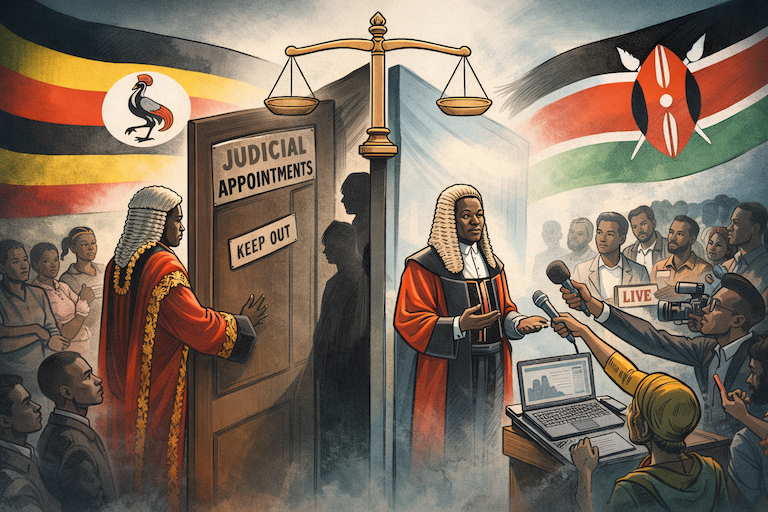
A tale of two systems: Uganda’s closed-door judicial appointments contrasted with Kenya’s open, publicly scrutinised process—through which the authors of this opinion raise critical questions about transparency, accountability, and public trust.
The constitutional petition challenging this composition has stalled, leaving the JSC to continue its work in a constitutionally questionable configuration. In the interim, more than a dozen judges have been appointed by this improperly constituted Commission, including the Principal Judge and the Chief Justice. These appointments may well have elevated individuals of impeccable integrity and outstanding legal ability, but the public cannot know for sure without having had the opportunity to observe the process.
The prognosis for judicial integrity and independence.
What is the prognosis for the integrity and independence of a judicial officer appointed through such an opaque process? The answer, I fear, is poor. A judiciary whose members are selected behind closed doors, through criteria that cannot be examined and processes that cannot be challenged, is a judiciary at risk of being controlled by political interests. We cannot know whether appointees have been selected for their legal acumen or their political pliability. We cannot assess whether adverse reports were genuine expressions of professional concern or instruments of vendetta. We are asked simply to trust, and trust, in matters of constitutional governance, not being matters of one’s sacred faith, is no substitute for transparency.
In Uganda, we have neither the scrutiny nor the confidence in the process. We now have the disgrace of having a Chief Justice who was cited in a High Court judgment (John Imraniraguh v URA), for interference with the decisional autonomy of a registrar. One wonders if this information was known to the JSC during vetting and if so, how was it dealt with?
The Kenyan model demonstrates that public interviews can enhance the legitimacy provided that sensitive lines of inquiry are handled through a structured hybrid model. Candidates who survive the rigours of public scrutiny emerge with enhanced legitimacy. Those found wanting are exposed before they can ascend to the bench. The public, having witnessed the process, has confidence in its outcomes.
Uganda could adopt a hybrid openness approach: interviews would be presumptively public for elements that test competence, judicial temperament, independence, experience and judicial philosophy; but the JSC could move into a closed session only for narrowly defined categories (such as credible security risks, protected personal medical/family matters, and sensitive third-party allegations) provided the JSC (a) records written reasons for closure, (b) keeps a sealed record of the closed portion in case this is required for judicial scrutiny, and (c) publishes a short post-process communiqué setting out the competency criteria applied and a brief, non-defamatory reasons summary for the recommended candidate. This would effectively address the concerns raised in Botswana about discouraging meritorious candidates.
Forward we march
The legal profession in Uganda must not accept this situation as inevitable. We should advocate for legislative reform to mandate public interviews for judicial candidates, following the Kenyan model and borrowing from Botswana to address sensitive inquiries. We should press hard to restore ULS representatives to the JSC.
The Constitution promises us a judiciary that is independent, impartial and accountable to the people. That promise cannot be fulfilled by a selection process that operates in darkness. If we truly believe in the rule of law, we must insist that those who will interpret and apply it be chosen in the light.