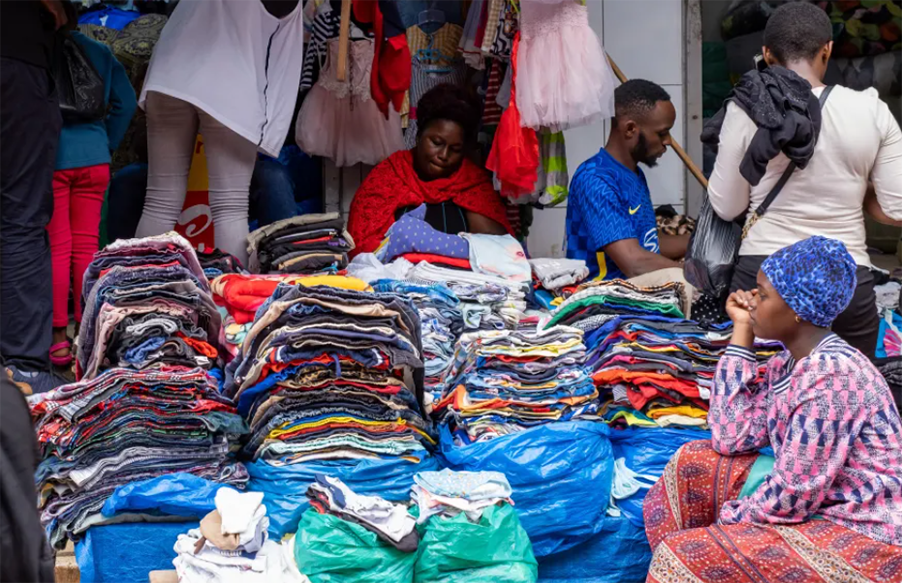
Government has revived its efforts to rein in the importation of second-hand clothing, proposing to double the surcharge from 15% to 30% under the 2026/27 Revenue Enhancement and Compliance Measures.
The proposal is expected to spark significant debate due to its wide-ranging impact, particularly on low-income Ugandans.
Government is expected to raise at least UGX 40 billion from the proposed adjustments.
The ruling NRM party at the weekend indicated the party’s Parliamentary Caucus had already agreed to unanimously support government’s tax proposals contained in the 2026/27 Revenue Enhancement and Compliance Measures.
Government says the proposed tax is intended to raise domestic revenue while signaling stronger policy support for Uganda’s local textile and garment industry.
“This proposal will support the local textile industry and act as a signal that government discourages the importation of used clothes,” notes, justifying the proposed tax read in part.
The proposal is part of a broader package of tax adjustments aimed at improving compliance and expanding the country’s tax base.
The renewed push comes after earlier, more ambitious attempts faltered. In recent years, the government floated a hardline proposal to completely ban the importation of second-hand clothes, commonly known as mivumba.
That plan met stiff resistance from traders, consumers, and regional stakeholders, forcing authorities to backtrack.
This time, government appears to be opting for a gradual strategy, raising taxes rather than imposing an outright ban.
 All Cash Withdrawals Now to be Taxed
However, the proposal could destabilise the clothes and garments sector, given that Uganda’s local capacity remains shaky and insufficient to meet existing demand, while at the same time, a sudden shift away from imported second-hand clothing may create shortages and price distortions.
Uganda’s clothing and garments industry continues to face structural constraints, including high production costs, limited access to capital, and unreliable infrastructure, such as electricity.
As a result, locally produced garments are not only limited in supply but often more expensive than imported alternatives.
“Without adequate local capacity, increasing taxes on second-hand clothes risks disrupting the entire clothing market,” an analyst in Kampala said. “You could see supply shortages, rising prices, and pressure across the garments sector.”
Traders in the second-hand clothing business have also voiced concern, warning that the proposed tax hike could erode their margins and threaten livelihoods across the value chain.
Even within the manufacturing sector, support for the measure is cautious. While some see it as a necessary step toward protecting local industry, they stress that it must be matched with targeted investments to boost production capacity.
Some analysts have previously observed that if demand shifts toward locally made clothes, the industry must be ready to supply consistently and affordably; failure of which the policy shift could destabilise the sector instead of building it.
As the proposal under the 2026/27 Revenue Enhancement and Compliance Measures takes shape, it once again underscores a persistent policy dilemma: balancing the ambition to grow local industry with the current realities of production capacity and consumer needs.
Whether this latest attempt will succeed where past efforts failed remains uncertain, but its impact could ripple across traders, manufacturers, and consumers alike.