Uganda heads into the much-awaited general elections, starting with the Presidential and Parliamentary polls this Thursday, 15 January 2026.
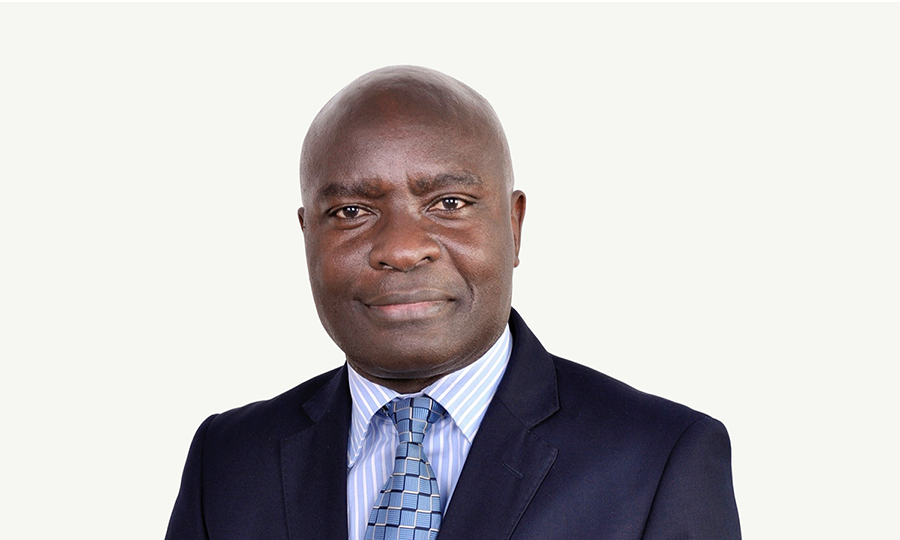
This will be Justice Simon Mugenyi Byabakama’s second national election since he was appointed chairperson of the Electoral Commission in November 2016 and sworn into office on January 17, 2017, succeeding Eng Badru Kiggundu, who had led the Commission for 14 years.
Byabakama, a career jurist and Justice of the Court of Appeal and Constitutional Court, presides over the institution that will determine who governs East Africa’s third-largest economy.
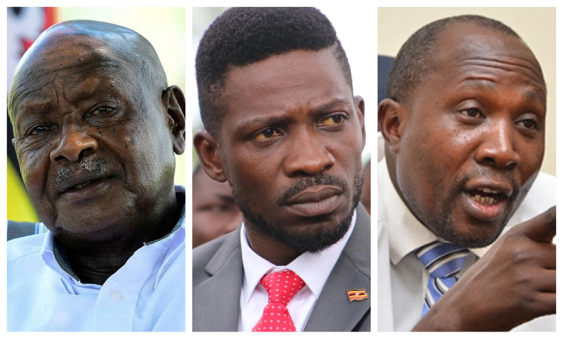
His Commission does not merely run polling stations; it manages legitimacy; the delicate line between authority and acceptance in a politically polarised country where the long-ruling National Resistance Movement (NRM), chaired by President Yoweri Kaguta Museveni, who is also its flag bearer, faces its strongest challenge from the National Unity Platform (NUP), led by Robert Kyagulanyi Ssentamu, likewise contesting as its presidential candidate.
Other parties in the eight-candidate race play a comparatively marginal role.
The Electoral Commission itself frames its mandate in ambitious terms. Its Vision is “to be a Model Institution and Centre of Excellence in Election Management.”
Its Mission is “to organise, conduct and supervise regular, free and fair elections and referenda through citizen participation, stakeholder engagement and information sharing to enhance democracy and good governance.”
In just a few days, those words will no longer be aspirational. They will be tested yet again at an unprecedented scale.
A UGX1.24 trillion election
This election cycle is also the most heavily funded in Uganda’s history. According to the Ministry of Finance’s Pre-Election Economic and Fiscal Update (December 2025), government has committed UGX 1.24 trillion to the 2026 general elections, with more than UGX 1.1 trillion already released.
Over UGX 600 billion has been channelled directly to the Electoral Commission. As such, Uganda’s most expensive election in its history leaves no room for failure.
Besides the Electoral Commission, the same election budget also finances the Uganda Police Force and Uganda Prisons Service, which together have received about UGX 278 billion so far; UGX 263.0 billion for Police and UGX 15.0 billion for Prisons, underscoring how heavily the 2026 elections are weighted toward security, logistics, and detention capacity as well as voting administration.
That matters because Byabakama’s first election, in 2021, established a distinctive legal benchmark for the Electoral Commission. According to the Electoral Commission’s official Report on the 2020/2021 General Elections, the Commission received and handled 462 post-nomination complaints spanning voter-register disputes, candidate qualifications, campaign violations and alleged irregularities.
Of the 52 decisions subsequently appealed to the High Court, 51 were upheld, and only one was overturned, resulting in a 98% litigation success rate for the Commission.
The courts also processed 72 applications for vote recounts, yet not a single declared result was reversed.
On the presidential front, Kyagulanyi filed Presidential Election Petition No. 1 of 2021, challenging the declaration of Yoweri Museveni as the winner, but later withdrew the case, prompting the Supreme Court to uphold the Commission’s declaration without making adverse findings against the EC.
In strictly legal terms, therefore, Byabakama presided over one of the most judicially defensible elections in Uganda’s history, with the courts repeatedly validating the Commission’s procedures and outcomes.
When courts approve but voters doubt
But elections are not judged solely by the courts.
As Uganda votes on Thursday, the political climate is highly charged. Opposition candidates, particularly those aligned with Kyagulanyi’s NUP, have reported disrupted rallies, blocked campaign events, arrests, and intimidation of supporters, as well as a series of late-stage disqualifications.
They have also criticised the Electoral Commission for releasing the final voters’ register late in the process, arguing that this left insufficient time for independent verification and quality inspection of the roll.
Several parliamentary and local government candidates have been removed on technical grounds, including academic qualifications and deficiencies in supporter-signature requirements.
 2025: Finance Trust Bank posts 32% growth in deposits; 74% surge in net profit in strongest performance yet
In a number of constituencies, these disqualifications were issued only days before polling, effectively narrowing or eliminating voter choice and intensifying accusations that procedural enforcement, while lawful, has had profound political consequences.
Byabakama has responded to these controversies with a consistently procedural defence; one he articulated clearly in an interview in the 2024 Electoral Commission Annual Bulletin.
There, he argued that the Commission can only act on formally lodged complaints, that electoral timelines are fixed by law, and that neither funding, political pressure, nor public controversy can override statutory deadlines.
“Elections cannot be postponed because they are clearly spelt out in the law with specific timelines,” he wrote, adding that even where problems arise, “the Commission must operate within the framework of the law.”
In the same bulletin, Byabakama also distanced the Commission from the conduct of political actors, noting that violence, intimidation, bribery, and campaign misconduct are committed by parties and their supporters, not by the Commission itself, even though the EC is often blamed for their effects.
Critics, however, argue that this legalistic approach, while formally correct, risks hollowing out electoral fairness in substance.
They contend that late-stage disqualifications deny voters meaningful choice, that administrative or technical errors should not determine who appears on the ballot, and that procedural enforcement has not always been even-handed across parties.
The result, they say, is an election that may survive in court but struggles to command public trust on the ground.
This is the central tension of Byabakama’s leadership: a Commission that is increasingly legally fortified and procedurally disciplined, yet operating in a political environment where legitimacy is measured not only by compliance with the law, but by whether citizens feel the contest was genuinely open, fair and credible.
The voter turnout problem
This tension is not abstract. It is reflected in how Ugandans themselves have engaged, or disengaged, with the ballot box over time.
The Electoral Commission’s own historical data also reveals a deeper challenge confronting Justice Byabakama as he heads into his second election.
Since the return of multiparty presidential contests, voter turnout has consistently struggled to rise above 60%, except in the founding 1996 poll.
Participation fell from 72.6% in 1996 to 69.2% in both 2001 and 2006, before dropping sharply to 59.3% in 2011.
Although turnout briefly recovered to 67.6% in 2016, it slid again to 59.4% in 2021, a decline of more than eight percentage points that occurred under Byabakama’s own watch, even as the voters’ register expanded from 8.5 million in 1996 to over 18.1 million.
The pattern suggests that while Uganda has more registered voters than ever before, a growing share are choosing not to participate.
For Byabakama, lifting turnout in 2026 would, therefore, do more than legitimise the next government; it would directly confront long-standing claims of voter apathy and disengagement, making citizen participation, a core pillar of the Commission’s mission, one of the most decisive tests of his leadership.
In the end, Uganda’s Constitution does not require the Electoral Commission to produce political harmony.
It requires it to deliver a free, fair, and lawful election. Whether Justice Byabakama can also deliver something harder, broad public confidence in the outcome, is the question that will define this week’s vote.
This is why Justice Byabakama sits squarely on our list of CEOs in the hot seat, this 2026.